Solutions and such do some things and some other things here Maecenas sed diam eget risus varius blandit sit amet non magna. Aenean lacinia bibendum nulla.
You’re measured on different outcomes—but your success depends on the same buyer decisions. This is where you find the programs and proof built for your goals.
Choose your role to see what that looks like in practice.
When teams rely on opinions, content gets noisy and inconsistent. Our resources are grounded in buyer evidence—so you can sharpen decisions, messaging, and execution.
Find insights, articles, webinars, and more evidence-backed resources to grow revenue.
5 Powerful Biases that Steer Your Buyers' Decisions
Anton Rius /
March 16, 2026 /
Core Concepts
Every day, your deals are being shaped by forces your buyers won’t acknowledge and often can’t see.
While buyers claim to make rational, data-driven decisions, behavioral research in B2B sales has identified several powerful cognitive biases that drive their choices.
This is why understanding sales psychology—the underlying behaviors and motivations that influence purchase decisions—is so critical for B2B sales teams.
When you understand the psychology of sales, you can identify what really drives buying behavior—the hidden mental shortcuts that stall deals, the emotional triggers that accelerate decisions, and the cognitive biases that shape the buying journey.
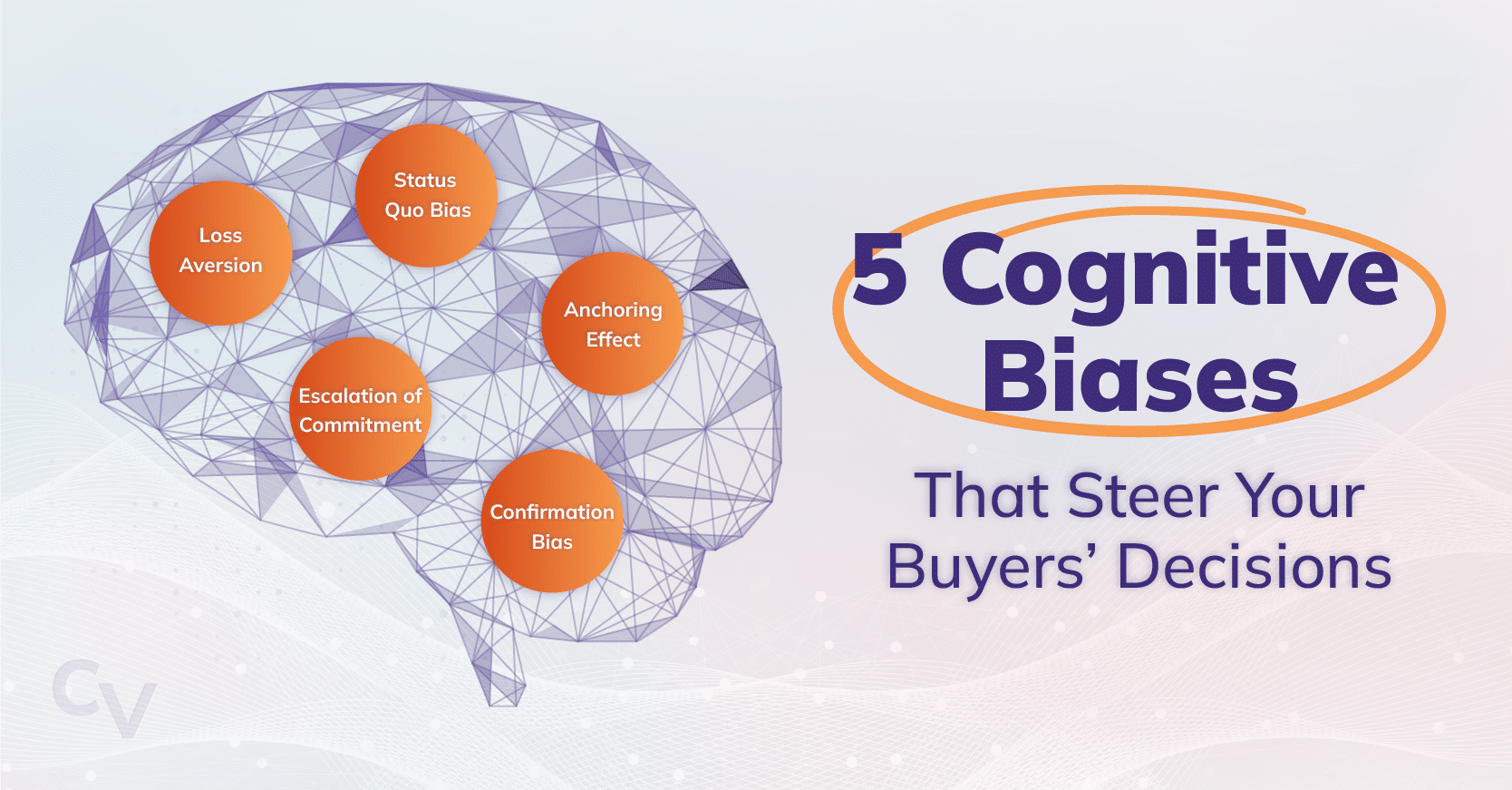
Based on extensive behavioral science research, here are the five most impactful cognitive biases shaping B2B buying decisions today, and how you can respond strategically to each one.
Escalation of Commitment is the psychological tendency to continue investing in a failing course of action despite mounting evidence that it’s not working.
This creates a major sales challenge: By the time you talk to prospects, they’re often locked into a path and resist changing direction—even when your solution is clearly better.
They’ve Gone Too Far to Turn Back Now
You can spot Escalation of Commitment when buying teams stick with their original plan, even when new information shows it’s not the best option.
By the time you talk to buyers, they’re usually 60-80 percent through their decision process. They’ve already:
Spent countless hours researching options
Used their influence to get others on board
Given multiple presentations where they publicly backed a direction
Put their reputation on the line
Used emotional energy overcoming objections to build agreement among team members
All these investments make it very hard for buyers to change direction. Switching would mean dismantling everything they’ve built thus far.
Two psychological factors contribute to Escalation of Commitment in B2B buying decisions.
An Example of Escalation of Commitment
A buying team at a mid-sized company spends six months looking at marketing platforms. They narrow it down to two options, initially favoring Vendor A because of its well-known brand.
In demos, Vendor B clearly shows better integration and a better fit for their needs. But the committee still leans toward Vendor A.
When an analyst suggests they reconsider, the project lead says: “We’ve already got everyone on board with Vendor A. Changing now would delay our project by months.”
This is Escalation of Commitment in action. The company ends up choosing the weaker solution simply because they invested too much time getting everyone to agree on their initial choice.
How Sellers Can Break Through
When you encounter Escalation of Commitment, use these evidence-backed tips to address the underlying psychology and help buyers reconsider their path:
Introduce Unconsidered Needs that reveal gaps in their current approach and give them a good reason to pause. “Most companies looking at solutions like you focus on [features they’ve prioritized], but often miss [important capability] that greatly impacts [business outcome they care about].”
Reframe around future costs vs. future benefits to help buyers separate sunk costs from future investments in their minds. “I know your team has spent a lot of time on [Vendor A]. Looking forward, what would the perfect solution be worth to your company over the next three years?”
Create contrast between status quo and change. Use clear numbers. “Companies that stuck with their initial choice had a 35 percent failure rate. Those who adjusted based on new insights had a 90 percent success rate.”
Offer a low-risk next step that doesn’t throw away their work. “You don’t have to start over. What if we had a quick meeting with two key team members to explore these ideas, without disrupting your current process?”
By addressing the psychology behind Escalation of Commitment, you help buyers make more rational decisions without feeling like they wasted their previous investments.
2. Loss Aversion
Loss Aversion is the cognitive bias where the pain of a loss is psychologically more powerful than the pleasure of a gain.
As Amos Tversky and Daniel Kahneman demonstrated in their groundbreaking 1979 paper on Prospect Theory, most people prefer avoiding losses to acquiring equivalent gains—we feel the sting of a $100 loss more intensely than the pleasure of a $100 gain.
This asymmetry fundamentally shapes decision making under uncertainty. For sales reps, it means that safety (not improvement) is your buyer’s primary motivation.
When Fear Overpowers Opportunity
In B2B buying and selling, Loss Aversion is a powerful bias that makes risks seem much bigger than benefits. This is especially pronounced in a risk-averse buying environment.
When evaluating a new solution, your prospects don’t weigh risks and rewards equally. They focus heavily on what could go wrong.
Implementation concerns: “What if this messes up our current operations?”
Budget anxieties: “What if this ends up costing more than we planned?”
Career risks: “Will I get blamed if this fails?”
Team resistance: “Will our team resist this new approach?”
Opportunity costs: “What other projects will we have to put on hold?”
At the same time, they’re skeptical about the benefits you promise. This creates an uphill battle where your solution’s advantages have to work extra hard to overcome their magnified fear of risk.
An Example of Loss Aversion
A healthcare system evaluates a new patient management platform that clearly offers better patient outcomes, happier doctors, and long-term savings.
Despite this compelling evidence, the buying committee ultimately chooses to renew their current vendor.
When asked why, the decision makers point to “risks during implementation,” “possible compliance problems,” and “costs to re-train staff.” All these concerns focus on potential losses.
They acknowledged the benefits of better efficiency, satisfaction, and patient care, but their fear of losing what they already had won out.
How Sellers Can Break Through
When addressing the psychology of Loss Aversion, focus on the three things executives care most about: risk, impact, and outcomes.
Lead with how you reduce risk rather than your benefits. “Our approach addresses the three biggest barriers keeping your team from hitting revenue targets” works better than “Our approach improves revenue by 15 percent.”
Quantify the cost of maintaining the status quo in clear financial terms. “Based on your numbers, keeping your current approach costs you about $1.2 million every year in missed opportunities and rework.”
Compare the downsides of doing nothing to the benefits of changing. “Companies that delayed making this decision saw customer churn go up by 23 percent. Those that moved forward saw 18 percent better retention.”
Use a de-scoping approach for price objections. “We can certainly adjust pricing, but that would require transferring some risk back to your organization. Would you prefer we discuss which protections to remove, or should we look at the ROI for the complete solution?”
By directly addressing Loss Aversion in your sales conversations, you help decision makers overcome the emotional barriers that often prevent objectively better decisions.
3. Status Quo Bias
Status Quo Bias is a person’s psychological tendency to keep things as they are, even when changing would benefit them.
First identified by economists William Samuelson and Richard Zeckhauser in their 1988 paper Status Quo Bias in Decision Making, this cognitive tendency leads people to disproportionately stick with established options or default choices.
Research psychologist Christopher Anderson found four main reasons people resist change:
Preference Stability: People don’t like changing their minds once they’ve formed an opinion
Anticipated Regret/Blame: People worry they’ll regret making a change that goes wrong
Cost of Action/Change: Switching to something new feels like too much work
Selection Difficulty: Having too many options makes people tend to stick with what they know
Researchers have identified four causes of Status Quo Bias.
The Devil They Know
In B2B sales, Status Quo Bias appears as the powerful inertia that makes “no decision” your biggest competitor.
This psychological tendency explains why at least 40 percent of deals in the pipeline end with no decision. Despite showing early interest in change, when it’s time to commit, the comfort of the familiar often wins.
Even when buyers acknowledge problems with their current approach, sticking with what they know feels safer than changing.
It’s amplified in consensus-driven buying environments. Nobody wants to risk their reputation by pushing for change. Buyers also tend to notice and remember when their current solution works while discounting its limitations.
An Example of Status Quo Bias
A financial services firm spends six months looking at new cybersecurity solutions. Their current provider isn’t performing well—detection rates are below standards and it creates too many false alarms that waste staff time.
After carefully evaluating options, they find a new solution that clearly meets all their needs and offers major improvements. But when it’s time to decide, the CISO chooses to stick with their current provider.
“We know their limitations and we’ve created workarounds,” the CISO explains. “At least we know what we’re dealing with.”
How Sellers Can Break Through
When fighting Status Quo Bias with new prospects, you need to make staying put feel riskier than changing.
Introduce Unconsidered Needs they haven’t fully recognized. “Most companies focus on detection rates, but we’ve found the hidden cost is actually in the false alarms taking up 40% of your team’s time.”
Compare staying put vs. changing. “Companies that stayed with legacy systems experienced three major breaches on average last year, while those who upgraded reported zero critical incidents.”
Put a price tag on doing nothing. “Based on your numbers, keeping your current system costs about $1.4 million every year in extra staff time and emergency responses.”
Make staying put seem riskier than changing. “The real question isn’t whether changing has risks—it’s whether those risks are worse than the problems you’re already facing.”
By shifting the risk equation so that inaction feels riskier than action, you help buyers overcome the powerful psychological pull of the status quo.
4. Anchoring Effect
The Anchoring Effect describes how people rely heavily on the first piece of information they receive (the anchor) when making decisions.
As Amos Tversky and Daniel Kahneman explain in their 1974 research paper, Judgement under Uncertainty, once an anchor is set in someone’s mind, they don’t adjust away from it enough—even when that initial number or idea was completely random.
Think of it like this: If you see a $1,000 jacket first, a $400 jacket seems like a bargain. But if you see a $200 jacket first, that same $400 jacket suddenly seems expensive.
First Impressions That Last
In B2B sales, anchoring means the first price or feature list your buyer sees becomes their measuring stick for everything else. This is especially tricky today when buyers research solutions long before talking to a sales rep.
If your competitor sets the anchor first—through their pricing, analyst reports, brand reputation, or early conversations—you’re stuck working within the mental framework they created.
Instead of selling your solution’s full value, you end up haggling over small differences within the buyer’s pre-set price range, rather than negotiating based on your solution’s true value.
An Example of Anchoring Effect
A manufacturing company starts researching ERP systems and reads a report that states, “most mid-sized manufacturers spend between $250,000-$350,000 on implementation.”
Weeks later, your sales team meets with them and presents your premium solution at $500,000. The buying committee immediately pushes back, calling your price “excessive” and “outside market norms.”
They’re mentally stuck on that initial price range—even though your solution has capabilities the report didn’t consider.
Your team shows how your system would generate millions in additional value with superior ROI. But throughout negotiations, the buyer keeps mentioning that “$350,000 ceiling,” making it nearly impossible to get what your solution is actually worth.
How Sellers Can Break Through
In your sales conversations, you need to either set the anchor first or change existing anchors:
Be first to set the anchor whenever possible. “Before we talk about price, let’s figure out what this problem is costing you each year.” This moves the conversation from your price to the cost of their problem.
Label and address existing anchors right away. “I’ve noticed you’ve mentioned $350,000 several times. Where did you get that number? That’s important for me to understand because market reports often don’t account for the specific capabilities you need.” This helps you identify the source of their anchor and gives you a better chance to reset it.
Show different comparison points. “Companies that focus only on implementation costs typically see a 15% improvement. Those who invest in our complete approach see 40-60% better results.” This creates a new anchor based on value.
Use specific numbers instead of round ones when talking about price. “$503,600” sounds more carefully calculated than “$500,000” and gives buyers less room to negotiate.
By recognizing the psychological power of anchoring and actively managing these reference points throughout the sales process, you help buyers evaluate options based on true business impact instead of arbitrary numbers.
5. Confirmation Bias
Confirmation Bias is people’s tendency to look for information that supports what they already believe. They pay less attention to facts that might prove them wrong.
Psychologist Peter Wason first showed this bias in the 1960s. In his famous “2-4-6” experiments, he found that once people form an idea, they only look for evidence that confirms it instead of testing other possibilities.
Confirmation Bias is especially powerful when people feel emotional about a topic, have strong beliefs, or have already told others about their position.
Seeing What They Expect to See
In B2B buying, Confirmation Bias acts like a filter that screens out important information that doesn’t fit a buyer’s existing views.
Once a buying team starts leaning toward a certain vendor or solution, they begin to:
Look only for information that supports their initial choice
See unclear information as backing up their preference
Remember things that confirm their decision while forgetting evidence against it
Question information that challenges their choice more than information that supports it
This filtering gets stronger as the buying process continues, especially after people publicly share their opinions in meetings. By the time they reach the final decision, many buying teams have built such a one-sided view that they can’t see solutions that might actually work better.
An Example of Confirmation Bias
A manufacturing company starts looking for a new CRM system. Early in the process, several key team members say they prefer Vendor A because of its well-known brand.
The team sets up what looks like a fair evaluation process, but Confirmation Bias shows up in several ways:
They spend hours reading positive stories about Vendor A but barely look at reviews mentioning its problems
When Vendor B performs better in demos, the team says it’s just because “they prepared better,” not because they have a better product
When someone raises concerns about Vendor A’s implementation challenges, the team says, “We can manage those issues.” But when similar issues come up with other vendors, they’re seen as deal-breakers.
Features that Vendor B does better suddenly get labeled as “nice-to-have” rather than “must-have”
The company chooses Vendor A, and later struggles with the very problems they dismissed during evaluation, wasting money and time on a system that doesn’t work well for them.
How Sellers Can Break Through
To break through Confirmation Bias, you need approaches that get past your buyer’s mental filters:
Ask “What would change your mind?” early in your conversations. “If I could show that our approach cuts implementation time in half, would that be enough for you to reconsider your current direction?” This question helps buyers commit to staying open to new information.
Bring in outside experts that buyers already trust. Buyers are more likely to believe information that challenges their thinking when it comes from neutral third parties instead of from salespeople.
Show them problems they haven’t noticed rather than attacking their current thinking. “Most companies look at these standard requirements, but our research shows that 80% of implementation failures actually come from this overlooked issue that no one’s talking about.”
Offer an objective scoring system for their evaluation. “Would it help if we created a simple scorecard your team could use to rate all solutions fairly?” This helps prevent personal bias from taking over.
By helping buyers recognize and counteract their natural tendency toward Confirmation Bias, you help them make clearer, more balanced decisions.
Turn Psychological Barriers into Bridges
Every B2B buying decision is shaped by these five powerful psychological biases, even though your buyers claim to make purely logical, data-driven choices.
Understanding these biases gives you a major advantage in sales.
Escalation of Commitment explains why buyers stick with their original path even when it’s not working
Loss Aversion reveals why safety matters more to buyers than improvement
Status Quo Bias shows why “no decision” is often your biggest competitor
Anchoring Effect demonstrates how first impressions lock in expectations
Confirmation Bias illustrates why buyers filter out information that challenges their beliefs
The most successful sales teams don’t fight these biases—they work with them. They recognize the psychological patterns driving buyer behavior and adapt their approach accordingly.
By applying the techniques in this article, you transform these hidden barriers into bridges that lead to better deals and stronger relationships.
Your buyers get better outcomes, and you win more business.
Buyers forget most of what you tell them, and what sticks tends to be random. A 10% message is a science-backed way to control the single point you want them to remember and act on.
Knowing a sales skill and executing a sales competency are different things. Find out which competencies predict wins and how to close the gaps on your team.
Acquisition vs. expansion: Why the same sales message that wins new logos can backfire in existing accounts. A practical look at the buyer psychology at play.
Anton Rius, Sr. Director of Content Marketing, leads all content marketing strategy and production at Corporate Visions. Anton's extensive experience supporting B2B revenue growth with insightful content has been featured in publications like SalesPOP! and Relevance. Anton writes regularly at Long Tail Thinking.