Solutions and such do some things and some other things here Maecenas sed diam eget risus varius blandit sit amet non magna. Aenean lacinia bibendum nulla.
You’re measured on different outcomes—but your success depends on the same buyer decisions. This is where you find the programs and proof built for your goals.
Choose your role to see what that looks like in practice.
When teams rely on opinions, content gets noisy and inconsistent. Our resources are grounded in buyer evidence—so you can sharpen decisions, messaging, and execution.
Find insights, articles, webinars, and more evidence-backed resources to grow revenue.
Escalation of Commitment: The Hidden Bias That's Killing Deals Before They Start
Anton Rius /
July 30, 2026 /
Core Concepts, Discovery
“We’ve been working on this approach for the past six months…”
“We already have buy-in from leadership on our current plan…”
If you’ve heard a prospect say something similar, you witnessed one of the most dangerous forces in B2B sales today: Escalation of Commitment.
Escalation of Commitment is a psychological bias that’s becoming increasingly devastating in modern B2B sales.
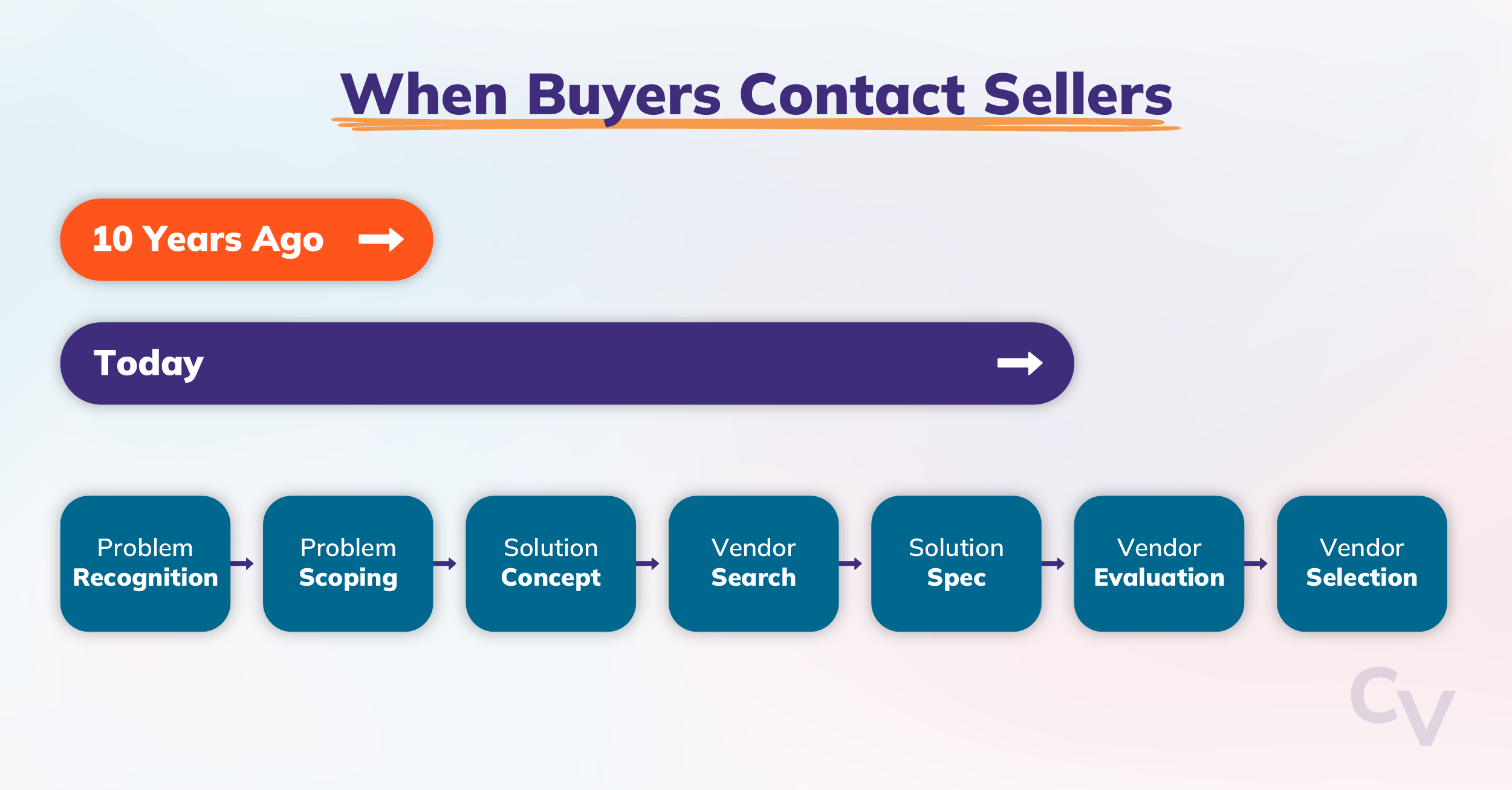
Why? Because today’s **buyers are spending 50-70 percent of their journey in self-directed research before talking to sales. By the time you enter the conversation, they already have strong convictions about their problem and the solution, and those convictions are often wrong.
Corporate Visions’ research with Dr.Leff Bonney at Florida State University’s Sales Institute found that there’s an average 54.5 percent misalignment between how sellers and buyers perceive the core problem to be solved. This misalignment jumps to 77 percent in lost deals—a costly disconnect that’s driven by buyers’ escalating commitment to their initial (and often incorrect) problem diagnosis.
The cost? Millions in failed implementations, wasted resources, and deals that die on the vine. But more importantly, it represents missed opportunities to solve your buyer’s problems.
What Is Escalation of Commitment?
Escalation of Commitment in sales is when a buyer keeps investing in a failing course of action, such as an incumbent tool, a flawed plan, or a wrong problem diagnosis, because backing out would mean admitting the first decision was wrong.
Originally coined by Barry M. Staw, a professor at the University of California, Berkeley, Escalation of Commitment is a psychological phenomenon where individuals and organizations continue to commit resources to a failing course of action.
Staw also found that people are more likely to stay committed to a failing strategy if they’re the one who made the initial call.
To effectively address Escalation of Commitment in sales conversations, you first need to understand the psychological forces at play.
The Psychology of Escalation of Commitment in Buying Decisions
Two main psychological factors drive Escalation of Commitment in B2B buying decisions:
Sunk Cost Fallacy – When buyers have invested significant time and resources into a project or solution path, they tend to stick with it even if it’s not working. The mental accounting of what they’ve already spent makes it psychologically painful to change course.
Cognitive Dissonance – Buyers experience mental discomfort when faced with evidence that contradicts their chosen path. To reduce this discomfort, they often double down on their original decision rather than admit they might be wrong.
Two psychological factors contribute to Escalation of Commitment in B2B buying decisions.
Additional factors that reinforce this behavior include:
Loss Aversion: The pain of accepting a loss feels worse than the potential pleasure of gains
Social pressures: Fear of looking bad in front of colleagues and stakeholders
Optimism bias: An unrealistic belief that things will improve if they just stay the course
While these psychological factors have always influenced buying decisions, recent changes in how B2B buyers approach purchases have amplified their impact.
Why It’s Getting Worse: The Modern B2B Buying Landscape
How buyers now make purchasing decisions creates the perfect conditions for Escalation of Commitment to take root and flourish. Here’s why:
Independent Research without Expert Guidance
Modern B2B buyers spend significantly more time conducting independent research before engaging sellers
Without an objective guide, buyers often interpret information through the lens of their existing beliefs and assumptions
Over time, misconceptions can become deeply entrenched and harder to correct
Increased Stakeholder Complexity
The average B2B buying committee now includes 10 or more decision makers, according to 6sense’s 2025 B2B Buyer Experience Report
Each stakeholder has their own success metrics and departmental priorities
Competing agendas and technical requirements create analysis paralysis
Getting alignment becomes exponentially harder with each new stakeholder
Internal Pressure to “Get it Right”
High-value purchases face intense scrutiny from executive leadership
Failed initiatives can damage careers and departmental credibility
Budget constraints create pressure to show immediate ROI
Fear of making the wrong choice leads to risk-averse decision making
Extended Decision Cycles
B2B buying cycles now average around 10 months, according to 6sense’s 2025 B2B Buyer Experience Report
Longer evaluation periods create more opportunities for sunk costs to accumulate
Extended timelines increase the psychological investment in the chosen path
As time passes and more stakeholders get involved, your buyer’s Escalation of Commitment becomes increasingly more entrenched.
Buyers are spending 50-70 percent of their journey in self-directed research before talking to sales.
What Escalation of Commitment Looks Like in a B2B Deal
Picture a buying committee that decided early to fix a stalling pipeline by doubling down on the CRM automation they already owned.
A director championed the call in a leadership review, and the plan won budget. Three months in, adoption is flat and the numbers look shaky. This is the point where the team starts thinking in sunk costs. They’ve spent a quarter and staked their credibility on the approach, so backing out would mean conceding the original diagnosis was wrong.
Instead, the committee reinterprets the warning signs. They reframe missed targets as a timing issue and low adoption as a training gap. Every new data point gets bent to fit the decision they already made, a textbook case of cognitive dissonance. When a seller shows up with a sharper read on the underlying problem, the buyer hears a threat to defend against, not a better path forward.
This is where our seller-buyer problem-misalignment research bites hardest. When a buyer diagnoses the wrong problem up front and then escalates commitment to that diagnosis, you can bring a technically superior solution and still lose. You don’t lose the deal because your product fell short, though. You lose it because the buyer locked in on a flawed problem statement and kept spending against it.
Signs Your Buyer Is Experiencing Escalation of Commitment
Corporate Visions research identified several key indicators that your buyer might be experiencing Escalation of Commitment. Watch for these telltale signs:
Negative feedback. When presented with feedback that the purchasing project is not going well, buyers paradoxically invest even more resources rather than stepping back to reassess.
Project ownership. The stakeholders who originally proposed or championed the project are willing to commit more resources at every stage of the project.
Hard deadlines. Under pressure to meet organizational timelines, buyers double down on their current approach.
You might hear sentiments like:
“We’ve already invested too much to change direction now”
“I know the numbers don’t look great, but we just need to give it more time”
“We can’t afford to slow down and reconsider our approach”
When you hear these phrases, it’s a strong signal that Escalation of Commitment is affecting your buyer’s judgment.
How to De-escalate an Over-Committed Buyer
When facing an over-committed buyer, conventional discovery techniques can make things worse. Here’s what to avoid and what works.
What doesn’t work:
Standard consultative selling techniques (they push buyers to defend their current path)
Challenging their current decision-making process by highlighting potential losses (triggers defensive responses)
Acknowledge Progress: Compliment the buyer on the work they’ve done so far
Share Insights: Provide data about alternative paths that have worked for others
Frame Benefits: Focus on the potential gains of adjusting their approach
Tell Success Stories: Share examples of other companies who made similar adjustments
Offer Partnership: Position yourself as a helpful guide in refining their process
This positive approach makes buyers more likely to reconsider their current path, include you in future discussions, and remain open to alternative solutions.
In Corporate Visions research, sellers who led with a positive, gain-framed message during discovery roughly doubled their odds of getting into the deal. The single most effective message the researchers tested was one that acknowledges the buyer’s progress, then points to the specific gains a refined approach would add, rather than dwelling on what’s going wrong.
Why This Matters Now
Escalation of Commitment isn’t another buzzword to add to your sales vocabulary. It’s a real challenge that’s getting worse as buying cycles get more complex.
But understanding this bias gives you a serious edge. When you train your sellers to spot and address Escalation of Commitment in discovery conversations, they can:
Help buyers make better decisions before they’re locked into the wrong path
Turn potential deal-killers into opportunities for deeper conversations
Build real partnerships instead of rushing to close another deal
The old way of doing discovery isn’t enough anymore. Traditional discovery techniques can sometimes make buyers dig in their heels even more. When your team understands the psychology behind their buyer’s decision-making process, they can take a different approach—one that helps buyers see past their blind spots and make a more favorable choice.
Take a moment to think about your current approach to discovery. Is it helping your sellers navigate these psychological barriers, or could it be accidentally reinforcing them?
Frequently Asked Questions
What is the difference between the Sunk Cost Fallacy and Escalation of Commitment?
The Sunk Cost Fallacy is one driver of Escalation of Commitment, not a synonym for it. The Sunk Cost Fallacy describes why people weigh already-spent time and money in a decision they should judge on future value alone. Escalation of Commitment is the broader pattern: a buyer keeps investing in a failing course of action, pushed by sunk costs along with cognitive dissonance, Loss Aversion, and social pressure.
What is an example of Escalation of Commitment in sales?
A common example is a buyer who commits early to a problem diagnosis or an incumbent tool, hits clear warning signs, and then invests more rather than reconsidering. Earlier in this article, you’ll see one version play out: a committee that, pushed by sunk costs and cognitive dissonance, defends a failing path instead of stepping back. The tell is simple: the worse the results look, the harder the buyer works to justify the original call.
What are the main causes of Escalation of Commitment?
The main causes are the Sunk Cost Fallacy, cognitive dissonance, Loss Aversion, social pressure, and optimism bias. Barry Staw’s original research also found that people hold tighter to a failing course of action when they made the initial decision themselves. In longer B2B cycles with larger committees, buyers give these forces more time and cover to take hold.
Can Escalation of Commitment ever be a good thing?
Sometimes it can. Persistence and consistency pay off when the original plan is sound and the setbacks are temporary. The problem is that buyers tend to escalate commitment precisely when the evidence says stop. In a buying decision, a committee under that bias keeps spending against a flawed problem diagnosis long after the warning signs are clear, which is why sellers should surface it as a risk early rather than admire it as a virtue.
Dig Deeper
Want to learn more about Escalation of Commitment? Dig into these science-backed resources.
Buyers forget most of what you tell them, and what sticks tends to be random. A 10% message is a science-backed way to control the single point you want them to remember and act on.
Knowing a sales skill and executing a sales competency are different things. Find out which competencies predict wins and how to close the gaps on your team.
Acquisition vs. expansion: Why the same sales message that wins new logos can backfire in existing accounts. A practical look at the buyer psychology at play.
Anton Rius, Sr. Director of Content Marketing, leads all content marketing strategy and production at Corporate Visions. Anton's extensive experience supporting B2B revenue growth with insightful content has been featured in publications like SalesPOP! and Relevance. Anton writes regularly at Long Tail Thinking.