Authors: Tim Riesterer, Chief Strategy Officer at Corporate Visions and David Shacklette, Founder of Skillcraft
Is it time to stop letting sellers grade their own tests?
When was the last time a sales rep said, “I’m terrible at objection handling,” or “I have no idea how to create urgency in a deal?”
The problem with traditional competency self-assessments is that they don’t measure skill; they measure self-perception. And that’s a flawed approach.
When reps assess their own abilities, they tend to either overestimate their effectiveness (because confidence is a sales prerequisite) or underestimate themselves (because sales is a confidence-destroying profession). Neither bias leads to an accurate or useful measure of sales competency.
If you’re serious about improving sales performance, it’s time to move beyond self-reported skills assessments and toward Precision Skills Intelligence—a data-driven, real-world approach to evaluating and developing sales capabilities.
What’s Wrong with Self-Assessments?
For years, companies have relied on self-assessments to determine which skills their sellers need to improve. But let’s face it:
- Salespeople don’t always know what they don’t know.
- Their self-ratings rarely align with actual sales outcomes.
- The assessments themselves lack objective benchmarks.
The result? Training and coaching programs built on a shaky foundation of subjective feedback rather than real-world performance. (Arguably, this is also true for manager assessments of their sellers.)
What’s the alternative? Precision Skills Intelligence—a more scientific, objective, and results-driven approach to sales skill measurement.
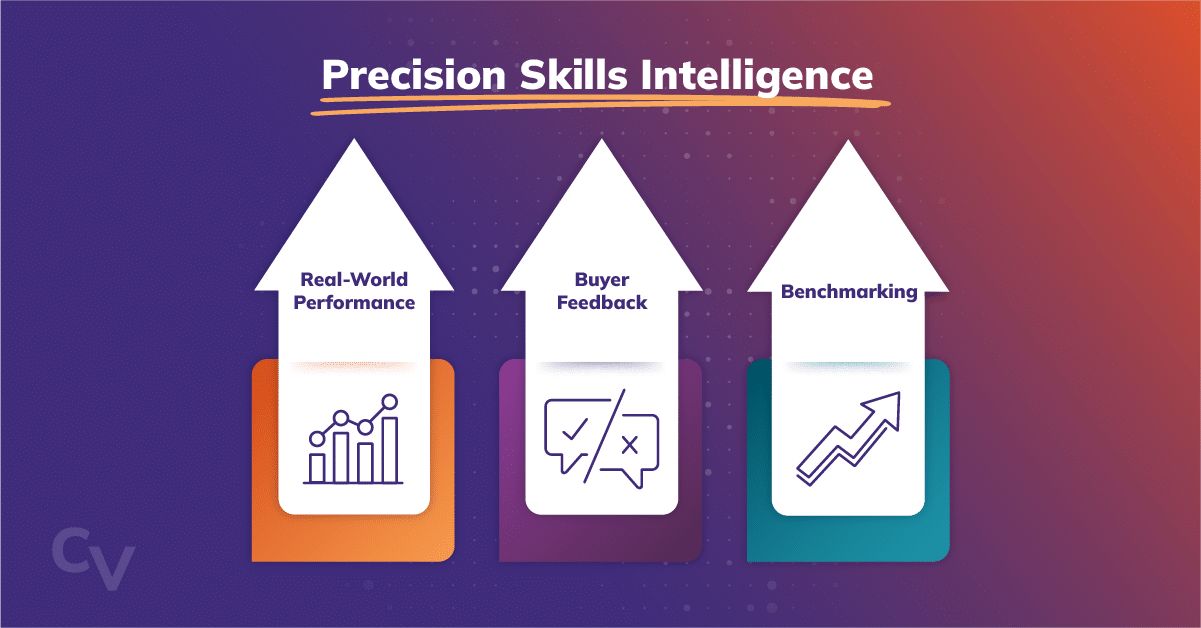
The Three Pillars of Precision Skills Intelligence
To truly measure and improve sales competencies, you need a system that goes beyond “how good do you think you are?” Here’s how Precision Skills Intelligence provides a more accurate and actionable approach:
1. Real-World Performance, Not Hypothetical Perception
Instead of relying on a seller’s self-reported confidence in their skills, getting to Precision Skills Intelligence requires that we gather skills data and insights from real sales performance. Call recordings, email engagement data, and AI-driven conversation intelligence platforms give us a clearer picture of sales behaviors in action—revealing what sellers actually say and do, the real skills your team leverages; not what they think they do.
2. Buyer Win-Loss Feedback: The Ultimate Reality Check for your Skills Data
To supplement this skills data, we know that the most precise measure of a seller’s effectiveness doesn’t come from the seller or their manager—it comes from the buyer. Win-loss analysis captures direct feedback on why deals were won or lost, highlighting the specific moments that created or destroyed value in the buyer’s mind. When buyers say a rep didn’t differentiate well enough, struggled to articulate a compelling reason to change, or failed to create urgency, that’s the kind of intelligence you can act on. It’s a direct measure of how well (or poorly) a seller applies their skills in the real world.
3. Benchmarking Skills Against High Performers, Not Just Themselves
The final pillar of Precision Skills Intelligence is about defining and sharing a standard for what “good” looks like across the skills of your organization. Self-assessments or even manager feedback often leads to conflicting interpretations of excellence. Just as you collect performance data to measure performance results, you need performance-based skill models to set reliable performance benchmarks for your organization’s skills. By analyzing how top sellers handle discovery, position value, and overcome objections—and standardizing those insights through scientifically validated assessment technologies—you can pinpoint skill gaps with laser accuracy and provide coaching that truly moves the needle.
The Takeaway: Precision Performance Data Drives Proactive Coaching
Traditional self-assessments (or manager ratings in isolation) offer a rearview mirror perspective—they tell you where sellers think they are today, but they don’t tell you where they need to go next. Precision Skills Intelligence, built on a 360 foundation of real skills data and buyer insights, allows you a real opportunity to accurately predict which skill gaps are most likely to impact sales performance.
Why This Matters for Sales Leaders
When sales organizations shift from self-assessment to Precision Skills Intelligence, they move from guessing about skill gaps to knowing exactly what will improve performance for their company. The benefits are real and measurable: More effective coaching based on actual performance data. Faster skill development by focusing on the right capabilities, through validated and standardized performance-based assessments. Higher win rates by addressing skill gaps that directly impact revenue.
It’s time to stop letting sellers grade their own tests. Self-assessment belongs in the past. The future is Precision Skills Intelligence—a reality-based, results-driven approach to sales development that helps reps win more deals, more often.
Are you still relying on self-assessments to measure sales skills? Maybe it’s time to rethink your approach.