Solutions and such do some things and some other things here Maecenas sed diam eget risus varius blandit sit amet non magna. Aenean lacinia bibendum nulla.
You’re measured on different outcomes—but your success depends on the same buyer decisions. This is where you find the programs and proof built for your goals.
Choose your role to see what that looks like in practice.
When teams rely on opinions, content gets noisy and inconsistent. Our resources are grounded in buyer evidence—so you can sharpen decisions, messaging, and execution.
Find insights, articles, webinars, and more evidence-backed resources to grow revenue.
Stop Training on Assumptions: Use Sales Skills Assessments to Target Real Skill Gaps
Madeline Cunningham /
April 8, 2026 /
Assessments
You’ve felt this frustration: You roll out more training, add more coaching, buy more tools—but win rates don’t move.
Deals still stall. Sellers insist they “know what to do,” even when the numbers say otherwise.
The real culprit?
You’re measuring confidence, not competence.
Traditional assessments rely on self-reflection and manager judgment—two of the least reliable indicators of what really happens in sales conversations.
When your view of seller performance is distorted, every training and coaching decision that follows is built on sand. But when you can see the behaviors that cause buyers to choose you or choose your competitors, training stops being a guessing game.
A sales skills assessment is simply a way to understand how prepared your sellers are to perform in the moments that influence deal outcomes. With the assessment data, you get a clear snapshot of the strengths and gaps across your sales team, so you know where coaching and training will have the greatest impact. The more precisely the assessment reflects real selling situations, the more useful it becomes for improving performance.
Common Sales Skills Assessments
Sales skills assessments fall into a few categories, each measuring something slightly different.
Self-assessments – Reps rate their own skills or confidence levels. These are easy to deploy but often unreliable, since sellers tend to over- or under-estimate their abilities. These might help gauge sellers’ confidence, but they aren’t much better than a survey in practice.
Manager-assessments – Front-line managers assess seller skills based on observations, deal reviews, or coaching interactions. These add context, but they’re inconsistent, because managers often have their own preferences and biases about what will drive performance.
Knowledge-based assessments – Quizzes or tests that measure understanding of products, messaging, processes, or methodology. These assess what sellers know, but not necessarily how well they can apply it in real conversations with buyers.
Call analysis and conversation scoring – Recorded sales calls are reviewed (manually or via AI) to evaluate language patterns and correlate those patterns to scoring rubrics for things like questioning, messaging, objection handling, and talk-to-listen ratios.
Deal and CRM-based assessments – Analysis of deal progression, win-loss notes, and CRM activity to infer skill strengths or gaps. These are helpful for context but the data is often filtered through sellers’ notes, and often reflect outcomes of deals rather than behaviors.
Buyer feedback-based assessments – Skills or competencies are measured using direct buyer feedback tied to real deals. These tend to be more objective because they reflect how effectively sellers performed from the buyers’ perspective.
Role-play and simulation assessments – Sellers are evaluated through mock sales scenarios, live role plays, or recorded simulations. These are more behavior-focused and show how skills are applied in realistic situations.
What Does a Good Sales Skills Assessment Looks Like?
The best sales skills assessments measure how sellers perform in the moments that influence buying decisions. They’re also objective by design, eliminating any personal bias or plausible deniability in the results.
Here are some specific criteria to look for:
Linked to buyer decision-making. Sales skills assessments shouldn’t grade “general selling ability.” The best assessments measure skills and behaviors that influence how buyers decide and move the deal forward—especially in the high-stakes moments.
Based on observable behaviors. Instead of relying on self-ratings or subjective opinions, the best assessments evaluate observable behaviors in real or simulated selling situations to surface true strengths and skill gaps.
Results are consistent and coachable. Top sales skills assessments are designed to measure skills accurately and consistently. The result is a clear, evidence-backed snapshot of seller capability (not just confidence) and coachable insights.
If an assessment can’t connect selling behaviors to buying decisions, it’s basically a personality quiz with a budget. But how do you identify those behaviors?
What Sales Skills Should You Assess?
Every company has a list of “important” sales skills—often pulled from popular lists or based on whatever the top sales reps to do well. But when you ask buyers instead of sellers, the picture changes dramatically.
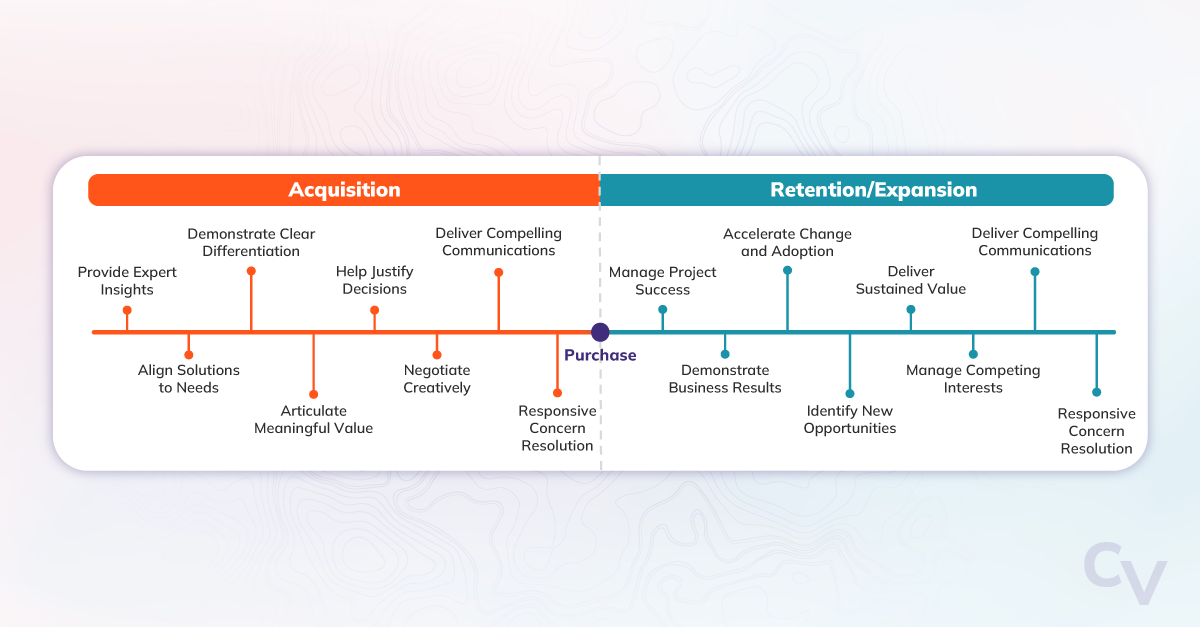
The Great 8 Sales Competencies for Acquisition and Retention/Expansion sales.
These sales competencies are predictive of wins and losses. Meaning, they’re the moments buyers say make them choose you, or go with your competitor. So when you assess your sellers against this framework and base your training and coaching on it, you’ll focus on the competencies that directly impact win rates.
What’s the Difference Between a Sales Skill and a Sales Competency?
A skill is a specific, observable behavior—something a seller can do. It’s usually easy to teach, practice, and even assess on its own.
A competency is different. It reflects how well someone brings multiple skills together and applies them with sound judgment and situational awareness.
Competencies aren’t just about activity—they show up in outcomes. That’s why someone can have strong individual skills, but only demonstrate true competency when those skills are used together, at the right time, and in the right way.
When Should You Use a Sales Competency Assessment?
Sales assessments shouldn’t be a one-time event. Used correctly, they provide an ongoing view of how effectively sellers are building and applying critical skills.
Start by assessing all sellers to establish a baseline. Then, repeat assessments on a regular cadence to understand how well training and coaching are translating into real behavior change. When paired with buyer feedback from live deals, assessments reveal where your enablement investments are paying off—and where gaps remain.
Assessments are especially valuable for onboarding new hires, giving you a clear picture of their strengths and development needs from day one. For tenured sellers, a consistent assessment cadence ensures skills stay aligned with evolving buyer expectations.
They’re also useful tools for planning your SKOs, helping you identify common skill gaps and then plan training sessions that target the highest-impact improvement areas.
How Should You Run a Sales Skills Assessment?
You can’t assess math skills by asking someone if they “feel good” about algebra. You ask them to do math. Sales competency should be measured the same way—by observing real behavior in realistic situations.
The means creating a controlled environment where every seller faces:
The same personas
The same deal context
The same decision moments
The same scoring rubrics
This approach isolates true skill expression—not charm, improvisation, or lucky guesses. Standardized simulations, run by managers or AI, reveal exactly where each seller on your team needs support.
What Should You Do With Sales Skills Assessments Results?
A sales competency assessment is only valuable if it changes what sellers do next. That means turning your diagnostic insights into focused training and manager-led coaching.
1.Correlate Competency Scores With Performance Data
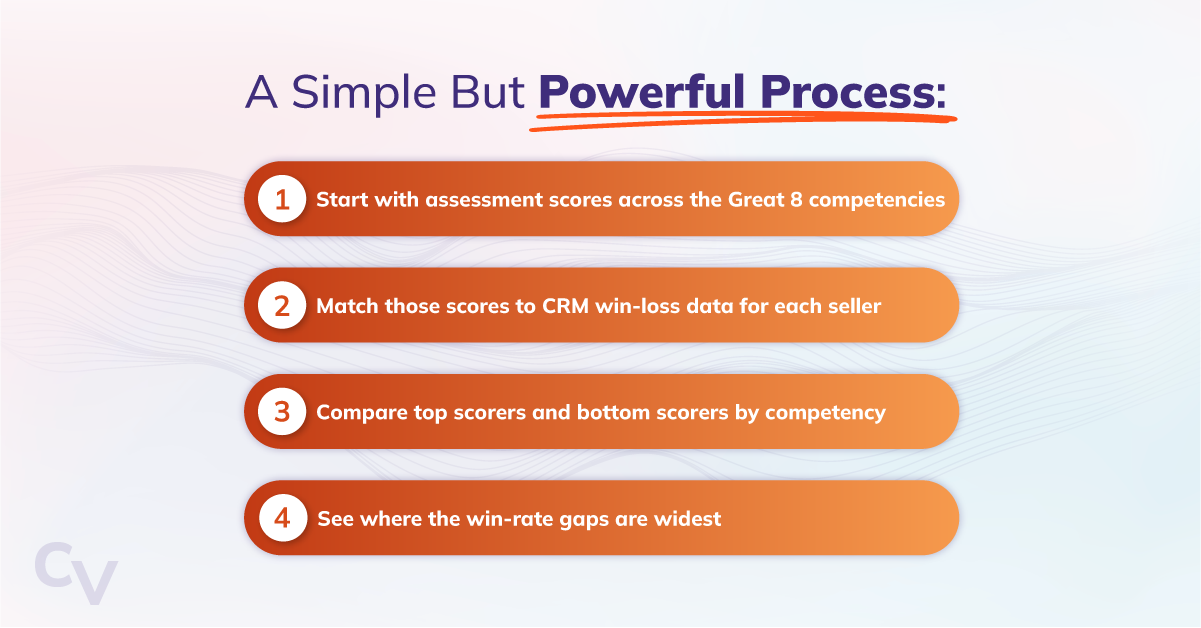
Combine assessment scores with win-rate data from your CRM. When you line up each seller’s scores with their win–loss results, patterns start to emerge. You’ll see which skills tend to drive wins—or show up most often in losses—and where the gap between top and bottom performers is widest.
Follow this process to turn your sales skills assessment data into a targeted coaching plan.
And when you tie your assessments to outcomes, the guesswork for where to focus your training falls away. What’s left is evidence—hard proof of which competencies are strong and where your team needs help.
2. Build Competency-Based Cohorts
Typically, companies will plan training around role, tenure, or territory. But with your assessment data in hand, you can get more precise.
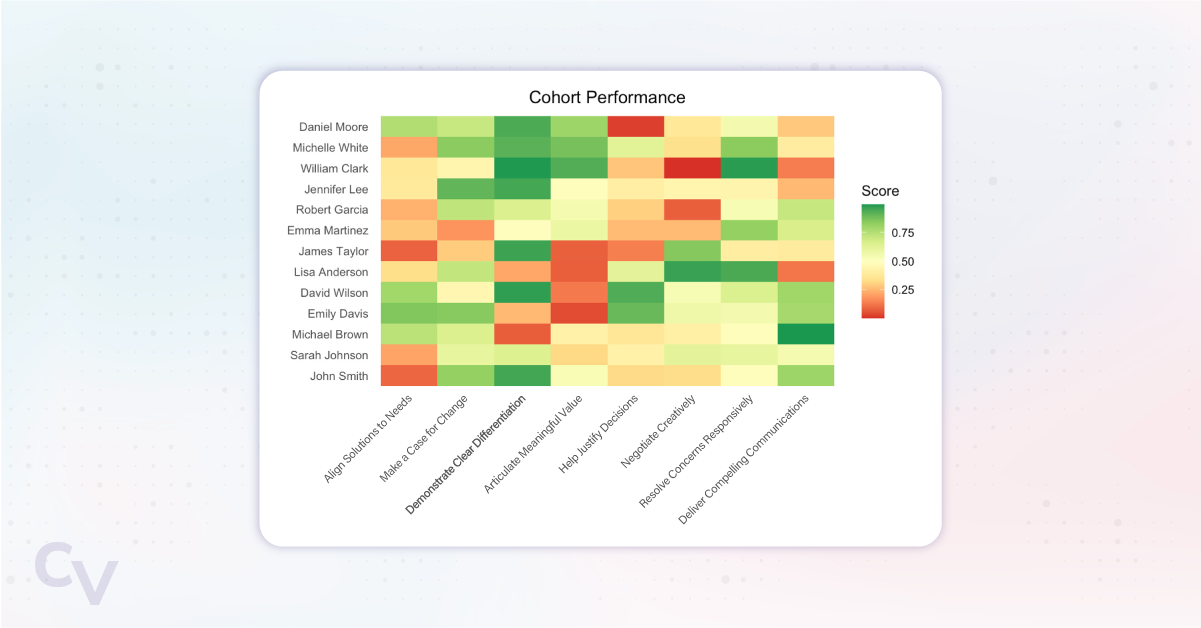
Once you know which competencies account for your biggest gaps, you can cluster sellers into cohorts based on shared skill gaps and prescribe training paths that are both targeted and scalable.
Once you have your assessment data, use it to group sellers into cohorts based on where they are struggling most.
Here’s how to use cohorts strategically:
Compare assessment results across regions, segments, or business units to see where strengths and gaps cluster—and adjust cohort design and training plans accordingly.
Use skill profiles to group complementary strengths and match sellers who excel in a competency with those developing it, so peer learning reinforces skill development.
Direct workshops, coaching hours, and content at the cohorts whose gaps most directly connect to revenue outcomes.
No more generic training. Coach the right people on the right skills at the right time.
3. Assign the Right Coaches
One surprising pattern: managers often share the same gaps as their teams.
If a manager scores low on a competency, don’t ask them to coach it. Tap internal experts or outside coaches who can perform the skill to lead that cohort.
Meanwhile, upskill the manager with practice and models—then assign them that competency when they can perform it.
4. Reinforce Skills in the Flow of Work
Put prompts, playbooks, and examples where sellers already are, like in your CRM, in pipeline reviews, and even in meeting prep. When guidance lives in the workflow, it shifts from “something I learned last quarter” to “something I can use right now.”
Your reps should spend time with buyers—not searching for the right playbook. They need learning tools at their fingertips, integrated into the tools they already use.
Make it:
Where sellers already work: plug playbooks, product knowledge, and micro-learning directly into your CRM, in the context of specific deals.
What they personally need: personalize recommendations based on a seller’s performance data and skill gaps.
When they need it most: integrate fluency coaching into the workflow so they can practice, get feedback, and apply new skills on real deals.
People retain more when reinforcement is close to application. Give short, scenario-based practice with immediate feedback, via AI role plays or a quick manager review, right before the call so skills carry into the conversation.
5. Equip Managers to Strengthen Competencies
Give managers simple coaching guides and observation checklists tied to the competencies their teams are working on now. Then every call review becomes a chance to spot the targeted skill and coach it in the moment.
Gathering feedback after wins and losses on specific competencies turns coaching from anecdote to evidence. And sellers who receive buyer feedback from just three deals improve win rates by up to 40 percent.
Because buyer, seller, and business needs evolve, your training strategy should, too. Use assessment data plus ongoing buyer feedback to spot gaps, adjust training quickly, and keep your team performing at its peak.
You Can’t Coach What You Can’t See
When you can see the competencies that shape buying decisions, you stop guessing where to coach, stop relying on confidence-driven self-assessments, and stop hoping training will move the numbers.
Instead, you:
Identify precise skill gaps
Personalize coaching
Strengthen execution
Link competency development directly to revenue growth
By replacing guesswork with precision assessments, you train to the specific competencies that will have the biggest impact on your win rate.
Learn how when sales organizations shift from self-assessment to Precision Skills Intelligence, they move from guessing about skill gaps to knowing exactly what will improve performance for their company.
Madeline Cunningham, Content Marketing Manager, is a content and communications leader with a track record of helping organizations strengthen communications, improve processes, and drive revenue impact. With experience supporting multimillion-dollar RFPs and enterprise-level marketing initiatives, Madeline brings a strategic, revenue-focused lens to storytelling.
From Assessment to Impact
Learn more about how to use precision skills assessments to increase win rates and prove real impact.