Revenue teams rarely struggle because of effort. Most teams work hard. They chase pipeline. They launch campaigns. They coach. They forecast. They analyze dashboards.
Where performance breaks down is somewhere else: It’s in the gap between activity and intentionality. Between insight and execution. Between process and discipline.
In other words, it breaks down when precision is missing.
In episodes nine through 12 of The Emblazers Show, different leaders approached that challenge from various angles. One focused on operational rigor. Another on behavioral science. Another on messaging clarity. Another on leadership standards. Together, they paint a clear picture: If you want better performance, you need sharper precision.
Here’s what you can take from each conversation.
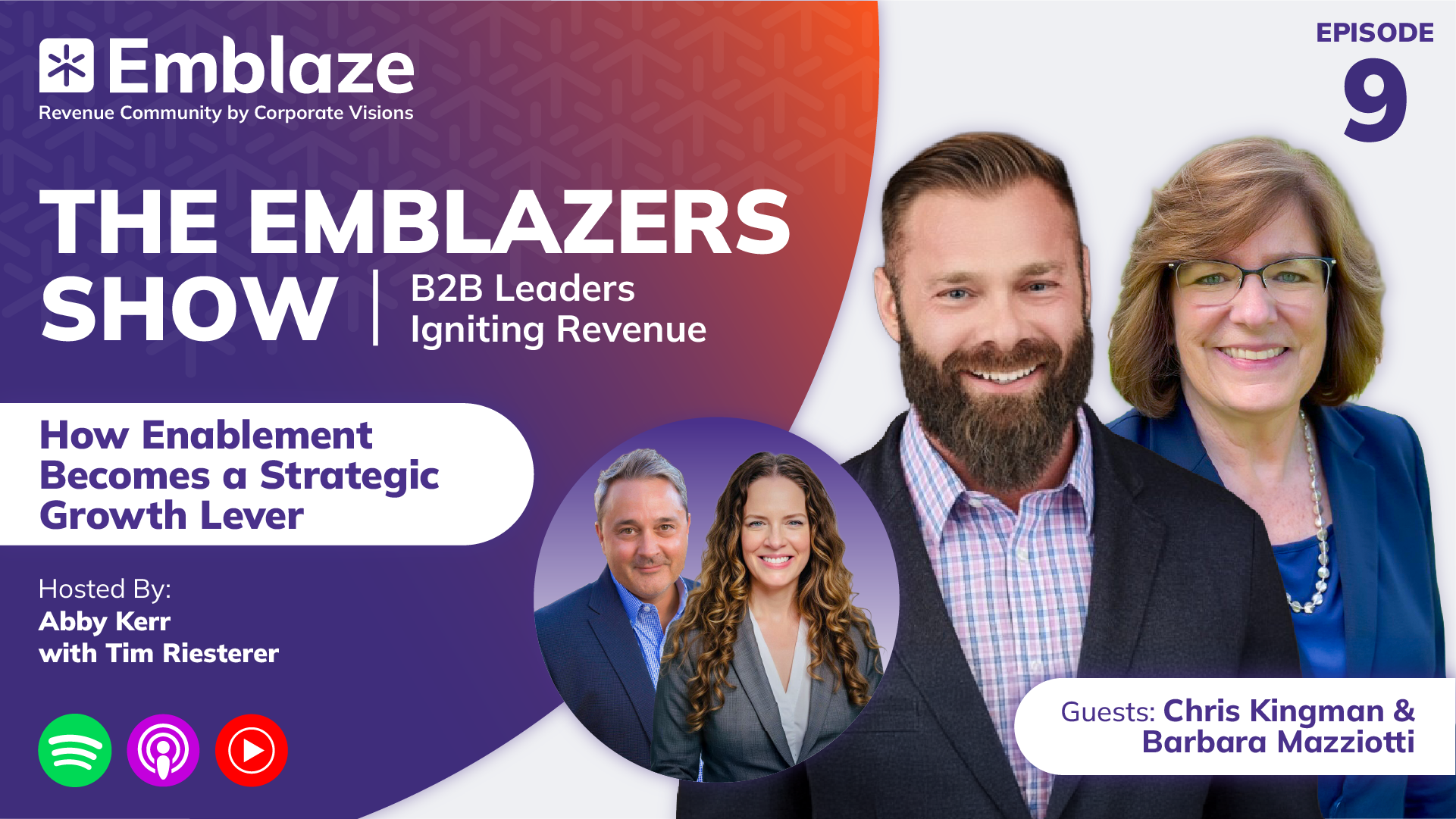
Chris Kingman and Barbara Mazziotti – Operational Precision Beats Heroics
Revenue enablement leaders Chris Kingman and Barbara Mazziotti challenged the idea that revenue growth is driven by hustle or individual heroics. Instead, they pointed to the power of disciplined systems—clear process, defined expectations, and cross-functional alignment.
When revenue leaders rely on instinct, experience, or “gut feel,” variability creeps in. Forecasts become unreliable. Handoffs between teams create friction. Wins depend too heavily on a few standout performers.
These guests emphasized that sustainable growth requires structure: defined stages, consistent qualification standards, shared definitions across marketing and sales, and accountability at every step of the funnel.
That kind of operational precision does more than improve reporting. It creates clarity for your team. Sellers know what good looks like. Managers know where to intervene. Leaders can diagnose bottlenecks without guessing.
The takeaway here: Predictable growth doesn’t come from working harder. It comes from tightening the system around how work gets done.
Listen to the full episode on Spotify, Apple Podcasts, or YouTube.

Tiffany Moceri and Nate Hartmann – Behavioral Precision in Buyer Engagement
Tiffany Moceri and Nate Hartmann brought a different lens: buyer psychology. Their conversation centered on a common mistake in modern lead nurture—mistaking activity for effectiveness.
More emails. More automation. More “touches.” Yet conversion stalls.
Drawing from research, they unpacked how teams often misread intent signals and overestimate buyer readiness. Not every download signals urgency. Not every click signals commitment. Without a precise understanding of buyer motivation and cognitive load, nurture sequences become noise rather than guidance.
They argued for a more disciplined approach: understand the buyer’s decision context, align messaging to real inflection points, and design engagement around how humans actually process information—not how marketing dashboards measure activity.
When you shift from volume to behavioral precision, conversion improves. Messaging becomes more relevant. Timing becomes more strategic. And buyers experience clarity rather than pressure.
The lesson: precision in targeting and message timing changes the math of growth.
Listen to the full episode on Spotify, Apple Podcasts, or YouTube.
Abby Kerr and Tim Riesterer – Message Precision in a Noisy Market
In a competitive market, everyone claims differentiation. Few demonstrate it clearly.
In this episode, Abby Kerr and Tim Riesterer explored why clarity—not complexity—creates advantage. When sellers overload buyers with features, data, and generic value claims, decisions slow down. Confusion increases. Risk perception rises.
Precision in messaging means making ideas easy to understand, easy to remember, and easy to justify. It requires discipline in how you frame problems. It demands that you prioritize what matters most rather than listing everything your solution can do.
They highlighted a critical tension: as AI tools make it easier to generate content and messaging, sameness accelerates. Templates multiply. Language converges. If you aren’t intentional, your message blends into the noise.
Precision, in this context, means sharpening your narrative. Defining your point of view. Giving buyers language they can use internally when they advocate for change.
When your message is precise, it becomes usable. And usable messages win.
Listen to the full episode on Spotify, Apple Podcasts, or YouTube.

Jeff Cummings and Dr. Johannes Habel – Leadership Precision as the Performance Multiplier
The final conversation in this set shifted from systems and messaging to leadership itself. For Jeff Cummings and Dr. Johannes Habel, precision, here, showed up in standards and accountability.
Revenue leaders often talk about culture. Fewer talk about the daily decisions that create it. Decision quality. Consistency in expectations. Clarity in feedback. Follow-through on commitments.
When standards drift, performance drifts. When accountability is uneven, effort becomes inconsistent. Precision at the leadership level means defining what “good” actually looks like and reinforcing it repeatedly.
It also means resisting shortcuts. Not lowering the bar when pressure rises. Not confusing busyness with progress. Leaders set the tone for how rigorously decisions are made and how carefully strategy is executed.
In this episode, the message was clear: precision at the top cascades through the organization. When leaders are intentional about standards, teams respond with focus.
Listen to the full episode on Spotify, Apple Podcasts, or YouTube.
Precision Brings Clarity
Across these four conversations, a pattern emerges:
- Precision in systems reduces variability
- Precision in buyer insight improves conversion
- Precision in messaging sharpens differentiation
- Precision in leadership raises performance standards
If your team is working hard but results feel inconsistent, the answer might not be more effort. It might be greater clarity.