Sales Process

You Have a Sales Process. So Why Isn’t Anyone Following It?

Build a buyer-aligned sales process your reps will actually use—embedded in your CRM, tied to real buyer milestones, and reinforced in every coaching conversation.
Trusted by Some of the World’s Leading Revenue Organizations

Your Sales Process Doesn’t Have to Be the Thing Everyone Ignores

Processes Need Adoption
Most teams have some version of a sales process, but reps keep selling “their own way” and managers keep coaching on assumptions.
Inconsistency Has a Cost
When every rep acts differently, pipeline quality becomes unpredictable, and forecasting turns into guesswork.
Sellers Need Better Systems
A sales process sticks when it’s built around how buyers actually make decisions and embedded directly in the tools your reps use every day.

Here’s What Changes When Your Team Follows a Solid Sales Process

Build Stages Around Buyer Milestones
Show reps exactly what to do at each stage with a process built around verified buyer decisions, not just internal seller activities or CRM checkboxes.
Embed the Process in Your CRM
Build a process that lives where your sellers already work—with stage-specific prompts that surface in active opportunities, so adoption doesn’t depend on memory.
Give Managers Coaching Frameworks
Give your managers structured coaching guides tied to stage progress and deal quality, so reinforcement happens consistently across the team.

Don’t Take Our Word for It

Corporate Visions builds revenue systems for mid-market companies creating their first formal sales process and enterprise organizations standardizing methodology across dozens of global markets.

And unlike most providers, we build three layers—process, skills, and messaging—so you’re not stitching together frameworks from three vendors to get one working system.
“Corporate Visions gave us a repeatable structure, language, and visuals for how to communicate our value in a way that resonates with our customers.”
Annie Lizenbergs, Senior Director, Revenue Enablement and Global Programs, Highspot

Building a Predictive Sales Process is Easy

Fill Out the Form
Tell us where things are breaking down—whether it’s inconsistent sales skills, a fragmented process, or manager coaching.
Get Matched with a Revenue Specialist
You’ll be connected with someone who has worked with organizations just like yours to solve this exact problem.
Walk Away with a Clear Plan
You’ll leave with a practical starting point for building the sales process your team can use right away.
FAQs

You Have Questions. We Have Answers.

We don’t have a real sales process today. Can you still build one, or do we need something in place first?

Not having a documented sales process is a normal starting point, not a disqualifier. You don’t need existing stages, a clean CRM, or a written process before you start. The work begins with discovery: understanding how deals actually move today, where they stall, and who touches them along the way. From there, you get buyer-aligned stages, gates, and exit criteria built from scratch and mapped directly into whatever system you use to track pipeline, even if that system today is a spreadsheet.

Rarely. If your sales stage names and structure already work for your team, you keep them. What usually needs more attention is what sits underneath each stage: the exit criteria, the buyer signals, and the standard a deal has to hit before it earns the right to move forward. You layer that definition onto the stages you already have instead of renaming everything and asking sellers to relearn a structure that was already familiar.

Sales process should live where reps already spend their time. A stage-by-stage playbook is built to plug into your CRM, sales enablement platform, or LMS, so a rep sees the right guidance the moment they open an opportunity at stage two, not a PDF buried on a shared drive. You decide where it lives; the content is built to be portable across whatever tools your team already opens every day.

It typically starts with discovery interviews across sellers, managers, and stakeholders to understand how deals really move, followed by a workshop where you define stages, exit criteria, and buyer milestones together. From there, the underlying detail gets built out: roles and responsibilities at each stage, tools, coaching guidance, and pipeline health metrics. Investment depends on scope, how much structure you already have, and how many stages you’re mapping, so a revenue specialist can walk through realistic timing and pricing once your starting point is clear.

Yes. A stage definition can stay constant across segments while the underlying criteria and pace differ. A high-velocity team might clear three stages in a single call, while an enterprise team works the same three stages over months with more stakeholders in the room. Instead of building a separate process for every segment, you define what good looks like once, then apply it at the right depth for each motion.

Built on Buyer Evidence, not Assumptions
Most sales methodologies are built on what leaders think good selling looks like.

When you work with Corporate Visions, you’re getting a revenue performance system designed around what real buyers say actually makes them choose one vendor over another.

Additional Resources to Explore

While you’re waiting to connect with your revenue specialist, check out what other leaders are reading right now.
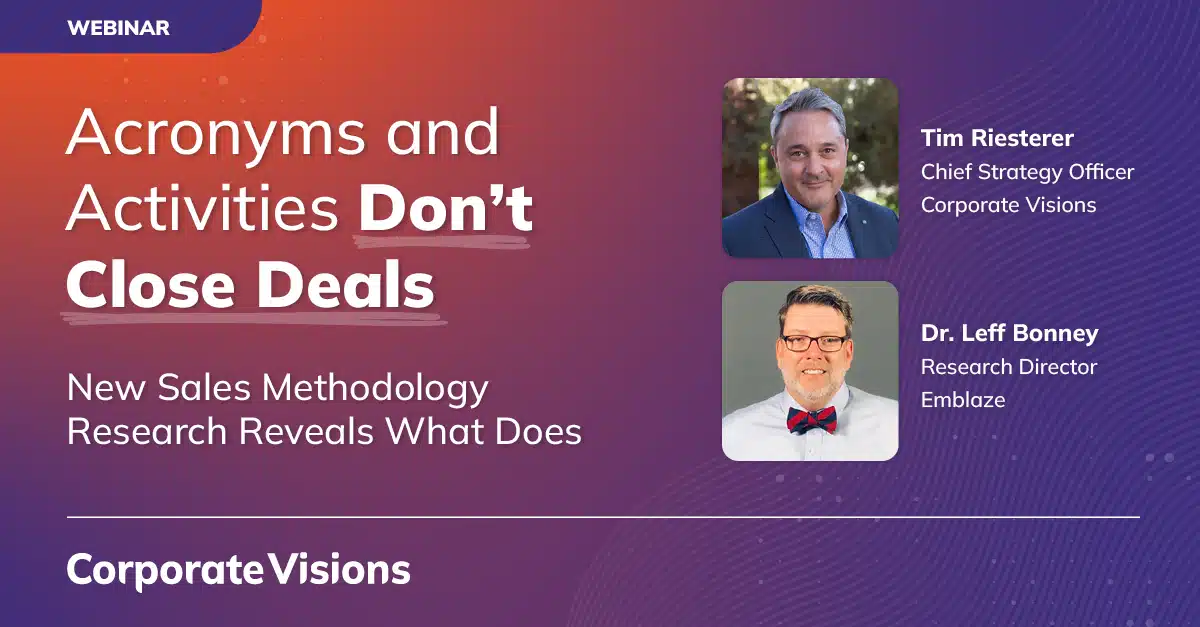
Acronyms and Activities Don’t Close Deals: New Sales Methodology Research Reveals What Does - Event cover
Webinars
Acronyms and Activities Don’t Close Deals: New Sales Methodology Research Reveals What Does
See what a real sales methodology looks like. Discover the GTM-aligned activities, skills, and behaviors proven to drive seller performance.
Tools
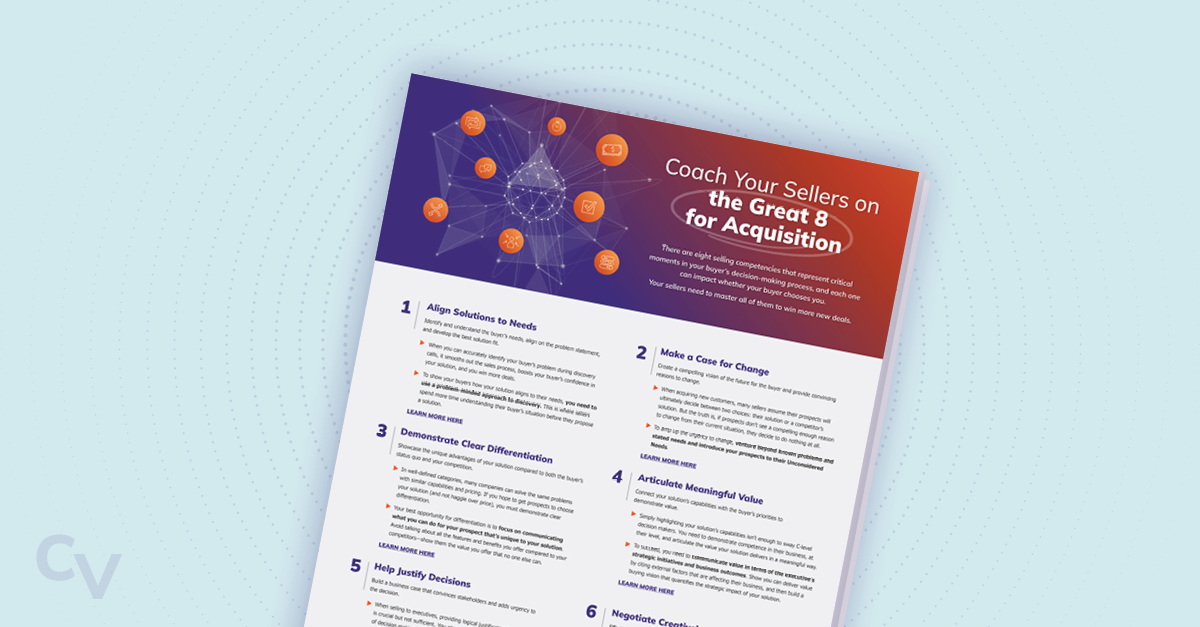
Coach Your Sellers on the Great 8 Skills
Discover the Great 8 sales skills that matter most to your buyer, and how to coach your sellers on each one.
E-Books
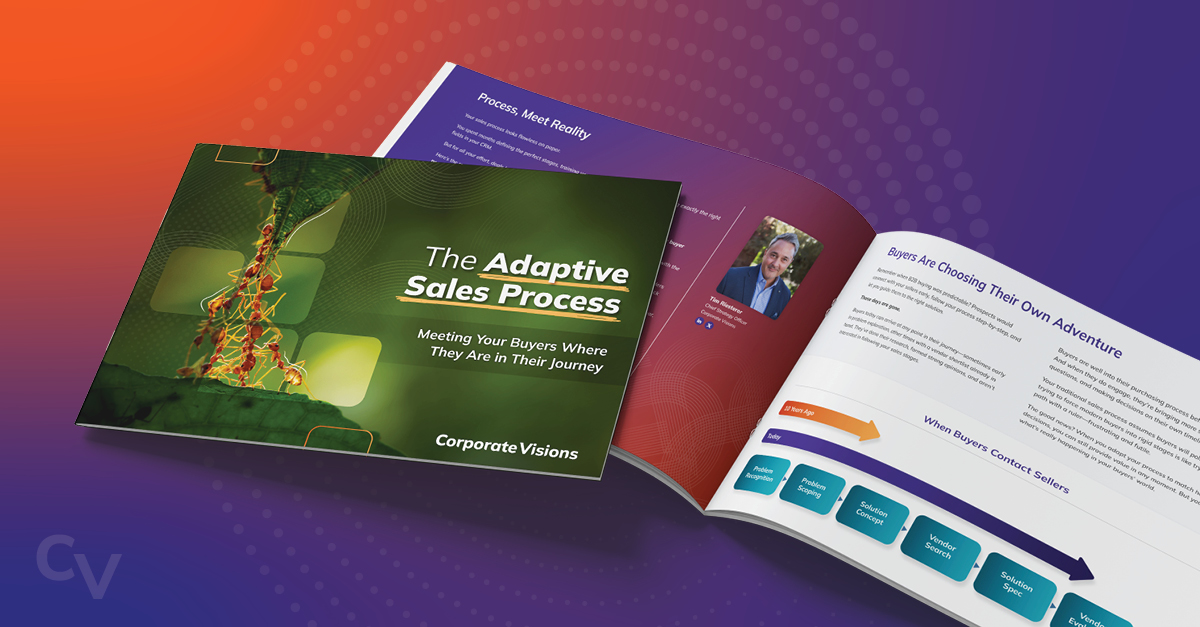
The Adaptive Sales Process
Discover how to create a sales process that adapts to how your buyers are making decisions.