Solutions and such do some things and some other things here Maecenas sed diam eget risus varius blandit sit amet non magna. Aenean lacinia bibendum nulla.
You’re measured on different outcomes—but your success depends on the same buyer decisions. This is where you find the programs and proof built for your goals.
Choose your role to see what that looks like in practice.
When teams rely on opinions, content gets noisy and inconsistent. Our resources are grounded in buyer evidence—so you can sharpen decisions, messaging, and execution.
Find insights, articles, webinars, and more evidence-backed resources to grow revenue.
Scroll through social feeds or search results and you’ll see the same tired statistics about B2B buying behavior.
That often-quoted “67 percent of the buyer’s journey happens digitally”? It’s from 2013—ancient history in terms of buying behavior! Yet outdated stats like that one continue to shape most companies’ training and enablement strategies.
Fresh sales data from 2024-2025 tells a different story.
Buyers are reaching out earlier, but they show up with AI-driven research, pre-ranked shortlists, and a decision process that looks less like a formal committee, and more like a loose network of influencers.
Drawing from recent sales statistics, research, and insights from Emblaze, 6Sense, G2, SBI, Forrester, Gartner, and more, this article exposes five hard truths about modern B2B buying behavior that most sales leaders ignore.
Most importantly, you’ll learn how to turn these emerging trends into your competitive advantage in 2026 and beyond.
1. AI-Informed Buyers Still Make Bad Decisions
Buyers are using AI-powered research to get faster answers and more confidence. But all that AI-assisted preparation still doesn’t translate into better decisions. The latest statistics reveal a growing gap between buyer confidence and sales effectiveness.
Economic pressures are driving buyers to move faster and engage sellers earlier.
Buyers show up earlier and more informed:
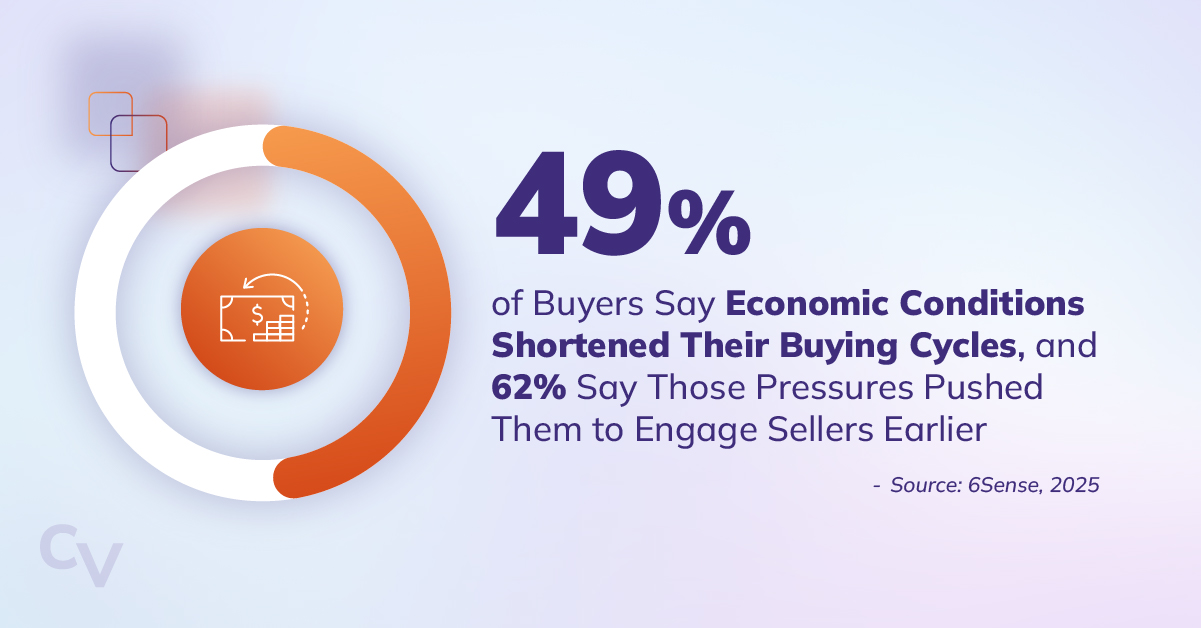
Nearly half of buyers (49%) say economic conditions shortened their buying cycles, and 62% say those pressures pushed them to engage sellers earlier (6Sense, 2025)
Average sales cycle length dropped from 11.3 months in 2024 to 10.1 months in 2025 (6Sense, 2025)
The point of first contact moved from 69% of the journey to 61%, pulling outreach forward by roughly six to seven weeks (6Sense, 2025)
Even with earlier contact, buyers still mostly or fully define their purchase requirements 83% of the time before speaking with sales (6Sense, 2025)
94% of buyers use LLMs during their buying process and 89% ultimately purchase solutions with AI features (6Sense, 2025)
72% of buyers encountered Google’s AI Overviews during their research and 90% clicked through to at least one cited source (TrustRadius, 2025)
40% of buyers say AI makes it easier to find information, and 80% say they trust AI tools at least sometimes—up 19 points year over year (TrustRadius, 2025)
But that independence isn’t leading to better outcomes:
B2B buyers still average 16 interactions per person with the winning vendor, essentially unchanged from prior years (6Sense, 2025)
62% of buyers say they needed sellers to clarify AI capabilities, and 58% say they engaged vendors earlier than usual, specifically to get AI questions answered (6Sense, 2025)
Only 38% of CEOs report having the right data and insights to achieve their commercial goals (SBI, 2024)
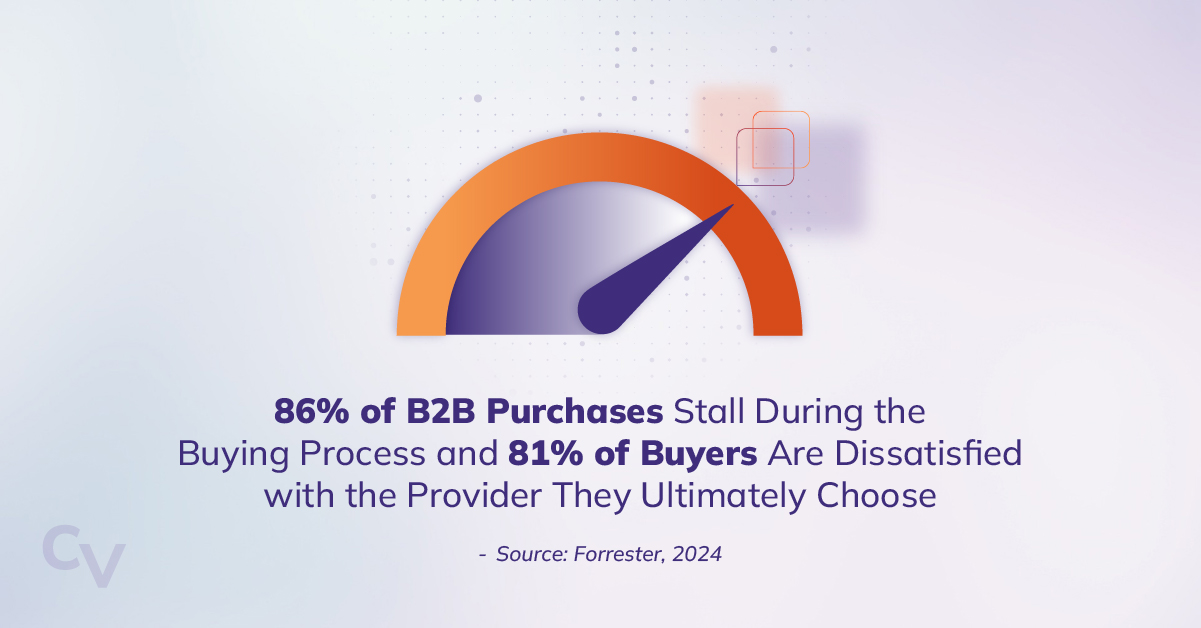
86% of B2B purchases stall during the buying process and 81% of buyers are dissatisfied with the provider they ultimately choose (Forrester, 2024)
Using AI to support purchasing decisions hasn’t prevented deal stalls or improved buyer satisfaction.
What changed since last year:
In the past year, AI stopped being ‘nice to have’ research help and became a front-door channel buyers use to define requirements and rank vendors—even as stall rates and decision regret remain stubbornly high.
Here’s how winning sales teams are navigating pre-convinced buyers:
Redesign opportunity stages around buyer milestones. Inspect deals based on how buyers are thinking and deciding (not just activity volume).
Equip sellers to test assumptions in discovery. Train reps to uncover where the buyer’s requirements came from, how they formed their problem definition, and whether that definition is incomplete or AI-distorted.
Build content for the messy middle (especially where AI is involved). Give buyers tools to weigh tradeoffs, hidden risks, and realistic outcomes, so “AI confidence” doesn’t become “AI-driven confusion.”
Use buyer feedback to tune qualification and coaching. Capture feedback about why buyers stalled, switched, or regretted their decision. Then use those insights to fine-tune discovery, qualification, messaging, and coaching to close any identified gaps.
Buyer overconfidence is just the first challenge. When stakeholders get involved, decisions aren’t made by tidy buying committees anymore. Most influence happens in buying networks you don’t get invited into.
2. Invisible Buying Networks Drive Decisions
Formal buying committees are giving way to fluid networks of influence—internal stakeholders, external peers, AI agents, and digital communities—all shaping decisions long before sellers get involved. The latest research shows just how dramatically buying team dynamics have evolved.
B2B buying committees now involve people from a wide variety of departments.
Decision dynamics are changing:
Typical B2B purchases involve teams of about 10 people, and these group sizes have stayed consistently large over multiple years (6Sense, 2025)
54% of buying groups are actively evolving their decision-making models (Demandbase, 2025)
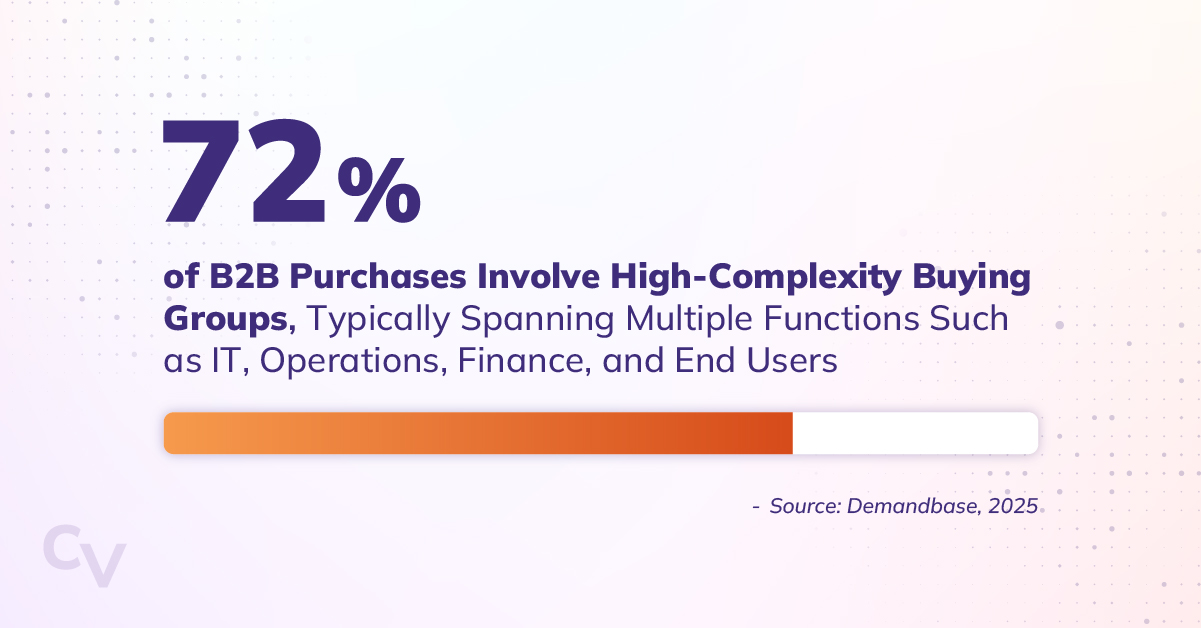
72% of B2B purchases involve high-complexity buying groups, typically spanning multiple functions such as IT, operations, finance, and end users (Demandbase, 2025)
There are 10 unique decision-maker functions in modern buying groups (Demandbase, 2025)
52% of buying groups now include decision-makers at VP level or above (TrustRadius, 2024)
79% of purchases require CFO approval (TrustRadius, 2024)
Buying cycles are more complex:
On average, B2B buyers have been through eight to nine prior purchase journeys for the same type of solution (6Sense, 2025)
Initial stakeholders and final decision-makers often have different priorities and success metrics (SBI, 2024)
87% of technology buyers reported adjusting their buying process to ensure they only bought mission-critical products (Forrester, 2024)
External influence adds another layer:
Only 9% of buyers consider vendor websites reliable sources of information (G2, 2024)
58% of B2B marketing executives rely on their networks to build a shortlist of vendors (Wynter, 2024)
73% of B2B marketing executives rank word-of-mouth and peer recommendations as the most influential factor in deciding which vendors to consider (Wynter, 2024)
56% of buyers consult with existing product users before purchasing, rising to 71% for enterprise purchases (TrustRadius, 2024)
Public product review sites are now the most consulted information source (31%) for software buying, with independent peer feedback outweighing vendor narratives and analyst coverage at every stage (G2, 2024)
Nearly three-quarters (72%) of buying teams hire consultants or analysts to help with purchasing decisions (6Sense, 2024)
Organizations using external advisors see longer cycles (13.6 vs 6.5 months) and larger buying groups (12.9 vs 6.4 people) (6Sense, 2024)
What’s changed since last year:
Last year, the story was that buying groups are getting bigger. This year, it’s that buyers are more experienced and more networked. Influence is moving toward informal networks and how well a solution fits their existing tech stack and workflows, making it harder for sellers to rely on a single champion or linear “approval chains.”
Here’s how market leaders are mastering new buyer dynamics:
Map the network—not the org chart. Give sellers a practical stakeholder mapping framework by deal type (new platform, rip-and-replace, expansion): who’s typically involved, who’s missing, where power hides, and where disagreement usually shows up.
Tell one consistent story across the network. In a network, inconsistent messaging spreads fast—and it costs you trust. Equip sellers with situation-specific messaging that anchors to the strategic problem the group is solving—plus forwardable internal assets (like a one-page summary, tradeoff comparison, and FAQs) that help stakeholders align when sales isn’t present.
Train multi-threading as a skill (and coach it in the flow of work). Multi-threading can’t be “send more emails to more people.” Sellers must earn introductions, gain executive access, and avoid cross-stakeholder contradictions.
While invisible buying networks create one set of challenges, timing creates another. Even if you can navigate the complex web of stakeholders, you might already be too late to influence the outcome.
3. Early Vendor Shortlists Decide the Winner
By the time sellers enter the conversation, buyers often have a preferred vendor, a pre-built shortlist, and a ranking order they’re trying to validate. These statistics illustrate how power dynamics have shifted.
Buyers rank solutions before speaking with sellers, and their first choice often wins.
Buyers drive the engagement timeline:
Buyers initiate outreach close to 80% of the time and overwhelmingly reach out first to the vendor they intend to buy from (6Sense, 2025)
61% of B2B buyers prefer an overall rep-free buying experience, and 73% actively avoid suppliers that send irrelevant outreach (Gartner, 2025)
81% of buyers initiate first contact with sellers, not the other way around (6Sense, 2024)
69–83% of opportunities are reactive (buyer led), and these reactive opportunities win at only 18–25%, compared with 33–41% win rates for proactive opportunities (Emblaze, 2025)
Sellers who have proactive sales habits generate ~19–30% higher annual sales revenue and 12–23% higher profit margins than their more reactive peers (Emblaze, 2025)
Most decisions are made before seller contact:
92% of B2B buyers start their journey with at least one vendor already in mind, and 41% start with a single preferred vendor before any formal evaluation (Forrester, 2024)
By day one, buyers have already placed about four out of five vendors on their shortlist and 95% of the time, the winning vendor is already on that day one list (6Sense, 2025)
81% of buyers choose vendors before sales contact (6Sense, 2024)
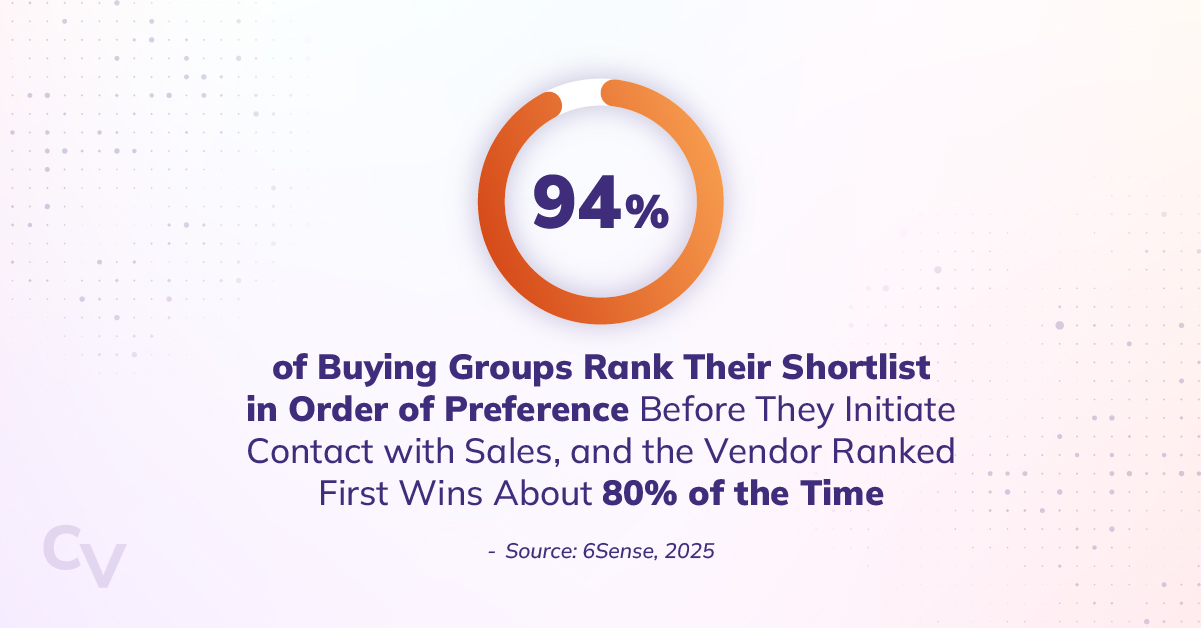
94% of buying groups rank their shortlist in order of preference before they initiate contact with sales, and the vendor ranked first wins about 80% of the time (6Sense, 2025)
71% of buyers went with their first-choice product after creating their shortlist (TrustRadius, 2024)
What changed since last year:
Buyers are still initiating most contact, still building and ranking shortlists before sales gets involved, and increasingly prefer rep-free buying experiences whenever possible. Economic pressure has sped up the process without giving sales more control, which means a reactive, inbound pipeline is now even more of a handicap than it was a year ago.
Here’s how to get ahead of deals before they’re lost:
Create deals before buyers start shopping. Don’t wait for inbound interest. Start conversations that help buyers see a problem worth solving—before they build a shortlist. Give sellers a powerful message and enablement tools to open more proactive conversations with prospects.
Help buyers solve problems, not compare options. If buyers show up with a ranked list, a standard discovery call won’t change anything. They need a clearer way to make the decision. Equip sellers with a tight set of questions and insights that challenge buyer assumptions without putting them on the defensive.
Coach differently for buyer-led deals. Buyers behave differently when they reach out vs. if a seller initiates the conversation. Treating them the same is how teams stay reactive. Use buyer feedback to find out what causes stalls, where your sellers lose influence, and what to coach—then adjust deal reviews accordingly.
A ranked shortlist doesn’t leave you much room for error. And when sellers respond with generic discovery and a one-size-fits-all sales process, they create the misalignment and friction that stalls deals and drags value down.
4. Decision Drag Stalls Deals (and Shrinks Them)
Deals often stall because the buyer’s decision gets harder to finish—too many options, too many people, and too little clarity on what will solve their needs. And when sellers miss the real problem buyers are trying to solve, momentum grinds to a halt.
Most buyers felt overwhelmed by options during their last major purchase.
Complexity kills momentum:
71% of buyers describe their experience with supplier reps as “frustrating” (SBI, 2024)
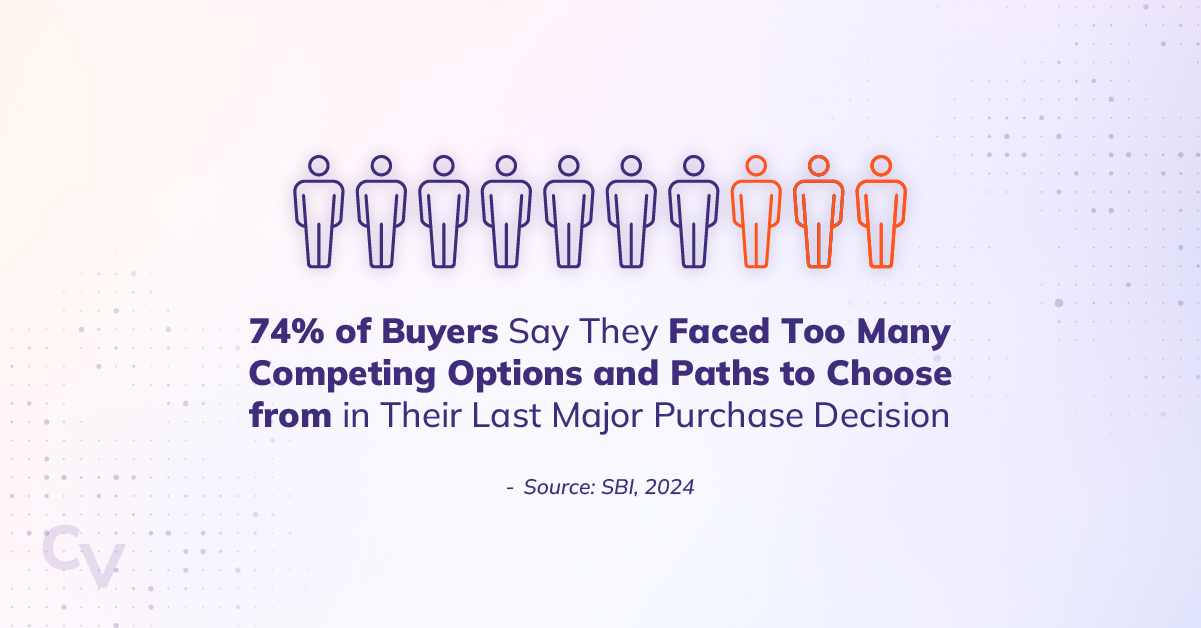
74% of buyers say they faced too many competing options and paths to choose from in their last major purchase decision (SBI, 2024)
70% of buyers say they worked with so many different people on the supplier side that they weren’t sure who everyone was through their experience (SBI, 2024)
High-friction environments reduce the odds of a purchase by 43% (SBI, 2024)
83% of sales leaders admit their teams struggle to adapt to changing buyer needs and expectations (Gartner, 2024)
57% of global B2B buyers expect ROI within three months of a software purchase, and 11% expect ROI immediately, raising the stakes on every decision—including the bad ones (G2, 2025)
Problem misalignment makes it worse:
There’s an average 54.5% misalignment between how sellers and buyers perceive the core problem to be solved (Emblaze, 2024)
When sellers underperform on the buyer’s top priority, it reduces win rates by up to 10 percentage points (Corporate Visions, 2025)
When sellers and buyers align on the problem definition, win rates improve by 38% (Emblaze, 2024)
Buyers change their problem statement an average of 3.2 times during complex purchases (Emblaze, 2024)
The most successful deals involve regular problem revalidation across the buying committee (SBI, 2024)
Problem-focused sellers are 30% more effective than solution-focused sellers, yet only 13% of sellers take a problem-minded approach to discovery (Emblaze, 2024)
What changed since last year:
Buyers are revealing exactly what slows their decisions (too many choices, too many paths, too many supplier-side people), and the evidence shows how quickly those experiences push deals toward smaller, safer outcomes. At the same time, problem misalignment is proving to be the silent killer: sellers keep solving one problem while buyers keep renegotiating a different one.
Here’s how to win when decisions drag:
Make problem alignment a required step. If the problem keeps shifting, the deal keeps stalling. Add a checkpoint where buyer and seller confirm the problem statement, impact, and success metrics—and revisit it when new stakeholders or new information show up.
Reduce friction like it’s part of the product. Buyers don’t separate your solution from the experience of buying it. So, simplify the process: fewer handoffs, clearer roles, and one obvious next step buyers can agree to without another round of internal debates.
Coach to what’s slowing the decision. Forecast calls don’t fix buyer confusion. In reviews, ask what the buyer’s stuck on and what’s creating friction. Then coach one specific tactic to remove that blocker this week.
When buyers feel stuck, it’s often because of the risk involved with making a change. That’s why delivery has become the differentiator: buyers treat the sales experience as a preview of what implementation, adoption, and support will feel like after they sign.
5. Delivery is Differentiation
Features are important, but delivery is what decides the deal. Buyers are judging two kinds of delivery: how you deliver the conversation, and how you deliver the solution once it’s live. The vendors that win are the ones that feel easiest to buy from—and easiest to live with.
Buyers rate identical services as better when the delivery experience stands apart from other vendors.
The experience matters more than features:
When it comes to bold purchase decisions (bigger spend, higher advocacy), the GTM experience drives 59% of the likelihood of a bold decision, while the offering itself accounts for just 41% (SBI, 2024)
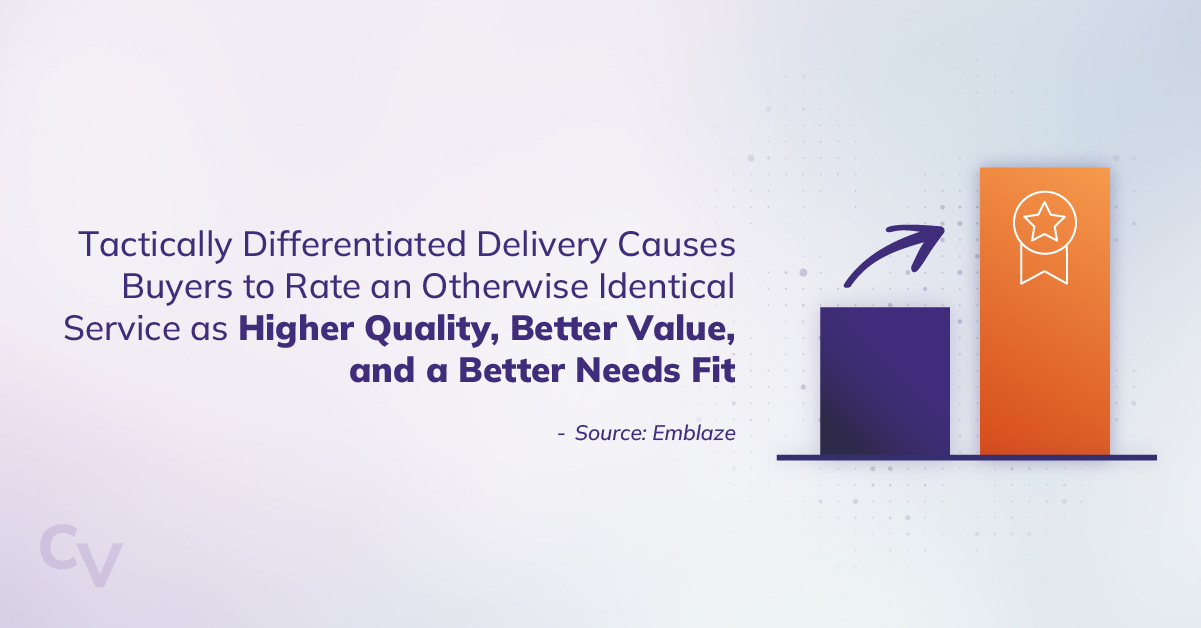
Tactically differentiated delivery causes buyers to rate an otherwise identical service as higher quality, better value, and a better needs fit (Emblaze, 2025)
Buyers rate winners 2+ points higher (on a 1–7 scale) than losers on four delivery attributes: solution fit, ease of implementation, integration capabilities, and training/support (Corporate Visions, 2025)
Integration and implementation are deal terms:
77% of buyers prioritize integration capabilities, and solutions that fail to integrate seamlessly with existing workflows are often deprioritized “regardless of features or price” (Demandbase, 2025)
Integration with other systems is the top consideration for buyers purchasing customer service, marketing, sales, and customer success software, and security is a top concern across key categories (G2, 2024)
Delivery drives loyalty:
In North America, 74% of buyers say their contracting experience made them more likely to buy from the same vendor again (6Sense, 2024)
Globally, roughly seven in 10 buyers say a smooth contracting process increases their likelihood to repurchase (6Sense, 2024)
At-risk customers most often cite value perception (42%), total cost of ownership (41%), alignment to needs (32%), and service and support (26%) as reasons not to renew (Corporate Visions, 2024)
What changed since last year:
Differentiation has moved even further away from your product. What makes the difference is how sellers perform before and after the contract is signed. Buyers are treating the pitch as a preview of the operating reality they’re signing up for. And they’re rewarding vendors who make solutions easy to implement, integrate, adopt, and expand, while punishing vendors who create friction—even if the feature set is strong.
Here’s how to nail your delivery:
Design the conversation like a product experience. Buyers judge competence by how you run the meeting, not just what you claim. Build repeatable talk tracks for high-stakes moments (first meeting, exec review, late-stage negotiation) that surface risk clearly and make the buyer’s decision feel simpler, safer, and easier.
Sell the operating reality, not the idea. If implementation and integration are risks in your buyer’s mind, show them how it works. Use simple, memorable visuals to walk through onboarding, integration, milestones, and support. Give buyers a picture of who does what, what happens when, and how you reduce risk within the first 90–180 days.
Coach delivery like a skill, not a personality trait. Great reps weren’t born that way—they’ve been trained and coached. Use call recordings, win-loss analysis, and sales skills assessments to pinpoint where delivery is breaking down. Then train and coach the behaviors that buyers want to see.
AI makes buyers feel informed. Buying networks make decisions harder to control. Shortlists make timing critical. And complexity kills momentum. But delivery is how you win anyway—it’s the one place you can reduce risk, make the decision feel simpler, and give buyers confidence they won’t regret later.
Your Evidence-Backed Playbook for Revenue Growth
A lot of commentary about buying behavior is stuck in old statistics and recycled talking points. But the latest B2B research points to a different reality in 2026.
Buyers arrive over-confident. Buying networks shape decisions. Shortlists form early. Complexity kills momentum. And delivery is what buyers use to reduce risk and choose who feels safest.
If your team is still running an outdated playbook built for a linear funnel, these B2B buying themes show exactly where it will break. Time to update what sellers say, how they lead discovery, and how you coach deals—so your approach matches the buying reality prospects and customers are living in right now.
Anton Rius, Sr. Director of Content Marketing, leads all content marketing strategy and production at Corporate Visions. Anton’s extensive experience supporting B2B revenue growth with insightful content has been featured in publications like SalesPOP! and Relevance. Anton writes regularly at Long Tail Thinking.