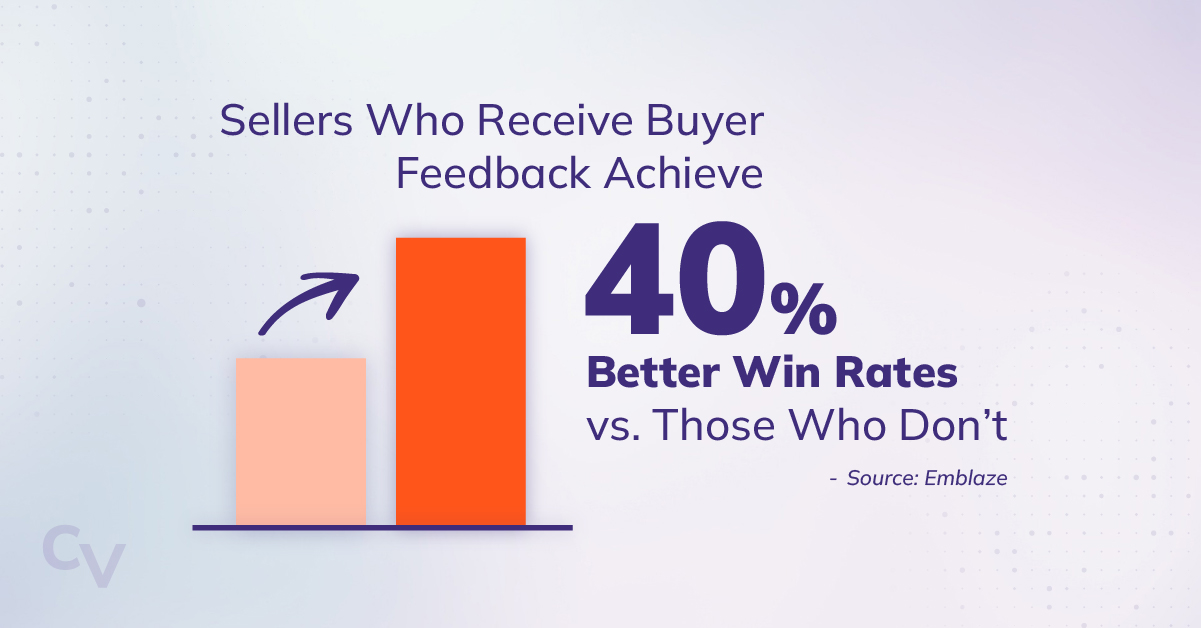
Sellers who receive buyer feedback acheive 40% higher win rates vs. those who don't. -Source: Emblaze

Feedback Is the New Forecast: How Buyer Feedback Improves Sales Performance

This is an excerpt from an article published by Sales and Marketing Management.

Sales forecasts are useful for tracking whether you’re going to hit your number. But they don’t tell you why you missed it—or what your team should do differently in the next set of deals.

For the people responsible for performance—sales leaders—that’s the frustrating part. You can’t coach a forecast. You can only coach behavior. But only if you can see what’s really happening in the conversations between your buyers and sellers.

That’s why buyer feedback is one of the most underrated components of modern sales enablement. Not because it’s trendy. Because it’s corrective.

Buyer feedback turns hindsight into a forward-looking performance management system.

The Sales Performance Blind Spot

When a deal is marked as lost in your CRM, the story usually comes from the rep. Sometimes it’s accurate. More often, it’s incomplete.

In fact, across win-loss data from over 150,000 B2B deals, we found that sellers and buyers cite different reasons for losing 50–70 percent of the time.

Think about what that means operationally. If you’re diagnosing performance gaps using only your sellers’ opinions, you’re going to place smart bets on the wrong problems. Buyers confirm the cost of getting it wrong.

In our buyer feedback analyses, buyers report that more than half of lost deals were winnable if sellers had avoided fixable missteps during the sales experience.

That should change how you interpret, “We lost on price” or “They went with the incumbent.” Those can be true and still be an incomplete explanation.

The real enablement question isn’t “What did the rep think happened?” It’s “What did the buyer experience, and what did they need that we didn’t get right?”

If you’re diagnosing performance gaps using only your sellers’ opinions, you’re going to place smart bets on the wrong problems.
Tim Riesterer
Chief Strategy Officer, Corporate Visions

Buyer Feedback as Performance Data

Most organizations treat buyer feedback like a periodic win-loss project: gather some interviews, summarize themes, hold a meeting, and file it away.

But feedback becomes far more powerful when you treat it as regular input for sales enablement and coaching – the same way you treat pipeline coverage or conversion rates.

Here’s one data point that’s hard to ignore: In an analysis of 6,984 B2B deals, sellers who received buyer feedback achieved 40% better win rates year-over-year compared to sellers who did not.

Even more instructive is how much feedback it takes to see impact.

When sellers received feedback from only two deals, their win rates dropped year over year. But when sellers received feedback from three deals, performance improved.

Three deals became the threshold—enough signal to learn from, without so much noise that it gets ignored. After that, performance gains began to level off. More feedback didn’t automatically translate into better outcomes.

That’s a useful design principle for sales leaders. You don’t need a mountain of feedback to change outcomes. You only need a small number of clear, comparable data points to see a pattern of performance gaps.

Read the full article to find out how to turn your buyer feedback into a performance plan.

Related Posts
Leading with Precision: The Discipline Behind Predictable Revenue Performance
Explore how precision in systems, buyer psychology, messaging, and leadership drives predictable revenue...
Elevating Performance in a Changing Market: Advice from Four Revenue Leaders
Learn from sales executives and academics as they share practical insight on strengthening talent, refining...
What AI Can't Replace: The Human Sales Skills Still Winning Deals
Human sellers remain the decisive factor in winning complex deals, despite AI's promise to automate everything...
About the Author
Tim Riesterer

Tim Riesterer

Tim Riesterer, Chief Strategy Officer at Corporate Visions, is the sought after expert on evidence-based revenue growth using counterintuitive approaches. Known for his candid thought leadership and engaging keynotes, he’s spent decades testing and refining go-to-market strategies that put buyers squarely at the center. Tim is the author of four insightful books, including Customer Message Management, Conversations that Win the Complex Sale, The Three Value Conversations, and The Expansion Sale.