A Clear Path to Sales Training ROI
Sales training programs are often evaluated on participation rates, completion data, or post-session surveys.
But that’s not the question your CRO or CFO is asking.
They’re asking: “Did it move the business?”
Did win rates improve? Did pipeline clean up? Did deal size increase? Did forecast accuracy tighten? Did we grow faster than the market?
To answer credibly, you need more than a training report. You need to be able to tell a story that shows the ROI of your sales training and how it directly impacts your revenue growth.
Why ROI Conversations Break Down
Before you can prove the ROI of sales training, you need to understand why most ROI stories fall apart under scrutiny:
Training output ≠ performance outcome: Completion and training evaluations don’t prove sellers did anything different in live deals.
Bad baselines: When your “before” data is unreliable—dirty pipeline, inconsistent stages, vague or wrong loss reasons—you can’t show movement credibly.
Revenue-only measurement: Waiting for bookings takes months and muddles cause and effect.
Attribution fantasy: Claiming training “caused” commercial outcomes without an evidence trail invites skepticism.
Make the Impact of Sales Training Defensible
You prove ROI when the path is visible: teach the skill, observe the behavior in live opportunities, see how leading commercial signals change, and then tie those shifts to business results.
This is the practical way to demonstrate the ROI of sales training in a way finance and executives will trust.
In this guide, you’ll see how to build a clear path to ROI into every training plan. You’ll learn how to set a clean baseline, pick the metrics that matter, build a tracking plan, and use that data to justify your investment and plan your next move.
Start with the Business Problem
A common mistake organizations make is starting with skills instead of starting with a performance gap.
They say: “We need better negotiation.” “We need executive selling.” “We need a new methodology.”
But they haven’t clearly defined what’s breaking.
Instead, start here: What commercial problem are you trying to fix?
Be specific:
- Are you losing too many competitive deals?
- Are deals stalling at a particular stage?
- Are you discounting too heavily and eroding margin?
- Is a key product underperforming?
- Is forecast accuracy volatile?
- Is the pipeline bloated with unqualified opportunities?
Fundamentally, you want to pinpoint where performance is breaking down in the system. When you define the problem precisely, you can then:
- Determine what behaviors you need sellers to change.
- Select the right metrics to track.
- Estimate the financial impact of improvement.
- Prioritize which issues need to be addressed first.
Training must be anchored to a business problem you’re trying to solve. Otherwise, you’ll end up measuring activity instead of impact and won’t be able to clearly show sales training ROI.
Establish a Clear Baseline for Sales Training ROI
To see how your training program improves performance, you need to know where you are today.
In an ideal world, you have clean, readily accessible data from across your organization.
In reality, data is fragmented, inconsistent, or hard to access—if it exists at all.
That’s normal.
But you still need to try and understand your current state as much as possible.
Where to Find Baseline Metrics
Look to these signal sources to build your “before” view:
CRM Data
- Win rate
- Stage-to-stage conversion
- Pipeline leakage
- Deal velocity
- Forecast variance
Note: A common blind spot is lumping all losses together. Competitive losses and no-decision outcomes are different problems and require different solutions.
Buyer Feedback
- Win-loss analysis
- Churn analysis
- Competitive analysis
- Sales performance analysis
- Call recordings
- NPS/CSAT Scores
Note: Analysis for over 150,000 deals has shown that the seller’s reason in the CRM for a lost deal differs from what buyers report 50–70 percent of the time. If you rely solely on seller feedback for win-loss, you might optimize for the wrong issue.
Skill and Execution Assessments
- Skill mastery
- Skill gaps
- Skills correlated most strongly with wins and losses
Note: Self-assessments and manager-assessments don’t always provide the objective information you need about seller performance. That’s why it’s important to start with a standardized, objective assessment of sales performance.
Financial/RevOps Data
- Average deal size
- Margin and discount trends
- Revenue per seller
- Ramp time
Note: With this data, you can quantify the real cost of stalled deals, heavy discounting, slow ramp, or underperforming segments. It ultimately defines how much improvement in these areas is worth to the business.
You don’t need perfect data and you might not have all this information. Collect what you can and see what you need to start tracking going forward.
Map Your Metrics
Once you know where you are currently, it’s time to plan where you are going.
One of the first things to think about is where in a buyer’s journey the problem you are trying to fix occurs.
Once you know where the breakdown occurs, you can identify the behaviors that should move at that stage and the metrics that signal progress.
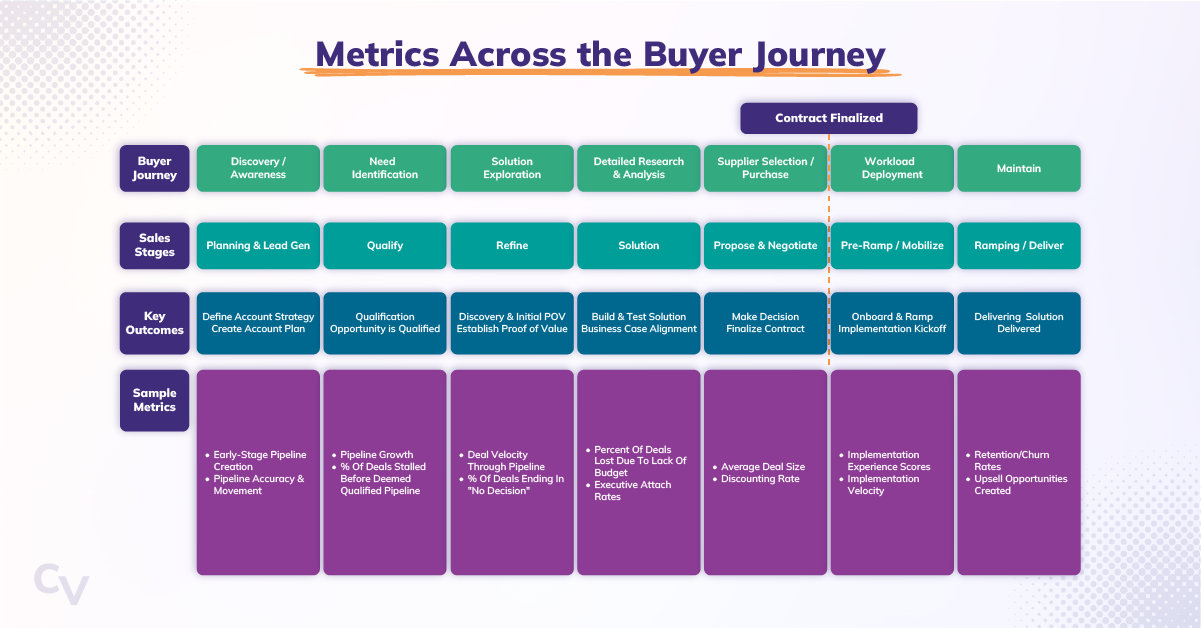
This stage-based mapping makes sure you are clear about where the problem is taking place and what your training is trying to fix. With this in mind, you can start thinking about the metrics that make sense to track for each stage.
Ultimately though, you need to link your efforts to changes in revenue. An easy way to do this is to use a model called the Triple Metric.
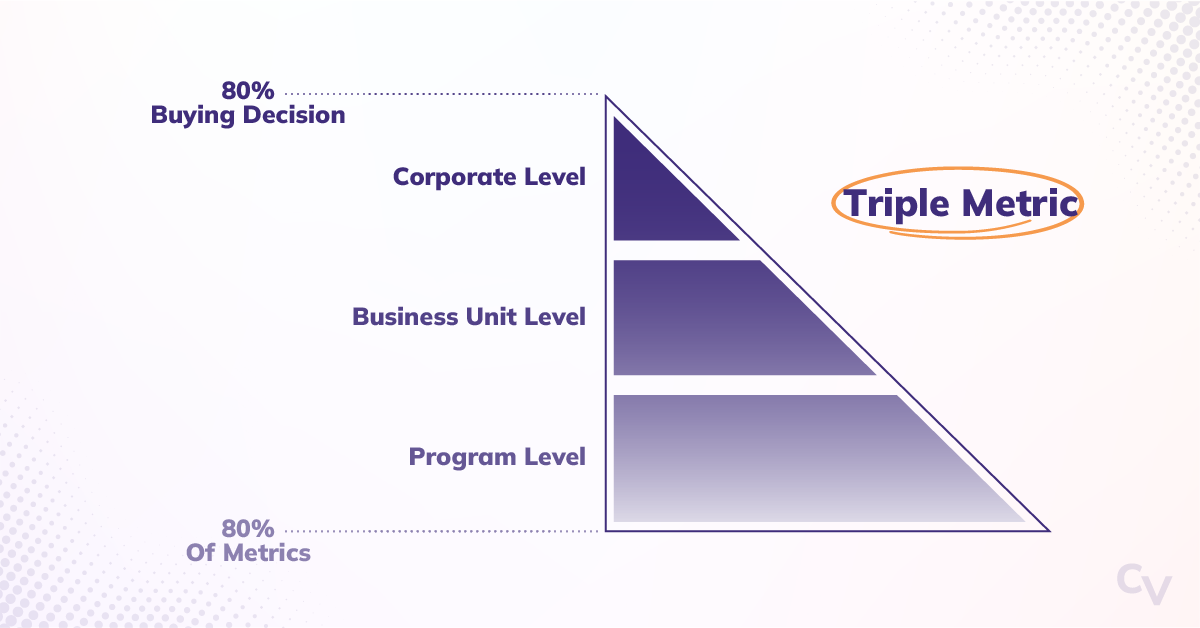
With the Triple Metric, you establish a chain of causation from what you did at the program level to the metrics your executives care about. Here’s how to use it.
Corporate Outcomes
At the corporate level, you want to show that your program contributed to strategic decisions and long-term growth. Corporate metrics are things like:
- Revenue growth
- Growth vs. market
- Margin expansion
- Net revenue retention
These outcomes are obviously influenced by many factors, like pricing, hiring, market conditions, and product changes. You won’t always have a perfect line of causation. But you can still connect your training to ROI by showing upstream shifts at the program and commercial levels that plausibly contribute to movement here.
Business Unit Outcomes
Metrics at this level should reflect how initiatives improve operational efficiency, customer experience, and team performance within revenue functions. These include things like:
- Stage conversion
- Average deal size
- Discount rate
- Forecast accuracy
- Ramp time
This is where enablement investments become visible to the revenue organization. When execution improves consistently, commercial metrics like these should begin to move. Tracking these is essential to demonstrating the ROI of your sales training program.
Program Outcomes
At the program level, your metrics should demonstrate the direct impact of specific initiatives. This is where you prove that what you introduced is starting to change something.
You can track dozens of indicators at this level, but precision matters. The more clearly your metrics align to the problem you’re solving, the easier it is to show a chain of causation.
Every sales training initiative is ultimately about behavior change. If your sellers don’t change how they sell, the training failed—even if everyone loved it and rated it highly. Your goal is to change execution.
For the program level, your sales training metrics should be able to answer:
- Did your sellers complete the training?
- Do your sellers think they learned something in the training? (Tracked through course evaluations or manager conversations)
- Can your sellers apply the skills learned? (Tested in a live or AI simulated role play)
- Do your sellers use the skills in conversations with customers? (Tracked through manager observations, call recordings, and buyer feedback)
You may not be able to prove causality, but you can show a clear correlation from training to learning to application to regular use. If your linked business unit metrics move shortly after the training, you can make a strong case the training worked. If they don’t move, identify where the chain broke down.
Should You Track Activity?
It’s tempting to track everything—number of calls, meetings, emails, pipeline touches.
But not all activity drives results equally.
If you are targeting a specific commercial outcome, prioritize the behaviors that research shows are most predictive of that outcome.
Learn what activities correlate most strongly with performance outcomes in the Emblaze Research Report, Set Strategic Objectives.
The Triple Metric in Action
Here’s an example of how to use the Triple Metric in practice:
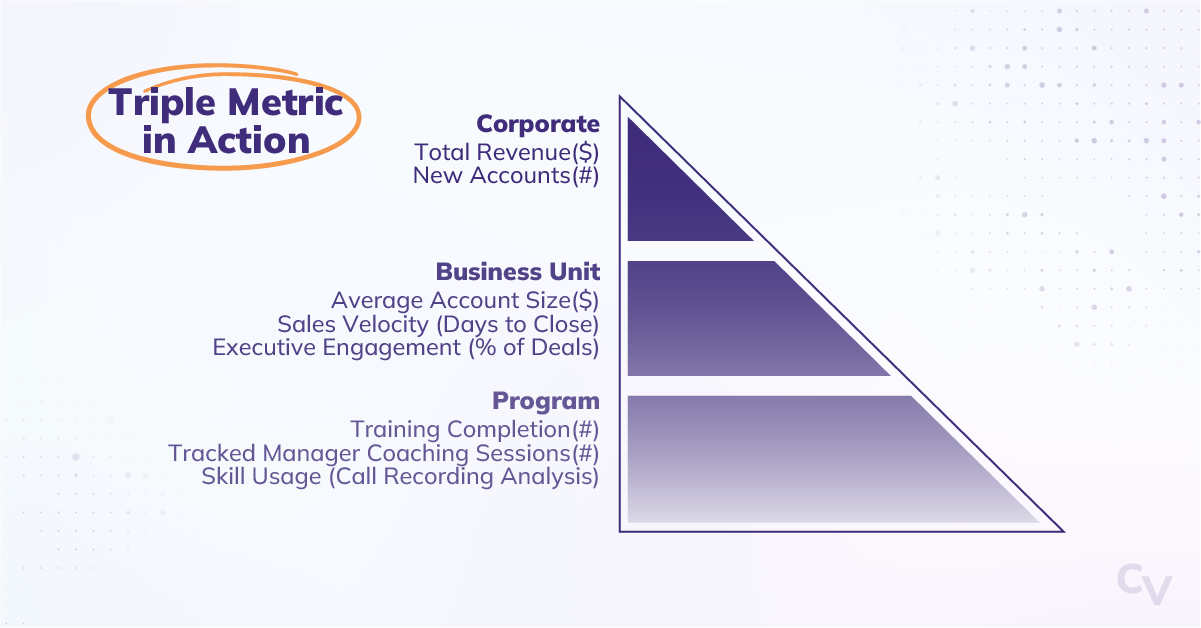
At the program level, the organization tracks leading indicators that show whether the training is being adopted and absorbed. Metrics such as evaluation scores, number of people trained, and e-learning completion rates provide early visibility into participation and comprehension. These signals help confirm that the enablement program is reaching the intended audience and landing effectively.
At the business unit level, the focus shifts to whether that training is translating into improved sales execution. Changes in close rates, average quota attainment, and cycle time indicate whether sellers are applying new skills in live opportunities. These metrics serve as leading indicators of performance improvement and show whether behavior change is impacting how deals progress.
At the corporate level, the impact is measured through top-line business outcomes. Improvements in revenue growth, margin, and cash flow demonstrate whether enhanced sales execution is driving meaningful financial results. These are the ultimate measures of success, reflecting the organization’s ability to convert training efforts into sustained commercial performance.
Why It Works
Instead of over-engineered analytics, with the Triple Metric you use repeatable pre- and post-training comparisons on a small set of agreed metrics, creating a clear evidence trail from program-level behavior change to leading commercial signals, and, ultimately, corporate outcomes. It’s a clean way to communicate the ROI of sales training in terms that survive CFO scrutiny.
Ready to quantify the ROI of your sales training program with your own Triple Metric? Get your planner.
Measure, Scale, and Refresh
Once you pick your metrics, be sure to put tracking mechanisms in place and a measurement timeline.
Partner with finance, revops, and frontline leaders to agree on owners, sources, and timing for every metric. When you explain the “why,” they’ll prioritize the work. Lock in pull dates and clear accountability so the numbers show up on time.
Then, with your metrics picked and collection plan in place, you can now start measuring the impact of your training.
Top-level metrics move last. The quicker you can adjust to program or commercial metrics, the better your team can realize their targets. That speed of adjustment is part of measuring the ROI of sales training with less wasted time, faster improvements, and a clearer payoff.
Presenting the ROI of Sales Training to Executives
Program success and the decisions that follow often depend on executive support. How the results are presented matters as much as the metrics themselves. Different stakeholders prioritize different outcomes, so the story should reflect what matters most to each audience.
Regardless of which metrics you’re tracking, tailor the message to your audience:
For the CRO: Focus on throughput and growth. Show how stage efficiency improved, where leakage decreased, and how execution consistency is increasing revenue predictability.
For the CFO: Avoid overclaiming. Use contribution language, not causation. Present conservative assumptions, time-stamped comparisons, and clearly defined baselines. Emphasize risk reduction, margin impact, and improved forecast accuracy.
For RevOps: Highlight governance. Show clean stage definitions, standardized loss reasons, consistent pull dates, and cohort comparisons that ensure integrity.
The strongest ROI narrative demonstrates what changed, what improved, and the financial value of those shifts for each key stakeholder.
Using Your Results
Measurement is not just about proving ROI. It’s about deciding what to do next.
So, what do you do with those numbers?
As you examine metrics from the program level and commercial level, keep a close eye on what is happening there.
If those signals don’t change, commercial metrics won’t either. That’s your cue to reinforce, clarify expectations, or adjust support.
Your measurement should guide three decisions:
- Scale what is clearly working.
- Reinforce where behavior is improving but results lag.
- Adjust or pivot where neither execution nor performance is moving.
Back Your Training Investment with Evidence
Companies that consistently prove training ROI build measurement into their enablement initiatives from the start.
They don’t launch a program and hope the numbers move. They decide upfront what needs to change, how they’ll measure it, and what success will look like
When you build measurement into the initiative from the beginning, you stop debating whether enablement “worked.” You can clearly articulate and prove the ROI of your sales training program by clearly showing what has changed, by how much, and what it’s worth.