These four Sales Enablement trends present a glimpse into the future of your organization.
Sales Enablement has the opportunity to evolve in a big way.
When the role first showed up in the B2B enterprise, Sales Enablement became a sidekick to the in-person, acquisition-focused selling conversation.
But selling today looks completely different than it did back then. And given the role’s unique position, Sales Enablement is primed to step up, take the lead, and drive a new approach to sales and marketing messaging, skills, and content for years to come.
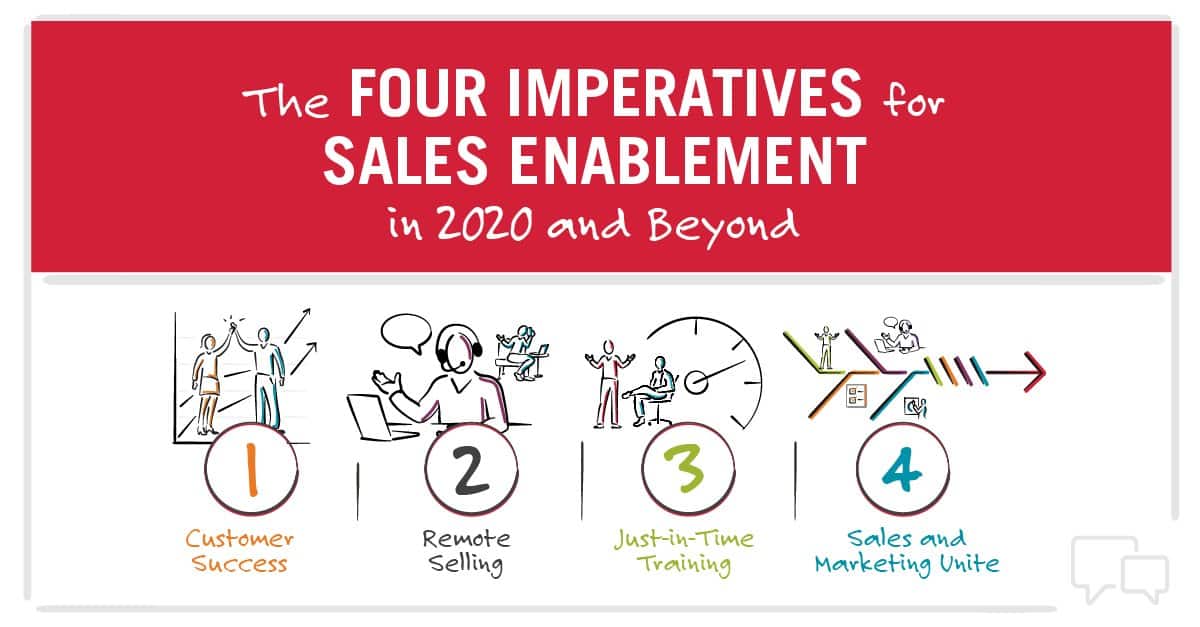
These four emerging and imperative trends will drive Sales Enablement in 2020 (and beyond).
Four Sales Enablement Trends for 2020
1. Customer Success Emerges as a Growth Engine
Analysts estimate that 70-80 percent of the average company’s annual revenue now comes from existing customers. And our research shows that if you use the same selling strategy, message, and skills to sell to an existing customer that you use when you acquire a new logo, you decrease the likelihood of retaining or expanding with that customer.
To adapt, Sales organizations need to become situationally fluent, recognizing the difference between acquisition and expansion, and Customer Success needs to get better at selling value proposition to existing customers.
2. Remote Selling Replaces Face to Face
75 percent of all sales calls are now conducted over the phone or the web, yet most Sales Enablement strategies are built for face-to-face selling scenarios. As a result, sellers are radically under-enabled for the most common selling scenario.
Remote selling is a different animal—one that requires a completely different approach to Sales Enablement. In 2020, you need to enable the remote selling conversation first. And only after you’ve done that should you enable the in-person conversation.
3. Training Adapts to the Speed of Business
Sales Enablement has generally been effective when looking at the company’s revenue budget for the coming year, building a twelve-month program against that budget, and executing that plan. Unfortunately, twelve-month plans are rarely relevant past month three.
Businesses are so dynamic and new challenges come up so quickly that traditional training models just can’t keep up. When unplanned business needs arise, you need to launch dynamic training that equips your team with the skills they need to respond immediately. To deliver training at the speed of business, organizations need to identify needs and roll out the appropriate solutions in weeks, not months.
4. Sales and Marketing Converge
The B2B buying process isn’t as linear or predictable as Sales leaders assume. In fact, it’s more convoluted than ever, handoffs are less defined, and buyers are struggling to make sense of their options. The companies that win will be the ones in which Sales and Marketing work together to help people make buying decisions. Sales Enablement is the natural bridge between these two sides.
One way to make your customer’s buying decision easier is to provide tools that help them take the next step in their buying journey. These tools should be simple, relevant, and credible. They should be built to enable consensus, since most buying groups are now made up of six to 10 people. And the best way to build those tools is to understand how customers make decisions.
Sales Enablement Can Take the Lead
As a Sales Enablement leader, you can choose to seize these trends and lead the charge toward the new reality of selling. Or, you can hold back, waiting to be told to address these issues to catch up with your competition.
Whatever choice you make, these trends presents a glimpse into your future.