Solutions and such do some things and some other things here Maecenas sed diam eget risus varius blandit sit amet non magna. Aenean lacinia bibendum nulla.
You’re measured on different outcomes—but your success depends on the same buyer decisions. This is where you find the programs and proof built for your goals.
Choose your role to see what that looks like in practice.
When teams rely on opinions, content gets noisy and inconsistent. Our resources are grounded in buyer evidence—so you can sharpen decisions, messaging, and execution.
Find insights, articles, webinars, and more evidence-backed resources to grow revenue.
Most sales organizations follow some kind of sales process. But despite their best efforts, 83 percent of sales leaders say their sellers struggle to adapt to changing buyer needs and expectations, according to Gartner.
The problem isn’t a lack of process—it’s that traditional sales processes were built for a world that no longer exists.
Here’s what leading enablement teams already know: The path to better results isn’t paved with more rigid processes. In fact, you might already have seen one of the four common ways sales process fail today.
The Four Horsemen of Sales Process Failure
Most sales organizations take what seems like a logical approach: They start with a process that worked before, tailor it based on top performer insights, train their leaders to coach to it, and expect results to follow.
But this well-intentioned approach comes with serious consequences. Here are four destructive scenarios that plague sales organizations today:
1. The Compliance Trap
Your sellers diligently check all the right boxes and update all the right fields. Your CRM looks pristine. But revenue targets slip further away. Meanwhile, your leaders waste precious coaching time forcing compliance with processes that don’t reflect reality.
2. The Mutiny
“Stop making us waste time on stuff that doesn’t close business!” This cry of rebellion echoes through sales organizations when processes feel like they’re being done to sellers, not for them. Calendars flood with panicked check-ins. Every one-on-one becomes a forecasting call rather than a coaching opportunity. Trust erodes as the gap widens between leadership expectations and seller reality.
3. The Ghost Process
You might have the perfect sales process on paper. But if sellers don’t know what actions to take and leaders don’t reinforce them, you have a brilliant process that no one follows. Instead, each seller creates their own path forward, leaving your buyers to navigate a maze of inconsistent experiences and mixed messages.
4. The Leadership Vacuum
When leaders don’t provide the communication, coaching, and reinforcement to support the process, even the best-designed system fails. A lack of leadership directly contributes to lost deals, inaccurate forecasts, and missed opportunities from high-potential accounts. In this vacuum, sellers feel abandoned, leaders feel overwhelmed, and everyone questions whether they have what it takes to succeed.
What’s the root cause of these four process failures?
While conventional wisdom points fingers at sellers or systems, forward-thinking organizations have uncovered a deeper truth: There’s a fundamental misalignment between how your buyers actually buy vs. how your sales process assumes they should buy.
A Buyer Evidence Gap
Most sales processes make four misguided assumptions about how B2B purchasing works:
Prospects march predictably through your sales process stages
Decision makers show up right on schedule at predetermined touchpoints
Purchase decisions unfold in a neat, linear fashion
Signed contracts magically transform into satisfied customers
That last assumption might be the most dangerous.
Traditional sales processes often end abruptly at “closed won,” leaving a wide gap between sales and customer experience. There’s rarely a clear plan for ensuring smooth implementation, establishing success metrics, or building the foundation for long-term growth.
But the problems start long before that handoff. Modern buyers pop up at different points in their journey, often armed with research and their own strong opinions. They engage later, bring more stakeholders, and follow anything but a linear path to purchase.
Consider a concrete example from early in the sales process: the discovery stage.
A typical process reduces discovery to a single checkbox or stage gate (“Has discovery been completed?”). The assumption is that buyers have already defined their problem and just need to be qualified.
The reality? Our recent study shows that in 54.5 percent of deals, sellers and buyers fundamentally misalign on the core problem to be solved. While prospects are indeed doing their homework, they’re often lost in a sea of information, struggling to identify the core problem they need to address. Sellers need to provide insight and clarity, not just qualification.
When your process ignores how buyers now behave in their journey, the cracks start showing up everywhere. Symptoms start to show in:
Forecast reliability – When your process stages don’t match how deals actually progress, pipeline data becomes unreliable. Leaders can’t trust the information they get, and every forecast review turns into a lengthy deal inspection.
Deal velocity – Without clear evidence of buyer progress, deals stall in stages while sellers complete activities that don’t match buyer readiness—lengthening sales cycles and frustrating buyers.
Revenue impact – Most importantly, this misalignment hits the bottom line. When sellers and buyers both feel confident about the problem they’re trying to solve, win rates improve by 38 percent. Yet most processes provide no way to measure or ensure this alignment.
So, what does a truly buyer-aligned sales process look like in practice?
Three Components of a Buyer-Aligned Sales Process
No need to keep tweaking process flowcharts and diagrams. It’s time to build a system that maps to the way your buyers make decisions.
Building a buyer-aligned sales process means creating a system that captures and responds to actual buyer behavior.
Here are three essential components:
1. Clear Exit Gates Based on Buyer Actions
Instead of relying on seller activities alone, define stage progression by specific buyer behaviors and commitments. For example:
Discovery isn’t complete until your seller and buyer are both confident in a clearly-defined problem statement
Solution development doesn’t advance until key stakeholders agree on the goals they want to achieve
Proposals don’t move forward without clear evidence of executive sponsorship
2. Just-in-Time Resources for Every Moment
Provide sellers with stage-specific playbooks that outline exactly what good looks like:
Conversation guides that help sellers ask incisive questions and surface real buyer needs
Qualification frameworks that go beyond basic BANT criteria to uncover true decision dynamics
Implementation and value-management tools that keep buyers engaged post-purchase
3. Built-in Coaching Opportunities
Give leaders concrete coaching cues tied to observable seller behaviors:
Clear indicators of pipeline health beyond just stage percentages
Specific questions to ask in deal reviews that surface buyer engagement
Weekly and monthly coaching cadences that focus on skill development, not just inspection
When you include these three components, you can build a sales process that sellers want to use because it helps them win deals. One that leaders coach to because they know what to look for. And a process that buyers respond to because it matches how they want to buy.
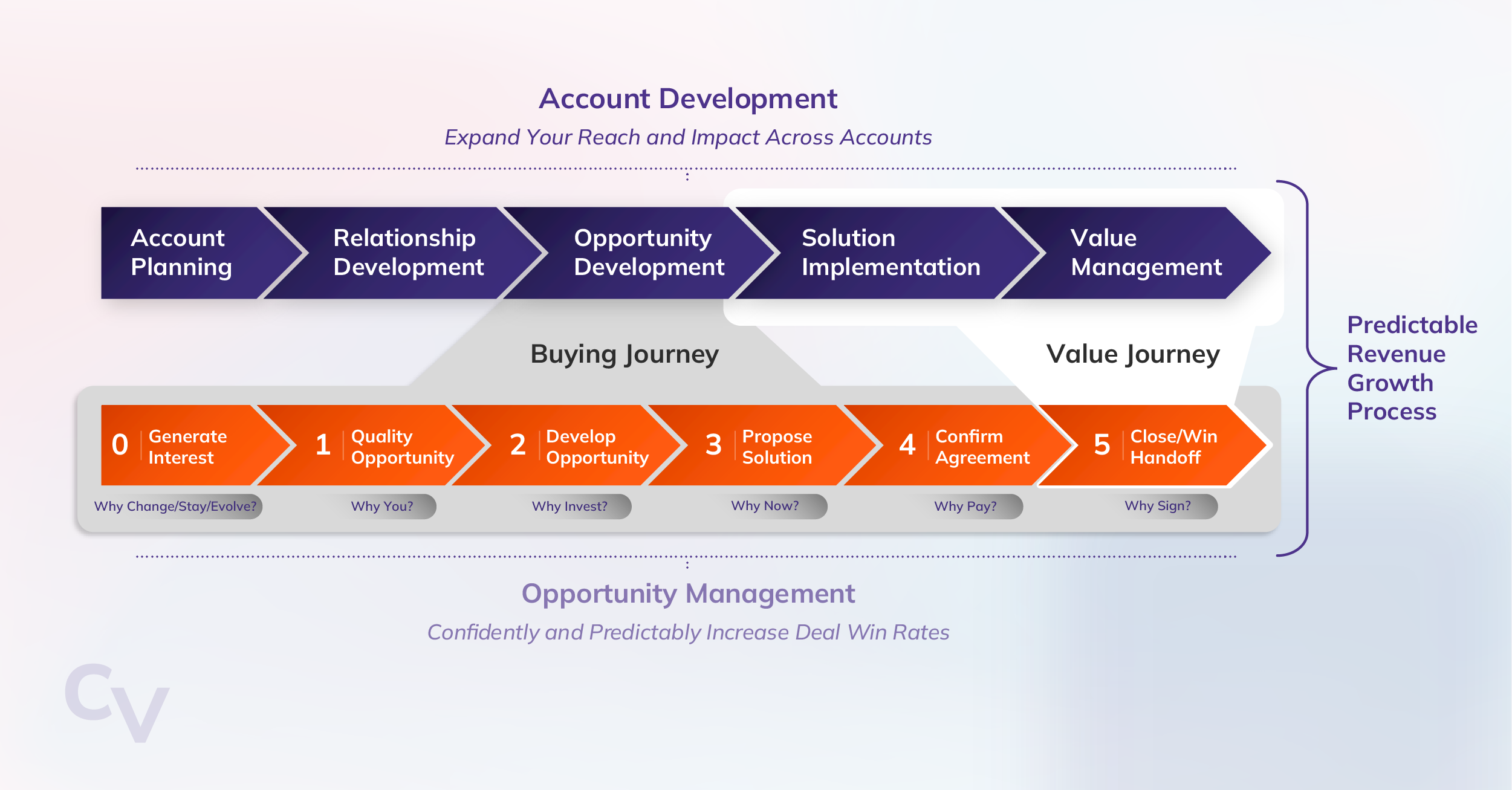
A buyer-aligned sales process matches your process stages with the buyer’s journey.
Making It Stick: The Leadership Component
Even the best-designed sales process will fail without effective leadership reinforcement. But most sales leaders simply don’t have the time—they’re trapped in a cycle of pipeline inspection and deal reviews, leaving little time for actual coaching.
The solution? A leadership system built around three key responsibilities:
1. Pipeline and Forecast Management
Establish a framework for evaluating deal health that goes deeper than the CRM. This includes:
Clear indicators of buyer engagement at each stage of the process
Coaching questions that surface real deal progress
Early warning systems for stalled opportunities
2. Coaching to Sales Execution
Transform managers from “super-reps” who save deals into coaches who develop seller capability:
Define observable behaviors to evaluate at each stage
Establish regular skill-building sessions with clear outcomes
Prioritize buyer alignment over activity metrics
3. Team Development
Create a culture of continuous improvement, including:
Weekly team meetings focused on skill building, not just deal updates
Monthly coaching sessions that develop long-term capabilities
Quarterly reviews that align process execution with business outcomes
When you build a buyer-aligned sales process—and equip managers to coach to it effectively—you create a self-sustaining engine of revenue growth. Sellers win more deals, leaders spend time developing talent instead of inspecting activity, and the entire organization rallies around what matters most—your buyers’ success.
Time to Reimagine Your Sales Process
The modern B2B buying journey unfolds through independent research, sporadic engagement, and evaluation patterns that your pristine process flowcharts can’t anticipate.
The most successful sales organizations have already figured this out. They know that better results don’t come from more rigid systems or prettier CRM workflows—they come from understanding and adapting to how buyers actually make decisions.
When you stop obsessing over process compliance and start focusing on buyer behavior, your forecast becomes more reliable and pipeline health strengthens. Your leaders spend less time in painful review meetings and more time on meaningful coaching. And instead of burning out your best people with administrative busywork, you get the predictable revenue your sales process was supposed to deliver in the first place.
Anton Rius, Sr. Director of Content Marketing, leads all content marketing strategy and production at Corporate Visions. Anton’s extensive experience supporting B2B revenue growth with insightful content has been featured in publications like SalesPOP! and Relevance. Anton writes regularly at Long Tail Thinking.