Solutions and such do some things and some other things here Maecenas sed diam eget risus varius blandit sit amet non magna. Aenean lacinia bibendum nulla.
You’re measured on different outcomes—but your success depends on the same buyer decisions. This is where you find the programs and proof built for your goals.
Choose your role to see what that looks like in practice.
When teams rely on opinions, content gets noisy and inconsistent. Our resources are grounded in buyer evidence—so you can sharpen decisions, messaging, and execution.
Find insights, articles, webinars, and more evidence-backed resources to grow revenue.
Buyer feedback from more than 150,000 B2B decisions shows this:
53 percent of your losses were winnable if key moments in the sales experience were handled better. And sellers and buyers aren’t aligned on why deals go sideways. They cite different reasons 50–70 percent of the time.
Sellers often blame price or product. But buyers point to deeper issues, such as weak discovery, fuzzy differentiation, and unclear value.
So how do you stop losing winnable deals?
In acquisition conversations, you need to make your prospect’s status quo feel risky, and the path forward with you feel urgent and safe. Based on buyer feedback data and scientific analysis, we identified eight sales competencies that reliably create that momentum in new business pursuits—the Great 8 for Acquisition.
When you measure and coach your sellers on the sales competencies that make up the Great 8 for acquisition, you take the guesswork out of what’s going wrong, target training precisely, and turn more deals into wins.
The Great 8: Eight Sales Competencies to Win New Logos
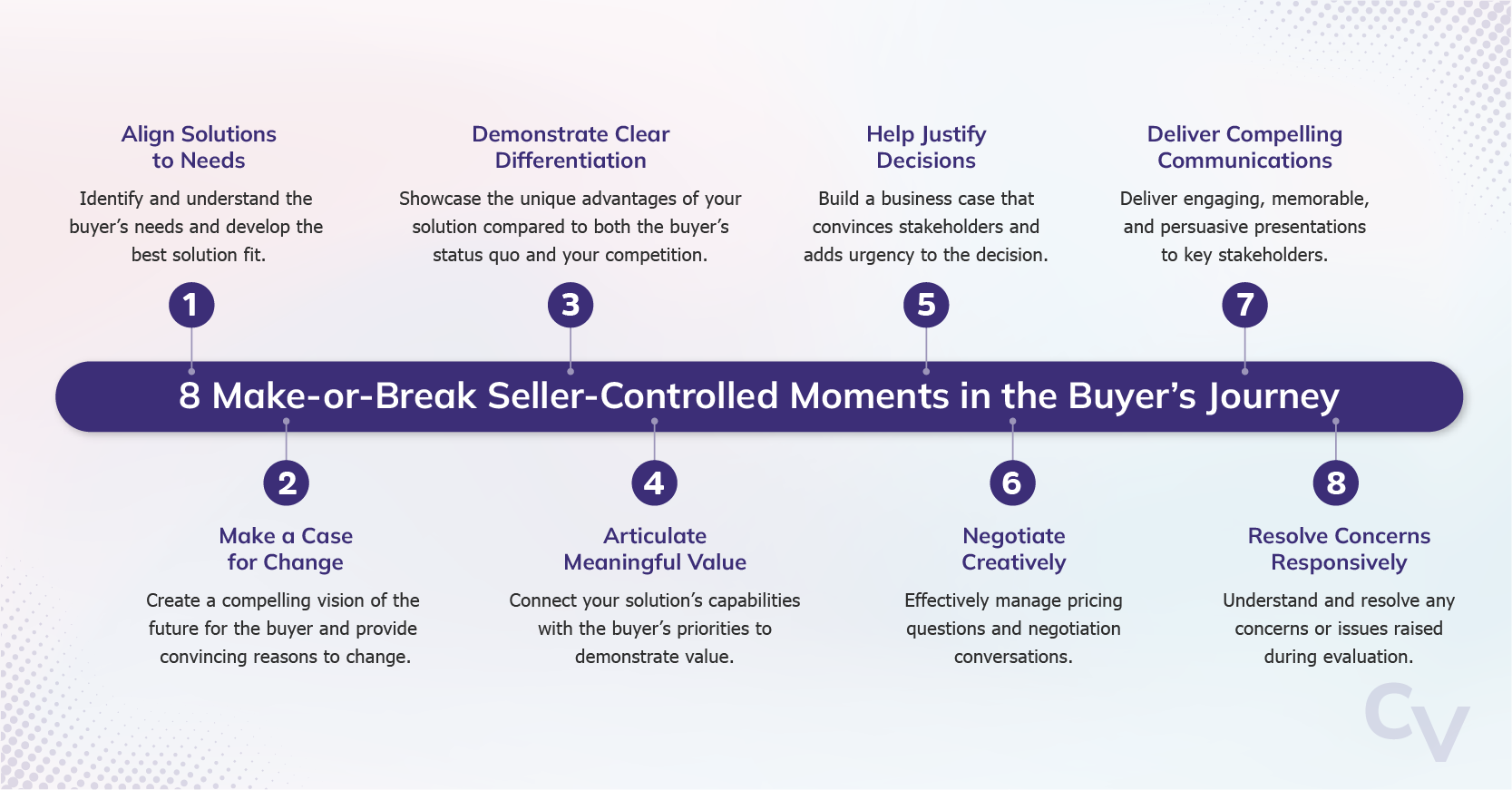
These eight pivotal selling competencies align to the make-or-break moments that determine whether a deal is won or lost.
The Great 8 Sales Competencies for Customer Acquisition
Together, these sales competencies define how top-performing sellers create momentum in the buying process. Each one represents a critical point in the buyer’s journey.
Align Solutions to Needs
Identify and understand the buyer’s needs and develop the best solution fit.
Great sellers don’t take the buyer’s first answer at face value. They dig in, help refine the problem, and surface what’s actually holding a buyer back.
When you frame discovery around the buyer’s world, not your product, you create clarity, confidence, and a solution that feels unmistakably right. Learn More.
Make a Case for Change
Create a compelling vision of the future for the buyer and provide convincing reasons to change.
When you’re trying to win a new prospect, your toughest rival isn’t another vendor—it’s the buyer’s status quo. You’re asking them to leave what feels familiar, and inertia wins far more often than it should. Nearly 40 percent of opportunities stall out with no decision at all.
Your job is to spotlight the hidden costs and Unconsidered Needs they haven’t recognized yet. Once the status quo starts to look unsafe, the conversation shifts. You create the urgency that turns hesitation into forward motion. Learn More.
Demonstrate Clear Differentiation
Showcase the unique advantages of your solution compared to both the buyer’s status quo and your competition.
In crowded markets, feature lists blur together. Sellers win when they elevate their meaningful differences and tie them directly to the buyer’s biggest priorities.
When you speak to what’s uniquely valuable to your solution, you give buyers a decisive reason to choose you. Learn More.
Articulate Meaningful Value
Connect your solution’s capabilities with your buyer’s priorities to demonstrate value.
Senior leaders make decisions through the lens of strategy and impact. They want to see how your solution fits into the forces shaping their world and the outcomes they’re accountable for.
When you connect your capabilities to the pressures they’re navigating, like market shifts, growth targets, and efficiency challenges, you position your story at their level. That’s what helps them view you as someone who understands their business, not someone reciting product features. Learn More.
Help Justify Decisions
Build a business case that convinces stakeholders and adds urgency to the decision.
Even excited buyers must navigate internal scrutiny. They need a case that proves ROI while also addressing the emotional drivers behind business decisions, like risk, confidence, and credibility.
When you package data, strategic impact, and a compelling narrative, you make the internal “sell” as clear and comfortable as the external one. Learn More.
Negotiate Creatively
Effectively manage pricing questions and negotiation conversations.
Every negotiation comes with pressure, and most sellers try to avoid it. But tension is where buyers reveal what truly matters, and that’s where your best opportunities emerge.
When you stay steady and explore what your buyer is trying to accomplish, you can propose options that feel fair, protect value, and strengthen the relationship. Learn More.
Deliver Compelling Communications
Deliver engaging, memorable, and persuasive presentations to key stakeholders.
Your message only matters if it’s remembered. Research shows that buyers forget 90 percent of what they hear within 48 hours, and the little they do recall is random.
That means you need to define your core point and highlight it in your presentation. When you guide attention to this key information, your message becomes the one buyers can’t stop repeating internally. Learn More.
Resolve Concerns Responsively
Understand and resolve any concerns or issues raised during evaluation.
The most effective sellers acknowledge concerns, explore the root issue, and offer a new lens that changes how the buyer interprets the problem.
When you respond with empathy and clarity, objections become confidence-building moments—not deal-stoppers. Learn More.
When your sellers master these competencies, they can consistently meet a buyer’s wants and needs in every sales conversation.
Monitoring the Great 8
Buyer expectations don’t stand still. As markets shift and new competitors emerge, your sellers’ skills must evolve.
That’s why you need to continuously evaluate buyer feedback to identify which skills to prioritize next in your coaching.
Improving seller performance starts with objective buyer feedback, not just CRM notes. Sellers who receive structured buyer feedback have 40 percent higher win rates than those who don’t.
By tracking performance across the Great 8 competencies, you can pinpoint skill gaps, coach with precision, and focus on the moments that truly influence outcomes. Over time, this buyer-informed approach builds an adaptive, agile sales organization that evolves with buyer expectations.
Mastering the Great 8 for Acquisition
Sales are decided in moments. When your sellers build these eight competencies, they handle those moments with precision, aligning to real buyer needs and communicating value that sticks.
AI and automation may grab headlines for helping your sellers improve, but the evidence shows human skills matter most to buyers. With buyers facing more choices, less time, and higher expectations, the sellers who consistently demonstrate the Great 8 are the ones buyers remember and choose.
Tim Riesterer, Chief Strategy Officer at Corporate Visions, is the sought after expert on evidence-based revenue growth using counterintuitive approaches. Known for his candid thought leadership and engaging keynotes, he’s spent decades testing and refining go-to-market strategies that put buyers squarely at the center. Tim is the author of four insightful books, including Customer Message Management, Conversations that Win the Complex Sale, The Three Value Conversations, and The Expansion Sale.