Solutions and such do some things and some other things here Maecenas sed diam eget risus varius blandit sit amet non magna. Aenean lacinia bibendum nulla.
You’re measured on different outcomes—but your success depends on the same buyer decisions. This is where you find the programs and proof built for your goals.
Choose your role to see what that looks like in practice.
When teams rely on opinions, content gets noisy and inconsistent. Our resources are grounded in buyer evidence—so you can sharpen decisions, messaging, and execution.
Find insights, articles, webinars, and more evidence-backed resources to grow revenue.
Fifty-three percent of buyers say that a losing vendor could have won the deal if not for a fixable misstep during the sales process.
In other words, over half of the deals your sellers mark as “lost” were actually within grasp.
We analyzed over 100,000 B2B purchase decisions across 500 companies in 50 industries. It turns out, sellers and buyers provide drastically different reasons for why deals fall through 50-70 percent of the time.
Even more surprising? In 10 percent of “lost” deals, the buyer was still actively considering their options!
Now, picture your sales managers scrutinizing CRM data, believing they have the complete picture. The truth is, they don’t. Even advanced conversation intelligence tools—used to record and review sales calls—don’t reveal the real reasons your buyers aren’t choosing your solution.
Sales leaders are doing everything they can to coach their teams and win more deals. But for all the data they have at your disposal, they often only get sellers’ side of the story.
What if there was a way to know what buyers are thinking, outside of your CRM or recorded sales calls?
That’s the power of win-loss analysis. It won’t give you telepathy, but it’s the next best thing.
What is Win-Loss Analysis? (And Why It Matters)
Win-loss analysis is the practice of systematically examining your closed deals—wins, losses, and no decisions—to understand why buyers chose you (or didn’t).
And it goes far beyond what you might see in your CRM or call recording tools.
When you conduct win-loss analysis, you get direct feedback from buyers about why you win or lose deals.
Think of it this way: If your sales process is a movie, traditional feedback methods like CRM data or call recordings would be like watching the film. You’d see what happened, but you wouldn’t know what the audience was thinking.
Win-loss analysis is like interviewing each audience member after the show. You not only learn what happened, but why it resonated (or didn’t) with every viewer.
By going straight to the source (your buyers), you get insights about deals that even your most perceptive sales reps might miss.
With win-loss analysis, you can:
Uncover hidden decision factors that your team might not be aware of
Understand your buyer’s perspective on your sellers’ strengths and weaknesses
Gain insights into your competitors that you can’t get anywhere else
Close the gap between how your team thinks they’re performing and how buyers perceive them
To be clear, win-loss analysis is not meant to blame sellers or dwell on past failures. It’s meant to turn every deal—no matter the outcome—into a learning opportunity. It’s your go-to-market team’s secret weapon for continuously refining your marketing messages, sharpening your sales approach, fine-tuning product offerings, and ultimately, winning more business.
By gathering direct feedback from buyers, you get a level of insight that’s simply not available through any other method. It’s like your backstage pass into your buyer’s mind—and their decision-making process.
The Purpose of Win-Loss Analysis: More Than Just Keeping Score
You might think win-loss analysis is only meant to boost your win rate. And sure, that’s part of it. But limiting win-loss to win rates is like saying the purpose of a Swiss Army knife is just to cut things. There’s so much more you can do.
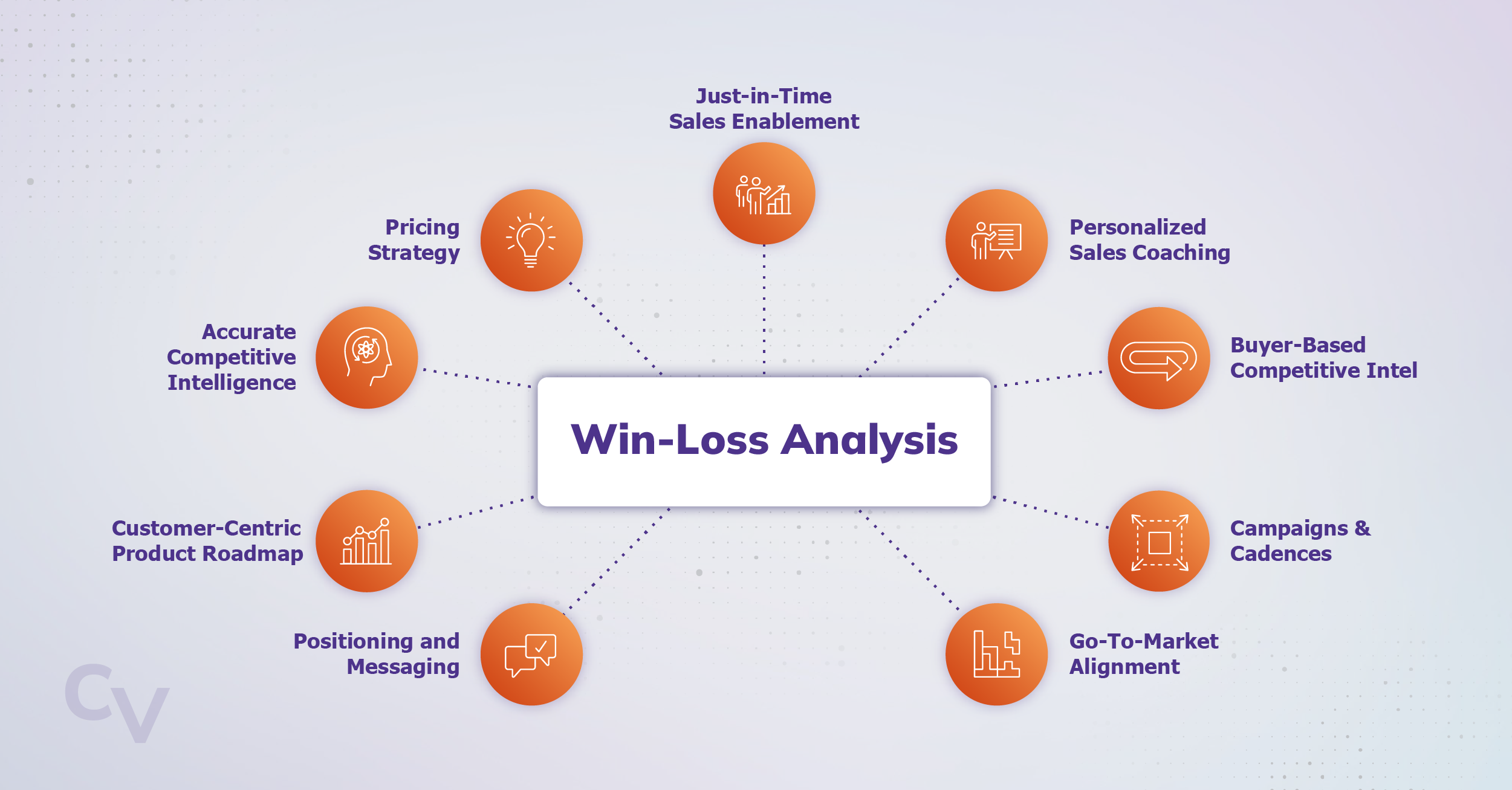
You can use insights from win-loss analysis to inform your entire go-to-market strategy.
When you build an effective win-loss analysis program, your organization can get a range of benefits that impact your entire revenue strategy—even product development. For example:
Decode Your Buyers’ Decisions
With the feedback you get from win-loss analysis, you can understand what really drives your buyers’ decisions. Not what you think drives them. Not what your sales team guesses. But what buyers themselves say matters most.
That unbiased insight is gold. You can use it to speak your buyers’ language, address their real concerns, and position your solution in a way that truly resonates.
Refine Your Sales Playbook
Win-loss analysis is like having your buyer review every play of the game with you. It highlights which sales tactics are scoring touchdowns and which are fumbling the ball.
Maybe your discovery calls are solid, but your demos put prospects to sleep. Or perhaps your negotiations aren’t meeting buyers where they need. With win-loss analysis, you get the intel to double down on what works and fix what doesn’t.
Make Coaching Count
Research shows that sellers are most motivated to change their approach after getting feedback from their buyers vs. their managers or peers.
Win-loss analysis provides that crucial context. No more generic “always be closing” pep talks. Instead, you can focus on specific skills that your buyers say need work, making your coaching sessions more targeted, more relevant, and more likely to stick
Shape Product Development
Win-loss analysis isn’t just for the sales team—it’s a treasure trove for your product team too.
When you lose deals, you learn which features or capabilities your product is missing compared to the competition. When you win, you discover which aspects of your solution are knocking it out of the park. This feedback loop ensures your product roadmap matches what the market actually wants, not just what you think it wants.
Keep Tabs on Your Competition
In the words of Sun Tzu, “Know thy enemy and know yourself; in a hundred battles, you will never be defeated.” With win-loss analysis, you get the inside story on how you stack up against competitors. You’ll learn their strengths, their weaknesses, and how buyers perceive them compared to you.
This competitive intelligence is crucial for positioning your offering effectively and staying one step ahead in the market.
Key Benefits of Win-Loss Analysis
At this point, you might be thinking, “This sounds great, but is win-loss worth the effort?” Here are some concrete benefits of win-loss analysis that might make you reconsider:
Improve Sales Performance
Remember that stat about 53 percent of lost deals being winnable? When you get buyer feedback, you can identify and fix the issues causing those losses. We’ve seen companies improve their win rates by 40 percent or more after implementing a robust win-loss program. That’s not small potatoes.
Align Sales, Marketing, and Product Teams
Ever feel like your sales, marketing, and product teams are speaking different languages? Objective buyer feedback provides a common ground. When every team works from the same playbook based on buyer insights, magic happens. Product teams build features that truly matter, marketing teams nail the messaging, and sales teams can sell more effectively.
Enhance Competitive Intelligence
Win-loss analysis provides crucial insights into market trends and competitive dynamics. With that foresight, you can anticipate changes in your industry, identify emerging competitors before they become serious threats, and spot market gaps before your competitors get the chance.
Increase Customer-Centricity
At its core, win-loss analysis is about deeply understanding your customers. With this insight you can do so much more than increase win rates. When you’re truly customer-centric, you build better products, create more compelling content, and deliver more value to your customers.
Deliver Measurable ROI
The beauty of win-loss analysis is its clear, measurable impact on the bottom line. When you can directly tie new initiatives or specific changes to increased win rates and larger deal sizes, justifying the investment in win-loss becomes a no-brainer.
With so much data available, you can’t rely on gut feelings and anecdotal evidence to understand your wins and losses. Your buyers will tell you what it takes to win their business—if you listen.
How Win-Loss Analysis Works
Win-loss analysis isn’t rocket science, but running a best-in-class win-loss program does require a systematic approach. Below are the four main components of a robust win-loss analysis program:
1. Feedback
The first step is gathering data, and not just any data—you want the good stuff. This means reaching out to buyers (yes, even the ones who ghosted you) to get their honest take on the sales experience.
You can gather feedback in several ways:
Buyer Surveys: Surveys sent to buyers immediately after a deal closes (win or lose). These are like exit interviews, but less awkward and more informative. Bonus points if you can automate these.
In-Depth Interviews: For high-stakes deals or when you need more context, nothing beats a conversation. These interviews can uncover nuances that surveys might miss. There’s a lot of value in using a third-party for these, especially if the buyer didn’t pick you.
Internal Feedback: Don’t forget your sales team. Their perspective is valuable, even if it doesn’t always match the buyer’s view. When you understand both your sellers’ and buyers’ sides of the story, you gain a more complete picture.
CRM Data: This provides the factual backbone – deal size, sales cycle length, stakeholders involved, etc.
2. Analysis
After you gather all the juicy data, it’s time to make sense of it. Modern win-loss analysis platforms use advanced analytics to spot trends and correlations. They’re looking for answers to questions like:
What are the most common reasons we win or lose deals?
How do our win rates vary by product, market segment, or sales rep?
Which competitors are we losing to most often, and why?
What skills or behaviors separate our top-performing reps from the rest?
3. Reporting
The goal here isn’t to create pretty charts (although those are nice). It’s about generating actionable next steps from the data. Good win-loss analysis reports should:
Highlight key insights clearly and concisely
Provide context and comparisons (e.g., how results compare to industry benchmarks)
Get the right information to the right stakeholders
Offer specific recommendations for improvement
4. Continuous Improvement: Rinse and Repeat
Win-loss analysis isn’t a one-and-done deal. The most successful companies make it a regular part of their operations, continuously gathering feedback and refining their approach based on new insights as they emerge.
Common Challenges in Win-Loss Analysis
Like any powerful tool, win-loss analysis comes with its own set of hurdles. But don’t worry—forewarned is forearmed. Below are some of the most common challenges, so you can tackle them head-on:
The “We Already Know Why We Win/Lose” Syndrome
This is perhaps the most significant obstacle to effective win-loss analysis. It’s a natural tendency to for people to believe they already understand why they win or lose deals. But remember: 50-70 percent of the time, sellers and buyers aren’t aligned on why a deal was won or lost. Overcoming this false confidence is crucial.
The fix: Start with a pilot program. When stakeholders see the gap between perception and reality, they often become your biggest advocates.
The Data Quality Conundrum
Garbage in, garbage out. If your data collection is flaky, your insights will be too. Low response rates from buyers, biased internal feedback, or incomplete CRM data can all skew your results.
The fix: Automate your feedback collection process. Use a platform that integrates with your CRM to trigger surveys immediately after deals close. And don’t forget to incentivize honest internal feedback.
The “So What?” Factor
You have mountains of data and insights. Great! But if nobody acts on them, you’re just spinning your wheels.
The fix: Focus on the actions that come from the insights. Don’t just report problems, recommend solutions and clear next steps for your team. And make sure you have a clear process for implementing changes based on your findings.
The Blame Game
Win-loss analysis can quickly turn into a finger-pointing exercise if you’re not careful. That creates defensiveness and resistance, especially among your sales team.
The fix: Frame the process as a learning opportunity, not a performance evaluation. Celebrate successes as much as you analyze failures.
Your Move
The practice of win-loss analysis is a competitive necessity for B2B revenue teams today.
Remember:
Win-loss analysis is your X-ray vision into the buyer’s decision-making process, revealing why you really win or lose deals.
It’s not only about win rates—it shapes product development, refines sales strategies, and keeps you ahead of the competition.
The process has evolved from guesswork to a data-driven science, with win-loss automation making it more accessible than ever.
While challenges exist, they’re far outweighed by the potential benefits—including significantly improved win rates and deeper understanding of your prospects and customers.
So, what’s your next move? Will you continue relying on incomplete information and assumptions about your sales performance? Or will you leverage the power of win-loss analysis to gain a clear, evidence-based understanding of your buyers, outmaneuver your competition, and drive your business forward?
Jonnie Anderson is a driven product marketer, overseeing product marketing initiatives for TruVoice and Corporate Visions. Jonnie’s career began in customer success, where she developed strategies and programs to drive better customer experiences. But her passion for
creative storytelling drove her to pursue a career in marketing. In her current role, Jonnie applies her background in customer success to develop customer-centric positioning and enablement for the Corporate Visions product suite.