Guide

How to Choose the Right Sales Training Provider

Learn how to evaluate B2B sales training providers based on seller behavior change, deal outcomes, and measurable revenue impact—not just training satisfaction scores.

Choosing a sales training provider isn’t just a learning decision. It’s a revenue decision.

The right provider can change what sellers do in the moments that shape deals. The wrong one can give you better survey scores and the same stalled opportunities.

Key Takeaway: What to Look for in a Sales Training Provider

To choose the right sales training provider, look for a partner that diagnoses your underlying commercial problem, connects training to the selling behaviors that influence deal outcomes, equips managers to reinforce those behaviors, fits into sellers’ workflows, and measures impact against revenue outcomes like win rate, deal size, and forecast accuracy.

In this guide, you’ll learn how to evaluate providers and distinguish programs built for true behavior change from those that just look good on paper.

Plan Your Search for a Sales Training Partner

When preparing to compare training providers, think bigger than what you want sellers to learn.

What Problem Does This Sales Training Need to Solve?

Before you compare providers, get clear on the problem you’re trying to solve with sales training. You do this by clarifying what needs to change, why it needs to change, and who needs to change.

Which Revenue Outcomes Should Sales Training Improve?

A sales training program should be evaluated based on the specific revenue outcomes it is expected to improve.

  • Win rate
  • Deal size
  • Pipeline creation
  • Renewal and expansion
  • Forecast accuracy
  • Margin erosion

Start with the outcomes you want to improve, then go one level deeper. What’s driving those results?

You might see deals stall because discovery isn’t strong enough. You might face margin challenges because you didn’t clearly demonstrate differentiation early in the opportunity, leaving price as the only thing left to negotiate. Or managers might not be reinforcing the right behaviors to meaningfully influence deals.

Once you can name both the problem you want to solve and the root cause, you’re in a much better position to find out how to solve it. You’re no longer looking for a provider that’s “good at delivering workshops.”

Instead, you can look for a training program that can move the specific metrics tied to your problem.

A good sales training company should work with you to confirm that you’re targeting the right problem before you select a program.

If the problem or root cause isn’t clear, consider conducting a sales skills assessment. Assessments can provide an objective view of where your sellers struggle, how performance compares across the team, and where training and coaching will have the most impact.

What Kind of Sales Training Program Do You Need?

Not every sales problem requires the same type of training intervention.

Sometimes you’re trying to fix a specific skill gap. Other times, the bigger issue is inconsistency—different messages, different approaches, different standards across roles, regions, and managers.

That distinction shapes whether you need a targeted program or a broader shift in how your team sells.

Which Roles Should Your Training Program Target?

Sales training programs are most effective when they target all the roles that influence buyer conversations and deal outcomes.

In some organizations, the biggest gains come from account executives. In others, the bottleneck sits with account teams, frontline managers, solution consultants, or a broader cross-functional revenue team.

Deals rarely break because only one role missed the memo. If account executives, managers, consultants, and customer-facing teams all touch the buyer experience, training one group in isolation can create a polished pocket of improvement surrounded by business as usual.

Go back to your core problem and identify who touches that issue. Is it just your sellers, or do account managers and other customer-facing roles need to be involved as well?

If you silo the training too narrowly at this stage, you risk weakening the impact on commercial outcomes.

When and Where Will Sales Training Occur?

Decide where you expect to see this training show up in action.

Is this a one-time skills program or a longer-term effort?

Are you introducing a new approach or reinforcing work already in place?

Will this happen only in workshops, in the flow of deals, or both?

Who Should Be Involved in Choosing a Sales Training Provider?

Choosing a sales training provider usually requires input from every stakeholder who will judge the program’s business impact, fund the investment, reinforce the training, or use the outcomes to improve performance.

That means you need to align your internal buying committee before vendor comparisons get too far along. Otherwise, you can spend weeks evaluating providers only to discover that a late-stage stakeholder has a different definition of success, a new budget concern, or a very reasonable implementation question that should have surfaced much earlier.

Start by identifying who needs to weigh in or sign off. That group might include sales leadership, enablement, frontline managers, finance, procurement, operations, and executive sponsors.

Then map each stakeholder to the decision they care about most:

  • Sales leadership: revenue outcomes, adoption, deal impact
  • Enablement: program fit, reinforcement, learner experience
  • Frontline managers: coaching tools, inspection rhythm, team accountability
  • Finance: cost, ROI, budget timing
  • Procurement: vendor requirements, contracts, risk
  • Operations: data, systems, reporting
  • Executive sponsors: strategic fit, business priority, measurable impact

This work does not need to become a committee sculpture garden. The point is to know who owns which part of the decision before the process gets expensive, political, or stuck.

When you align stakeholders early on the problem, outcomes, budget, timeline, rollout needs, and measurement plan, you give the final decision a better chance of surviving contact with reality.

How to Evaluate Sales Training Providers

Once you’ve defined your problem and selection process, you can evaluate sales training providers based on how well they connect training to the selling behaviors and business outcomes you need to influence.

Here are some important questions to consider as you evaluate sales training vendors.

Does the Training Program Fit Your Sales Motion?

A strong sales training provider can tailor its approach to your unique sales motion. They can adapt to your growth priorities, your buying centers, your revenue model, and the complexity of your deals.

Start with a simple question: does the vendor understand how you actually sell?

If the training sounds generic in the pitch, it will play generic in the field.

Strong providers don’t just teach broad, generic skills. They prepare sellers for the reality of how buying happens now.

Research from Gartner, 6sense, and others shows that buyers don’t follow a clean, linear path—and more importantly, they often engage sellers at very different points in their deciding journey. Sometimes it’s early, during problem exploration. Other times, it’s after they already have a shortlist and preferences are in place.

That means sellers aren’t guiding the buyer’s journey from the beginning. They’re stepping into a decision process that’s already underway.

Strong training providers reflect this reality. They equip sellers to adapt to every key commercial moment in a deal.

That includes moments like:

  • First meetings
  • Turning curiosity into pipeline
  • Disrupting the status quo
  • Leading executive conversations
  • Protecting price
  • Renewing and expanding accounts

Ask the provider how their training approach changes across industries, buyers, and deal types. If the answer sounds the same regardless of context, the program might be more rigid than advertised.

Is the Training Methodology Backed by Evidence?

The strongest sales training providers ground their approach in research and evidence—not just theory.

For many sales training companies, their training foundation is built on what amounts to industry “best practices.” These are concepts that sound smart, get repeated often, and slowly harden into accepted wisdom—without much evidence behind them.

When you’re evaluating a sales training company’s approach or methodology, dig into how their approach was developed.

A provider might describe a framework they created. But is it backed by any kind of research or evidence?

How Does the Training Program Reinforce Behavior Change?

Most sales training programs fail because they focus on delivery rather than sustained behavior change.

Behavior change—not training delivery—is the point of the investment. Strong providers show how sellers will not just initially learn new material, but also how they will:

  • Practice new skills
  • Apply them to live opportunities
  • Receive feedback
  • Revisit and refine over time

That model should be concrete. Look for specifics like real-world practice, teach-backs, role plays, AI simulations, and feedback tied to actual buyer interactions.

Strong providers can show how sellers rehearse in realistic situations, demonstrate the skill, and then carry it into live opportunities. They should be able to easily answer what happens in the first 30, 60, and 90 days after training takes place.

Will Sales Managers Have Tools to Reinforce New Behaviors?

If managers don’t change, sellers won’t either.

One of the clearest red flags: managers attend the same session as reps and leave with a PDF.

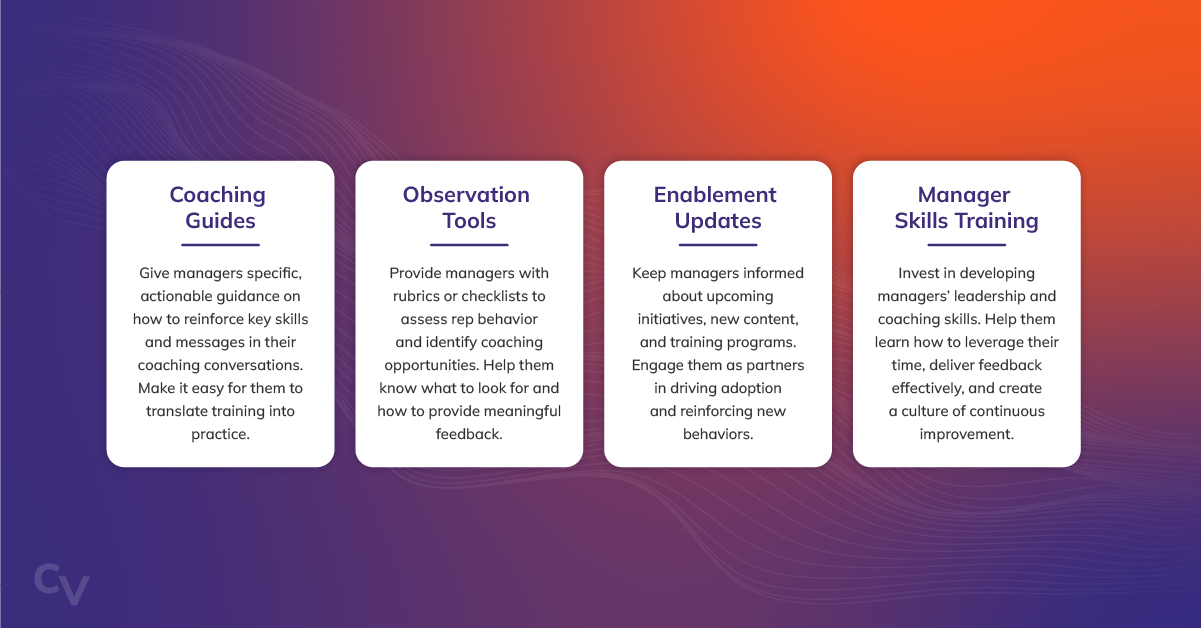
Strong providers treat managers as force multipliers. They give them tools and a clear operating rhythm:

  • Coaching Guides
  • Observation Tools
  • Enablement Updates
  • Manager Skills Training

Clear operating rhythm graphic that includes: Coaching frameworks, call review guides, pipeline and forecast questions scorecards and inspection tools

The goal isn’t to turn managers into trainers. It’s to make coaching on the material part of how the business runs.

You should see a clear cadence over time—team meetings, 1:1s, pipeline reviews, deal coaching. If that’s missing, the behavior change won’t last.

Does the Training Program Support Learning in the Flow of Work?

Sales training programs are more effective when sellers can practice, apply, and reinforce new skills inside the way they already work—not as a separate event they have to remember later.

The strongest sales training providers connect their approach to your CRM, conversation intelligence platform, and enablement tools. That way, learning shows up close to the moment sellers need it: before a call, during deal planning, in manager coaching, or after a customer conversation.

Ask practical questions:

  • How does the program connect to Salesforce or your CRM?
  • How do you use Gong or similar tools to observe and measure seller behavior?
  • How will content, coaching prompts, or reinforcement show up in the systems sellers already use?
  • What support do you provide for lean enablement teams that don’t have time to build every asset from scratch?

That last question is important. The right training partner should bring usable assets—content, reinforcement tools, manager guides, templates, and program support—that reduce the burden on your internal team.

Just-in-time reinforcement is especially important because sellers need guidance close to the moment of application. Gartner reports that organizations using just-in-time learning are 2.5 times more likely to exceed seller revenue targets and 3.5 times more likely to exceed customer retention targets than organizations that don’t.

AI should meet the same standard. The question isn’t whether a training company has AI. It’s whether AI makes practice more realistic, feedback more specific, and coaching easier to scale inside the seller’s actual workflow.

Look for AI-powered coaching, realistic simulated practice calls, automated scoring against defined competencies, and guidance that helps sellers apply the right behavior in the right selling moment.

Another disconnected system with a shiny dashboard is still just another disconnected system.

How Will the Provider Measure ROI from the Training?

Sales training ROI should be measured based on changes in seller behavior and business outcomes—not just participation, satisfaction, or test scores.

Smile sheets and test scores can tell you whether people liked the workshop or understood the material. But they won’t tell you whether sellers changed and improved in the conversations that shape pipeline, margin, renewals, or win rates.

You should be able to measure training ROI from the program to strategic goals the business cares about. A credible provider should show how learning leads to behavior change, how behavior change improves commercial performance, and how those improvements support broader business outcomes.

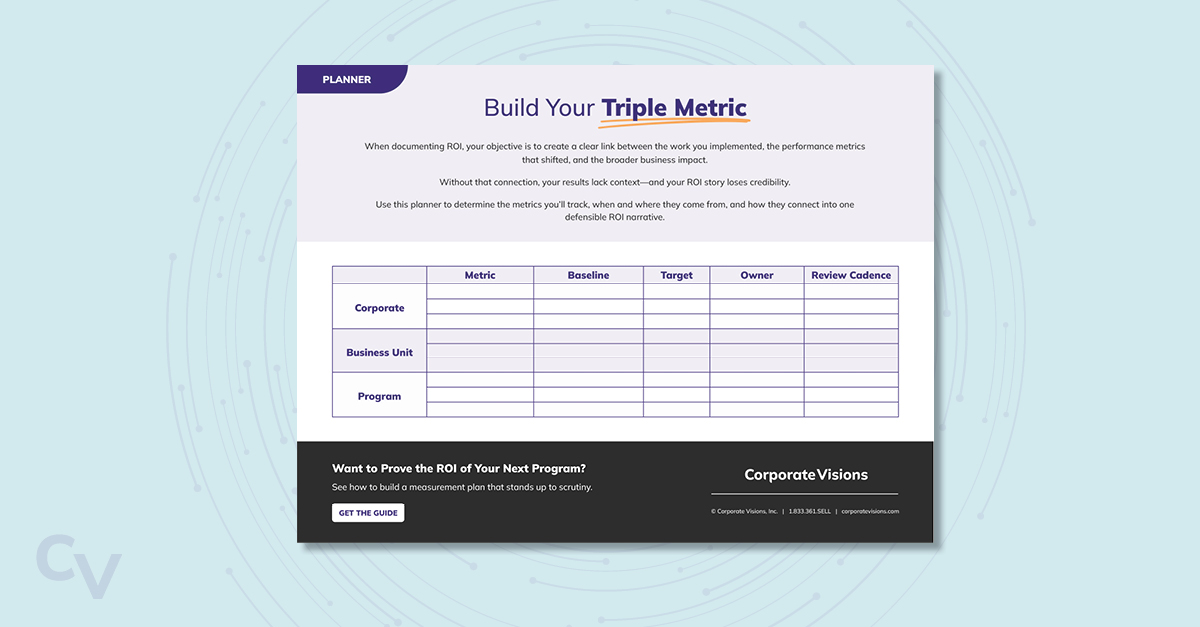
Strong providers should also help set up the tracking itself. They should be able to identify data sources, recommend pull dates and owners, and incorporate feedback mechanisms like buyer feedback and win-loss analysis to see whether conversations in the field are actually changing.

Those inputs are often what make the difference between a training report and a credible ROI story.

Can the Provider Prove Results in Similar Sales Environments?

The strongest sales training providers can show clear evidence that their programs changed seller behavior and improved business outcomes. And not all proof carries the same weight.

Ask for case studies that connect a clear problem to a specific intervention and measurable results. Look for before-and-after outcomes tied to real commercial initiatives, like acquisition, expansion, renewals, or margin protection.

Awards and analyst mentions can help narrow the field, but they’re supporting signals—not proof. The stronger proof is evidence that their work changed seller behavior and business outcomes in situations that look like yours.

And here too, the strongest providers go beyond showing proof of satisfaction scores and test results.

They can demonstrate how training translated into changed seller behavior, and they often use buyer feedback or win-loss analysis to prove the impact in the field.

Final Considerations for Choosing a Sales Training Provider

The best sales training providers can show how their approach changes what sellers do in real buyer conversations—and how those changes connect to measurable business outcomes.

Before you choose a provider, ask two final questions:

  • Will this change what sellers do and say in the moments that shape deals?
  • Will that change make it easier for buyers to decide?

Look for proof in specific selling moments: discovery, executive conversations, negotiations, renewals, and expansion. Then look for measurable outcomes tied to those moments, such as stronger pipeline, higher win rates, faster close times, better margins, or improved renewal performance.

A strong provider should be able to draw a clear line from the problem you need to solve, to the behaviors sellers need to change, to the business results you expect to measure.

If they can’t, keep looking. A better workshop won’t fix a selling motion that never changes in the field.


How to Choose the Right Sales Training Provider

Learn how to evaluate B2B sales training providers based on seller behavior change, deal outcomes, and measurable revenue impact—not just training satisfaction scores.

Choosing a sales training provider isn’t just a learning decision. It’s a revenue decision.

The right provider can change what sellers do in the moments that shape deals. The wrong one can give you better survey scores and the same stalled opportunities.

Key Takeaway: What to Look for in a Sales Training Provider

To choose the right sales training provider, look for a partner that diagnoses your underlying commercial problem, connects training to the selling behaviors that influence deal outcomes, equips managers to reinforce those behaviors, fits into sellers’ workflows, and measures impact against revenue outcomes like win rate, deal size, and forecast accuracy.

In this guide, you’ll learn how to evaluate providers and distinguish programs built for true behavior change from those that just look good on paper.

Plan Your Search for a Sales Training Partner

When preparing to compare training providers, think bigger than what you want sellers to learn.

What Problem Does This Sales Training Need to Solve?

Before you compare providers, get clear on the problem you’re trying to solve with sales training. You do this by clarifying what needs to change, why it needs to change, and who needs to change.

Which Revenue Outcomes Should Sales Training Improve?

A sales training program should be evaluated based on the specific revenue outcomes it is expected to improve.

  • Win rate
  • Deal size
  • Pipeline creation
  • Renewal and expansion
  • Forecast accuracy
  • Margin erosion

Start with the outcomes you want to improve, then go one level deeper. What’s driving those results?

You might see deals stall because discovery isn’t strong enough. You might face margin challenges because you didn’t clearly demonstrate differentiation early in the opportunity, leaving price as the only thing left to negotiate. Or managers might not be reinforcing the right behaviors to meaningfully influence deals.

Once you can name both the problem you want to solve and the root cause, you’re in a much better position to find out how to solve it. You’re no longer looking for a provider that’s “good at delivering workshops.”

Instead, you can look for a training program that can move the specific metrics tied to your problem.

A good sales training company should work with you to confirm that you’re targeting the right problem before you select a program.

If the problem or root cause isn’t clear, consider conducting a sales skills assessment. Assessments can provide an objective view of where your sellers struggle, how performance compares across the team, and where training and coaching will have the most impact.

What Kind of Sales Training Program Do You Need?

Not every sales problem requires the same type of training intervention.

Sometimes you’re trying to fix a specific skill gap. Other times, the bigger issue is inconsistency—different messages, different approaches, different standards across roles, regions, and managers.

That distinction shapes whether you need a targeted program or a broader shift in how your team sells.

Which Roles Should Your Training Program Target?

Sales training programs are most effective when they target all the roles that influence buyer conversations and deal outcomes.

In some organizations, the biggest gains come from account executives. In others, the bottleneck sits with account teams, frontline managers, solution consultants, or a broader cross-functional revenue team.

Deals rarely break because only one role missed the memo. If account executives, managers, consultants, and customer-facing teams all touch the buyer experience, training one group in isolation can create a polished pocket of improvement surrounded by business as usual.

Go back to your core problem and identify who touches that issue. Is it just your sellers, or do account managers and other customer-facing roles need to be involved as well?

If you silo the training too narrowly at this stage, you risk weakening the impact on commercial outcomes.

When and Where Will Sales Training Occur?

Decide where you expect to see this training show up in action.

Is this a one-time skills program or a longer-term effort?

Are you introducing a new approach or reinforcing work already in place?

Will this happen only in workshops, in the flow of deals, or both?

Who Should Be Involved in Choosing a Sales Training Provider?

Choosing a sales training provider usually requires input from every stakeholder who will judge the program’s business impact, fund the investment, reinforce the training, or use the outcomes to improve performance.

That means you need to align your internal buying committee before vendor comparisons get too far along. Otherwise, you can spend weeks evaluating providers only to discover that a late-stage stakeholder has a different definition of success, a new budget concern, or a very reasonable implementation question that should have surfaced much earlier.

Start by identifying who needs to weigh in or sign off. That group might include sales leadership, enablement, frontline managers, finance, procurement, operations, and executive sponsors.

Then map each stakeholder to the decision they care about most:

  • Sales leadership: revenue outcomes, adoption, deal impact
  • Enablement: program fit, reinforcement, learner experience
  • Frontline managers: coaching tools, inspection rhythm, team accountability
  • Finance: cost, ROI, budget timing
  • Procurement: vendor requirements, contracts, risk
  • Operations: data, systems, reporting
  • Executive sponsors: strategic fit, business priority, measurable impact

This work does not need to become a committee sculpture garden. The point is to know who owns which part of the decision before the process gets expensive, political, or stuck.

When you align stakeholders early on the problem, outcomes, budget, timeline, rollout needs, and measurement plan, you give the final decision a better chance of surviving contact with reality.

How to Evaluate Sales Training Providers

Once you’ve defined your problem and selection process, you can evaluate sales training providers based on how well they connect training to the selling behaviors and business outcomes you need to influence.

Here are some important questions to consider as you evaluate sales training vendors.

Does the Training Program Fit Your Sales Motion?

A strong sales training provider can tailor its approach to your unique sales motion. They can adapt to your growth priorities, your buying centers, your revenue model, and the complexity of your deals.

Start with a simple question: does the vendor understand how you actually sell?

If the training sounds generic in the pitch, it will play generic in the field.

Strong providers don’t just teach broad, generic skills. They prepare sellers for the reality of how buying happens now.

Research from Gartner, 6sense, and others shows that buyers don’t follow a clean, linear path—and more importantly, they often engage sellers at very different points in their deciding journey. Sometimes it’s early, during problem exploration. Other times, it’s after they already have a shortlist and preferences are in place.

That means sellers aren’t guiding the buyer’s journey from the beginning. They’re stepping into a decision process that’s already underway.

Strong training providers reflect this reality. They equip sellers to adapt to every key commercial moment in a deal.

That includes moments like:

  • First meetings
  • Turning curiosity into pipeline
  • Disrupting the status quo
  • Leading executive conversations
  • Protecting price
  • Renewing and expanding accounts

Ask the provider how their training approach changes across industries, buyers, and deal types. If the answer sounds the same regardless of context, the program might be more rigid than advertised.

Is the Training Methodology Backed by Evidence?

The strongest sales training providers ground their approach in research and evidence—not just theory.

For many sales training companies, their training foundation is built on what amounts to industry “best practices.” These are concepts that sound smart, get repeated often, and slowly harden into accepted wisdom—without much evidence behind them.

When you’re evaluating a sales training company’s approach or methodology, dig into how their approach was developed.

A provider might describe a framework they created. But is it backed by any kind of research or evidence?

How Does the Training Program Reinforce Behavior Change?

Most sales training programs fail because they focus on delivery rather than sustained behavior change.

Behavior change—not training delivery—is the point of the investment. Strong providers show how sellers will not just initially learn new material, but also how they will:

  • Practice new skills
  • Apply them to live opportunities
  • Receive feedback
  • Revisit and refine over time

That model should be concrete. Look for specifics like real-world practice, teach-backs, role plays, AI simulations, and feedback tied to actual buyer interactions.

Strong providers can show how sellers rehearse in realistic situations, demonstrate the skill, and then carry it into live opportunities. They should be able to easily answer what happens in the first 30, 60, and 90 days after training takes place.

Will Sales Managers Have Tools to Reinforce New Behaviors?

If managers don’t change, sellers won’t either.

One of the clearest red flags: managers attend the same session as reps and leave with a PDF.

Strong providers treat managers as force multipliers. They give them tools and a clear operating rhythm:

  • Coaching Guides
  • Observation Tools
  • Enablement Updates
  • Manager Skills Training

Clear operating rhythm graphic that includes: Coaching frameworks, call review guides, pipeline and forecast questions scorecards and inspection tools

The goal isn’t to turn managers into trainers. It’s to make coaching on the material part of how the business runs.

You should see a clear cadence over time—team meetings, 1:1s, pipeline reviews, deal coaching. If that’s missing, the behavior change won’t last.

Does the Training Program Support Learning in the Flow of Work?

Sales training programs are more effective when sellers can practice, apply, and reinforce new skills inside the way they already work—not as a separate event they have to remember later.

The strongest sales training providers connect their approach to your CRM, conversation intelligence platform, and enablement tools. That way, learning shows up close to the moment sellers need it: before a call, during deal planning, in manager coaching, or after a customer conversation.

Ask practical questions:

  • How does the program connect to Salesforce or your CRM?
  • How do you use Gong or similar tools to observe and measure seller behavior?
  • How will content, coaching prompts, or reinforcement show up in the systems sellers already use?
  • What support do you provide for lean enablement teams that don’t have time to build every asset from scratch?

That last question is important. The right training partner should bring usable assets—content, reinforcement tools, manager guides, templates, and program support—that reduce the burden on your internal team.

Just-in-time reinforcement is especially important because sellers need guidance close to the moment of application. Gartner reports that organizations using just-in-time learning are 2.5 times more likely to exceed seller revenue targets and 3.5 times more likely to exceed customer retention targets than organizations that don’t.

AI should meet the same standard. The question isn’t whether a training company has AI. It’s whether AI makes practice more realistic, feedback more specific, and coaching easier to scale inside the seller’s actual workflow.

Look for AI-powered coaching, realistic simulated practice calls, automated scoring against defined competencies, and guidance that helps sellers apply the right behavior in the right selling moment.

Another disconnected system with a shiny dashboard is still just another disconnected system.

How Will the Provider Measure ROI from the Training?

Sales training ROI should be measured based on changes in seller behavior and business outcomes—not just participation, satisfaction, or test scores.

Smile sheets and test scores can tell you whether people liked the workshop or understood the material. But they won’t tell you whether sellers changed and improved in the conversations that shape pipeline, margin, renewals, or win rates.

You should be able to measure training ROI from the program to strategic goals the business cares about. A credible provider should show how learning leads to behavior change, how behavior change improves commercial performance, and how those improvements support broader business outcomes.

Strong providers should also help set up the tracking itself. They should be able to identify data sources, recommend pull dates and owners, and incorporate feedback mechanisms like buyer feedback and win-loss analysis to see whether conversations in the field are actually changing.

Those inputs are often what make the difference between a training report and a credible ROI story.

Can the Provider Prove Results in Similar Sales Environments?

The strongest sales training providers can show clear evidence that their programs changed seller behavior and improved business outcomes. And not all proof carries the same weight.

Ask for case studies that connect a clear problem to a specific intervention and measurable results. Look for before-and-after outcomes tied to real commercial initiatives, like acquisition, expansion, renewals, or margin protection.

Awards and analyst mentions can help narrow the field, but they’re supporting signals—not proof. The stronger proof is evidence that their work changed seller behavior and business outcomes in situations that look like yours.

And here too, the strongest providers go beyond showing proof of satisfaction scores and test results.

They can demonstrate how training translated into changed seller behavior, and they often use buyer feedback or win-loss analysis to prove the impact in the field.

Final Considerations for Choosing a Sales Training Provider

The best sales training providers can show how their approach changes what sellers do in real buyer conversations—and how those changes connect to measurable business outcomes.

Before you choose a provider, ask two final questions:

  • Will this change what sellers do and say in the moments that shape deals?
  • Will that change make it easier for buyers to decide?

Look for proof in specific selling moments: discovery, executive conversations, negotiations, renewals, and expansion. Then look for measurable outcomes tied to those moments, such as stronger pipeline, higher win rates, faster close times, better margins, or improved renewal performance.

A strong provider should be able to draw a clear line from the problem you need to solve, to the behaviors sellers need to change, to the business results you expect to measure.

If they can’t, keep looking. A better workshop won’t fix a selling motion that never changes in the field.