You’ve invested heavily in your product. You believe you’re objectively better. But when deals get competitive, you keep hearing a version of the same line:
“Honestly, you all look pretty similar.”
You’re not imagining it.
Across more than 150,000 deals, 79 percent of buyers said sellers looked the same—so basically four out of five sales conversations blur together.
Further analysis found that a seller’s ability to differentiate is one of the strongest predictors of winning.
If you can’t stand out, you either lose or get dragged into a price fight. And lower price doesn’t guarantee a win. Even with a discount, buyers still need a clear reason to choose you.
Neuroscience shows that for differentiation to matter, a buyer’s brain must:
- Detect a real difference between you and a competitor
- Value that difference enough to consider change
- Remember it, as people act on what sticks
So how do you do differentiate your solution from competitors? Follow these evidence-backed steps to stand out:
- Find What Makes Your Different
- Build a Distinct Message
- Deliver a Differentiated Sales Experience
Find What Makes You Different
In most categories, especially mature ones, competitors can replicate features quickly. Buyers see similar proof points, reference logos, and ROI slides from everyone.
Your best opportunity is to focus on what you enable your buyer to do that’s unique to you. Avoid feature shootouts. Show the value only you can credibly claim.
That means you need to identify your Value Wedge—the distinct space where your solution intersects with your buyer’s needs in a way that’s uniquely yours, defensible with proof, and meaningfully different from the competition.
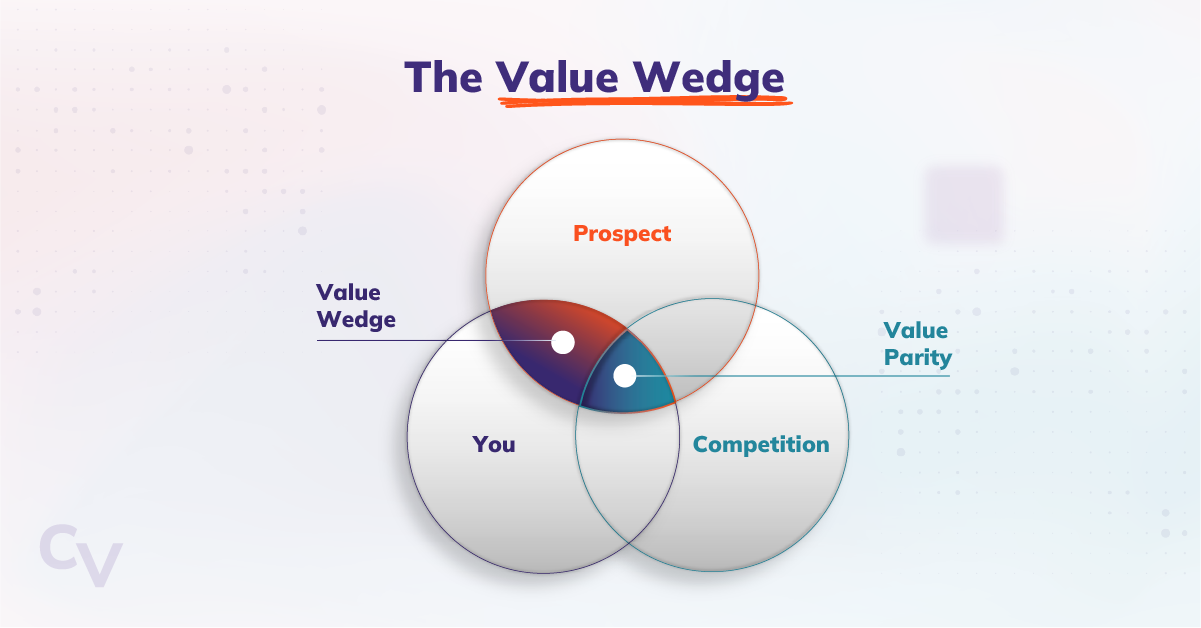
What you want to avoid is value parity, meaning:
- Capabilities your buyer needs
- That you can deliver
- That your competitors can also deliver
Most sales conversations end up in value parity because they’re grounded in features. The problem with that is if buyers can’t understand what’s unique or different about your solution, they’ll default to the lowest common denominator to make a decision: price. As a result, the cheapest option usually wins.
Define Your Value Wedge
To avoid the parity trap, identify your Value Wedge, the place where you offer something meaningfully different from competitors.
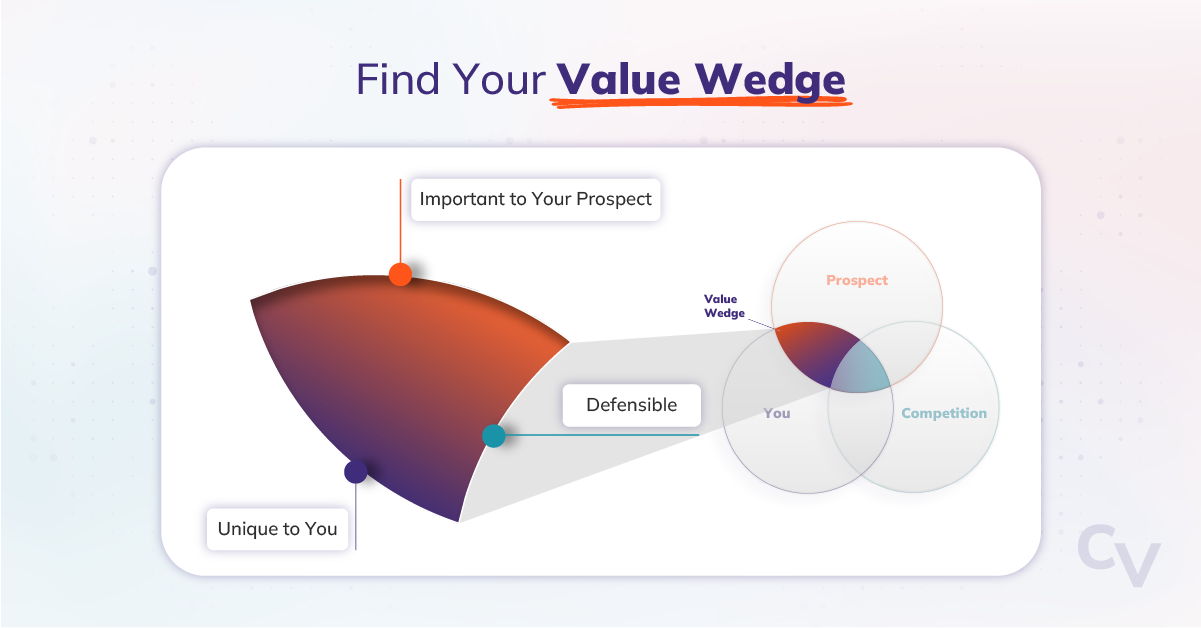
Your Value Wedge must contain three elements:
- Unique: It could be your product design, your service model, how you implement, how you integrate, or how you support customers over time. Competitors shouldn’t be able to credibly match it
- Important: It must map to a pressure, risk, or outcome that matters to your buyer right now (and sometimes you have to make it important by introducing an Unconsidered Need)
- Defensible: You can back it up with customer data, case studies, and buyer feedback, not just internal opinions
A clever feature that’s easy to copy, or not tied to buyer priorities, doesn’t belong in your Value Wedge.
It doesn’t have to be a huge differentiator either. The size of your Value Wedge matters less than the story you build around it. Even a small wedge can win if you make it the primary lens your buyers use to compare options.
Not All Differences Are Created Equal
When you define your Value Wedge, remember: buyers don’t value every attribute equally. They judge you against alternatives on the few factors that build confidence and lower perceived risk.
According to our data analysis, four attributes consistently move decisions forward:
- Solution fit: Make the link to their priority outcomes explicit. Even a small edge in relevance can tip the decision
- Ease of implementation: Show a clear path to go-live with a defined timeline, set resources, and plans to minimize risk. Then buyers believe adoption won’t disrupt operations
- Integration capabilities: Demonstrate how you connect to their systems and workflows (APIs, data flows, security). This shows how exactly you can work in their stack without surprises
- Training and support: Spell out onboarding, training, and ongoing support. Buyers feel confident they’ll achieve the outcomes after purchase
If you can, include something related to any of these items in your Value Wedge.
Build a Distinct Message
Once you’ve defined your Value Wedge, you need to translate it into a story that your buyers will remember. If you can’t make your differences clear and relevant in the conversation, you won’t stand out.
It’s not as easy as it sounds. Too often, sellers commit one of three “deadly sins” of messaging.
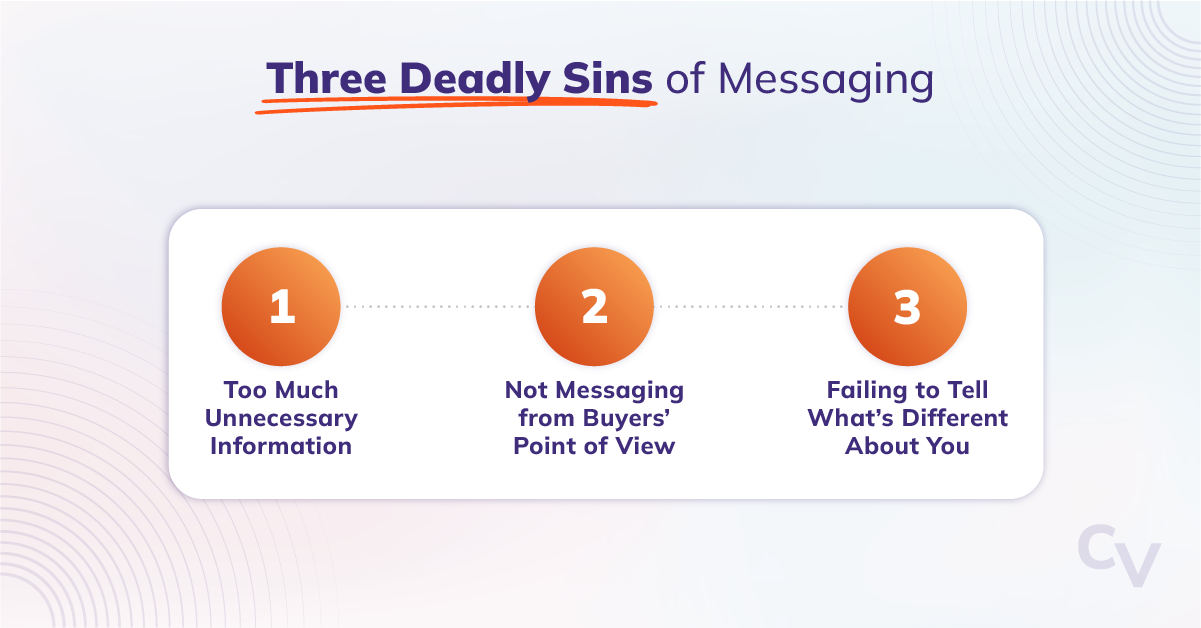
The three sins of messaging are:
- Too much information: Feature-by-feature rundowns flood buyers with details they can’t prioritize.
- Not messaging from buyers’ point of view: Talking about what the product does instead of what your buyer will be able to do.
- Failing to tell what’s different about you: Hoping buyers connect the dots instead of clearly saying, “Here’s what’s different about us and why it matters.”
In order to avoid these mistakes, there’s a clear structure for making your message your sellers can use: the Message Pyramid.
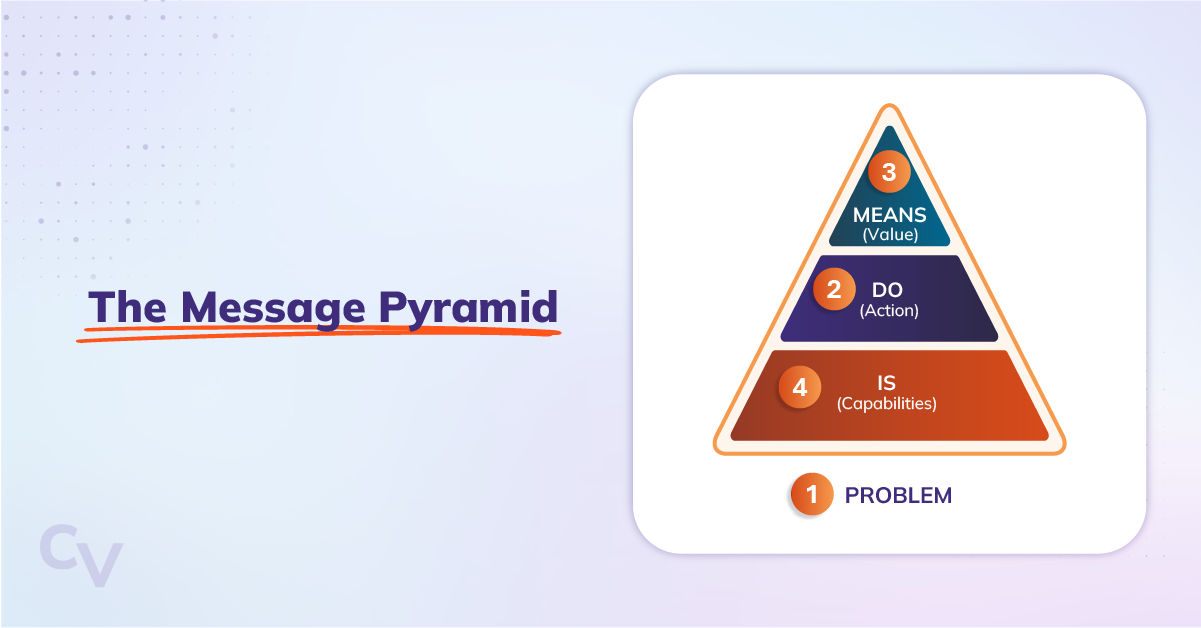
Most sellers start their presentation by talking about the features of their product first, but the research suggests you should invert that instinct. You need to ground your message in what your buyers care about.
Here’s how to build your Message Pyramid:
- Start with a problem in the buyer’s world—a risk or opportunity they’ve underestimated (in their own language)
- Show what they’ll be able to do differently with you than they can today
- Explain what this approach means in practice—how it works in their business and the outcomes they can expect
- Then introduce what it is, your named capabilities, and link its features to the outcomes above
This sequence tells a buyer-first story that makes it clear how your solution solves their problem.
Example:
- Problem: “Right now, your teams are making pricing decisions with incomplete data from disconnected systems.”
- Do: “With this approach, your regional leaders will be able to see margin impact in real time before they approve discounts.”
- Means: “That means you’ll consolidate deal data, pricing rules, and customer history into a single decision workspace.”
- Is: “That’s what the Revenue Decision Hub is built to do.”
Make Your Differences Come Alive with Telling Details
Besides just the structure of your message, how you talk about your differences matters to buyers as well. Researchers looked at how business decision-makers evaluated multiple versions of the same commercial message:
- A Features message that simply listed capabilities
- A Benefits message that focused on general advantages for the buyer
- A Superlatives message that layered in hype language like “all-in-one” and “best-in-class”
- A Telling Details message that used rich, specific, and buyer-focused details to describe the problem, the capabilities, and the value, with concrete snapshots of “today vs. tomorrow”
Across all four versions, the offer, structure, and proof points stayed the same. Only the level and quality of detail changed.
The results weren’t close.
Telling Details outperformed every other message from the study—individually and in aggregate—across clarity, credibility, uniqueness, value, and purchase preference.
There was a 91 percent difference in buyers who said the Telling Details message offered more value versus the other versions. And even though it was the longest, buyers were still more likely to choose that vendor.
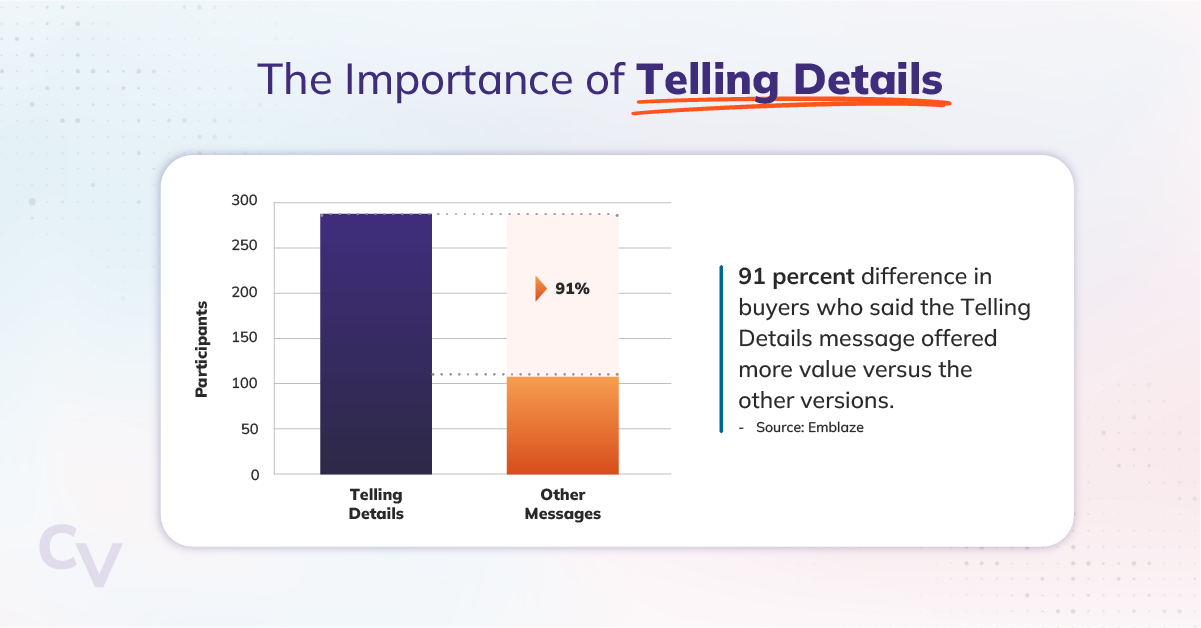
In other words, adding the right level of specific, buyer-relevant detail makes an otherwise similar story feel far more differentiated and compelling.
Use AI with Care
A word of caution when building your message: It’s tempting to rely on AI to do the work for you. But that shortcut can backfire.
In this video, you’ll see why and learn what to do instead:
Deliver a Differentiated Sales Experience
Even the best story can get lost in delivery. Our research shows that how you structure and run conversations is often what buyers experience as your biggest competitive difference.
In high-stakes purchases (bigger spend, higher advocacy), the go-to-market (GTM) experience explains 59 percent of the decision, while the offering itself explains just 41 percent.
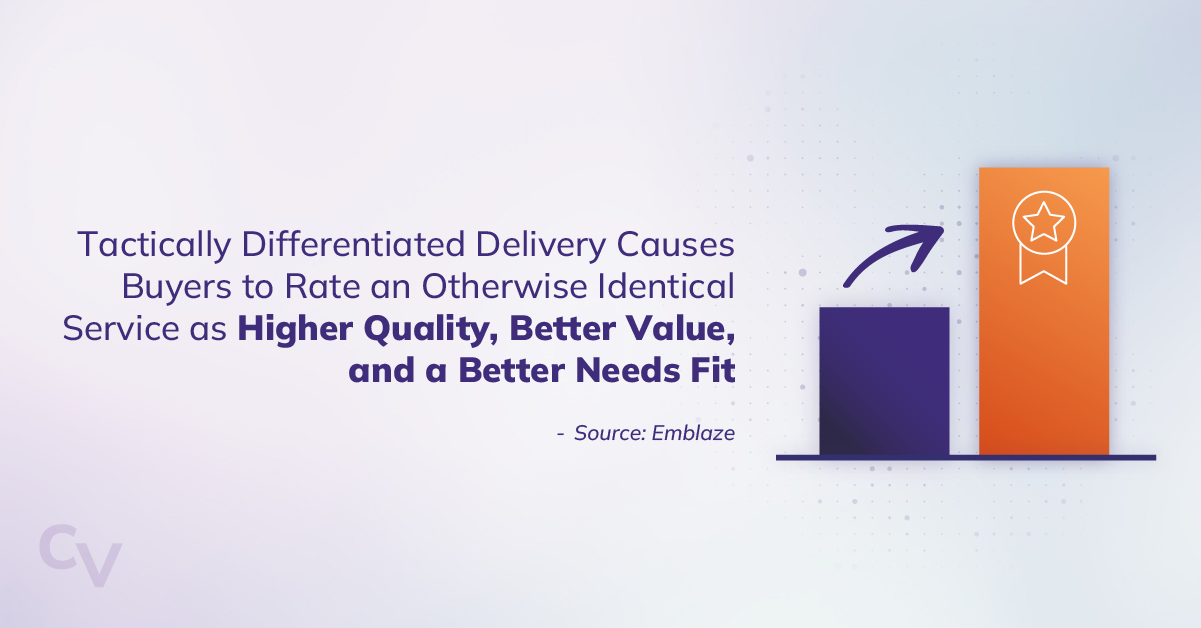
Also, tactically differentiated delivery—a meeting that breaks the standard pattern—leads buyers to rate an identical service as higher quality, better value, and a better needs fit. When conversations feel more noticeably different, buyers rate sellers more competent across every stage, with the strongest impact during solution presentation.
Use Whiteboards
Another slide-heavy presentation won’t help you stand out.
An underused but powerful alternative is whiteboarding. Instead of marching through a deck, use simple, hand-drawn visuals to tell the story live.
Our research found that concrete, marker-drawn visuals on a whiteboard (or a blank slide) made sales presentations more memorable and more engaging. Buyers rated these presentations higher on quality, credibility, and persuasive impact than typical slide-based talks.
Additional research showed that interactive visual stories in virtual calls boost engagement, increase favorable attitudes toward your story, improve recall, and make prospects more likely to meet with you again.
Use Pattern Breaks
In one study, using data from 478 companies on how tactical differentiation affects buyer perception, four vendor finalists pitched identical payroll services. Three followed a standard flow for the presentation and one used a reverse-order pattern (for example, placing price earlier and the agenda later)
- Buyers rated the unique presentation higher on service quality, value, needs fit, and how innovative the solution was, even though the products were identical
- In a follow-on test, when one seller had a product with a real edge, that product was more likely to be chosen. But the seller with the inferior product that used the differentiated delivery method was rated almost as highly as the seller with the better product
When you break a familiar pattern, you help buyers notice and believe the advantages you’ve worked so hard to build.
Invest in Differentiation Across Your Organization
Differentiation doesn’t happen by accident. It shows up when your messaging is clear, your sellers are prepared, and your organization reinforces what “different” actually looks like in a live deal.
Top-performing organizations treat differentiation as a capability you build, not a concept you introduce. Data shows they’re more than five times as likely to train sellers on competitive intelligence and differentiation, so reps can hold their ground in competitive conversations and make the differences clear when it counts. That kind of deliberate practice shows up in the moments that influence deal direction, not just in enablement sessions.
Buyers consistently pick up on two seller traits when they describe a sales experience as different: curiosity and creativity. You can build both into your team by assessing those traits and then reinforcing them through coaching and training.
Win with Competitive Differentiation
If you have a strong product and still hear, “You all look the same,” you now have clear next steps to take.
First, find your Value Wedge to keep your conversations out of value parity. Second, build a buyer-first story with a Message Pyramid and make sure it is full of telling details. Third, build a sales experience that feels unique and different with elements like whiteboarding and pattern breaks.
When you don’t stand apart, you invite a price fight. Clear competitive differentiation keeps the focus on you and your value.