For most revenue leaders, sales performance problems are visible long before they’re understood.
Deals slow at the same stage. Negotiations erode in predictable ways. Late-stage conversations don’t hold. They recognize the symptoms, but don’t fully understand the root cause.
That’s usually because the sales organization relies on seller-reported data to explain what’s wrong. But research shows that sellers and buyers describe the same deal outcome differently up to 70 percent of the time. That gap in understanding is why sales coaching can feel productive without moving win rates.
A structured sales performance evaluation, also called a sales skills assessment, is how revenue leaders close the gap between what they think sellers are struggling with and what’s actually limiting performance.
When done well, it surfaces the specific skills behind the symptoms, clarifies where coaching should focus, and gives training investment something more reliable than intuition to aim at.
The challenge is that not every approach to evaluating performance is built to produce that clarity. Some generate plenty of data without a clear direction, leaving leaders unable to tell managers where to focus because the output doesn’t point anywhere specific.
Key Takeaway
The most effective approach to evaluating and improving sales team performance starts with understanding what sellers do in realistic selling situations—not what they say they would do or how they rate themselves.
With a behaviorally grounded sales skills assessment, you can identify the skill gaps behind performance patterns, translates those results into coaching and training priorities, and establish a performance baseline you can measure against over time.
Use this guide to build a plan for evaluating sellers and improving performance. You’ll learn:
- What to clarify about your goals before evaluating any tool or vendor
- When to run an assessment and why timing matters
- What the most common assessment types are and what each is suited to measure
- What separates a diagnostic you can trust from one that produces interesting but unusable data
- How to translate results into coaching, training, and enablement decisions
- What to settle before you launch to protect data quality and promote adoption
Define Your Goals Before Choosing a Sales Assessment
Before you choose a sales assessment, anchor on what you need to evaluate. The type of insights you want should drive the type of assessment you choose.
Are You Trying to Assess Individuals, Teams, or the Entire Organization?
In some cases, you might need individual performance data to understand where each seller sits so you can personalize coaching and learning paths.
In other cases, you might need cohort-level insight to shape SKOs, field events, or training investments.
Both are legitimate goals, and many assessments can support both, but the reporting and rollout approach looks different depending on which is your primary objective.
If individual development is your first priority, confirm that the assessment produces something worth reading for the sellers themselves, not just for their managers. Participants who see clear personal value in the results are more likely to want to improve, which makes the data more reliable and actionable.
If organizational planning is your priority, confirm the assessment supports reliable comparison across people, teams, and segments. Without standardization, you’re comparing apples to oranges at exactly the moment you need apples to apples.
Are You Trying to Benchmark Now, Improve over Time, or Both?
A baseline assessment tells you where your team stands today. But to show that training and coaching are producing results, and to justify continued investment to stakeholders who want evidence, you need a way to measure change over time.
The most durable use of a sales skills assessment isn’t a single diagnostic or performance evaluation. It’s a structured improvement cycle: establish a baseline, run development programs, measure again, identify where progress has and hasn’t happened, and repeat.
If the assessment isn’t repeatable in a consistent, standardized format, it’s harder to use for tracking improvement, and harder to defend when leaders ask whether your work is changing anything.
The answer to this question shapes everything downstream: who sees the results, how you communicate the initiative internally, and how sellers experience it on the other side.
A development-focused assessment is most effective when sellers feel safe engaging honestly, which means results typically stay confidential and feedback flows back to the individual.
An organizational planning use case might require aggregated cohort data accessible to senior leaders, with individual scores deprioritized.
A formal evaluation tied to performance management, compensation, or promotion demands a different level of transparency and governance than either of the other two.
The problem is that many organizations launch without settling this upfront, then try to resolve it after the data is already in people’s hands. By then, sellers who expected a development tool are asking why their manager has their scores. Leaders who expected org-level insight are getting questions they can’t answer.
That friction usually doesn’t sink a performance improvement program, but it does make adoption harder and the data noisier, because sellers who aren’t sure what the results will be used for tend to respond more carefully than honestly.
When Should You Run a Sales Assessment?
The best time to run a performance assessment is before you need one. Most organizations think about evaluation when something has already gone wrong. Win rates have slipped, a training initiative didn’t land the way it was supposed to, or a new leader wants a clearer picture of the team they’ve inherited.
Those are legitimate triggers, but they’re reactive ones.
The organizations that get the most from their sales assessments treat them as a planned input rather than an emergency diagnostic. Here are a few moments where an assessment is particularly well-timed:
- Before a major training initiative or SKO. Running an assessment before a significant investment in development tells you which skills to prioritize and which to deprioritize. Without that baseline, training events tend to cover everything and change nothing—because there’s no data to anchor decisions about where to focus.
- When win rates drop without a clear explanation. CRM data and pipeline reviews can tell you that something is wrong. They rarely tell you why. But when you run an assessment, you can surface whether the issue is a skill gap—and if so, which one. When you have precise data, coaching and development can target the root problem rather than the most visible symptoms.
- When onboarding a new seller cohort. Assessing new hires early tells you who needs what before they’re in front of buyers. It also establishes a baseline that makes it possible to measure how much the onboarding program actually impacts performance.
- After a significant change to your sales methodology, messaging, or market. When sellers are asked to sell differently, it’s worth measuring whether they can. If you roll out a new methodology without a follow-up assessment, you won’t see evidence as to whether change took hold.
- As a regular annual baseline. Even without a specific trigger, annual assessment creates a consistent record of where skill levels are and how they’re changing over time. That record is what makes it possible to connect development investment to commercial outcomes in a way that holds up in a budget conversation.
The right question isn’t just whether your team needs an assessment. It’s whether you’re running one at the right moment to actually do something useful with the data.
What Are the Different Types of Sales Assessments?
Many buyers come into assessment conversations with a general sense that they need one, without a clear picture of how different types work or what each is suited to surface. Here’s a practical breakdown.
Self-Assessments
Best for: Gauging seller confidence, reflection, low-stakes initial engagement
A self-assessment asks sellers to rate their own skills or confidence levels. These are fast to deploy and require no external tooling.
The limitation: They’re often unreliable. Sellers tend to over- or underestimate their abilities, sometimes significantly, even when buyers experience those conversations very differently. Self-assessments can be a useful way to understand how sellers feel about their readiness, but in practice they’re not much better than a survey. If objective skill data is the goal, self-assessments alone won’t close that gap.
Manager Assessments
Best for: Coaching input, capturing observation over time, team-level conversation
Manager assessments add context that self-assessments miss: how sellers show up in real opportunities, how they handle specific moments, and whether behavior has shifted after training.
The limitation: Results vary significantly depending on how much exposure a manager has, what they personally value in a seller, and how consistently they apply any rubric. Managers bring their own preferences and biases about what drives performance, which makes it difficult to compare results across managers or use the data for org-level decisions without significant qualification.
Knowledge-Based Assessments
Best for: Measuring product knowledge, methodology comprehension, messaging familiarity
Quizzes and structured tests can tell you whether sellers understand key concepts like how a product works and how to position against a competitor.
The limitation: Knowing something and applying it in a live conversation are different skills. A seller who scores well on a knowledge assessment can still struggle when a buyer pushes back, when a negotiation gets complicated, or when the conversation doesn’t follow the script. Knowledge assessments measure what sellers understand, not how well they perform when it matters.
Call Analysis and Conversation Scoring
Best for: Evaluating real selling behavior in recorded interactions, identifying language patterns and conversational tendencies
Call analysis tools review recorded sales conversations, manually or through AI, and score them against rubrics covering things like questioning, messaging, objection handling, and talk-to-listen ratios. Because they analyze real interactions, they surface how sellers actually behave with buyers rather than how they say they would.
The limitation: Quality depends heavily on the scoring rubric and how consistently it’s applied. AI-based analysis can introduce its own inconsistencies depending on the tool and model. And because call analysis requires recorded conversations, coverage varies—some deals, some sellers, and some moments are captured; others aren’t.
Deal and CRM-Based Assessments
Best for: Providing deal-level context, identifying patterns in win-loss outcomes, supplementing direct skill measurement
Analysis of deal progression, pipeline data, win-loss notes, and CRM activity can surface patterns that suggest where skill gaps may exist. If deals consistently stall at a particular stage, or if certain sellers win consistently in specific contexts, the data is worth examining.
The limitation: CRM data is often filtered through sellers’ own notes, which means it reflects their interpretation of what happened rather than what a buyer experienced. It also tends to capture outcomes more than behaviors, telling you what happened without explaining why. Use it as context, not as a standalone measurement.
Buyer Feedback-Based Assessments
Best for: Understanding how selling behavior lands with buyers, capturing the perspective that determines outcomes
Buyer feedback tools, including win-loss programs, post-sale surveys, structured interviews, surface seller performance from the perspective that actually decides outcomes: the buyer’s. Because feedback is tied to real deals, it reflects how effectively sellers performed in the moments that mattered, not how they performed in a controlled setting.
The limitation: Buyer feedback works best as a complement to direct skill measurement rather than a standalone assessment. It captures what buyers noticed and how they felt, but it doesn’t isolate which specific behaviors drove or limited performance. It’s also subject to timing and response rate constraints that can limit coverage.
Role-Play and Simulation Assessments
Best for: Measuring how sellers apply skills in realistic scenarios, identifying behavioral gaps in a controlled format
Role-play and simulation assessments put sellers in mock selling situations—live role plays, recorded simulations, or structured scenario-based evaluations—and score how they respond. Because sellers have to demonstrate behavior rather than describe it, these assessments are more directly tied to what sellers actually do in real selling moments.
The limitation: The quality of the assessment depends heavily on scenario design, the scoring rubric, and the consistency of evaluation. Live role plays in particular can vary depending on who plays the buyer and how the facilitator scores the interaction. Structured simulations with defined rubrics tend to produce more consistent, comparable data.
What a Good Assessment Looks Like
Across all assessment types, specific qualities separate a tool that produces coaching direction from one that produces a report nobody knows how to use.
It Measures Behavior, Not Just Belief
A strong assessment evaluates what sellers do in context—not what they say they would do, and not how they rate themselves on a scale. The moment you ask sellers to self-report, you’ve reintroduced the same perceptual bias you were trying to eliminate. The assessment should require sellers to demonstrate skill, not narrate it.
It Reflects Realistic Selling Scenarios
Sellers respond to the scenario in front of them. If that scenario feels generic or disconnected from real deal flow, their responses will be too, and so will the data. The most credible simulations mirror real selling moments: responding to a hesitant buyer, building a case for change, navigating a negotiation. When the scenarios are realistic, the behavioral signals they surface are more trustworthy. When they’re abstract, sellers can cruise through without revealing anything about how they actually sell.
It Uses a Defensible Scoring Model
Scoring should reflect patterns of behavior across all responses—not whether a seller chose the single “right” answer on any given item. Strong scoring captures behavioral signals, accounts for question difficulty, and looks at the full picture of how a seller responds across the assessment. That’s a different model from a simplistic percentage score or a pass/fail cutoff.
The deeper question is whether the scoring model has been psychometrically validated. Psychometric validation is the process of proving a test accurately measures what it is designed to measure. It compiles statistical and theoretical evidence linking items to skills and outcomes. It is used to prove evidence of accuracy, reliability, and predictivity, leading to credible decisions, targeted interventions, and ROI you can defend with measurable impact. A validated model has each item calibrated for difficulty and discrimination, verified against business outcomes like win rates and conversion, and tested across a broad enough population that the results hold up outside a single company or industry. Without that foundation, you’re relying on perception with extra steps.
Before committing to any provider, ask how responses are scored, what the model is built on, and whether the tool has been psychometrically validated. If the answer is vague, the data will be too.
It Produces Outputs Leaders Can Read Without a Decoder
The assessment should return more than a number. Leaders should be able to see individual skill-gap reports sellers can act on, cohort-level dashboards that show where patterns cluster across teams or regions, and a clear view of which competencies represent the highest-priority gaps for development. If a manager has to spend hours interpreting a spreadsheet before they can coach anyone, the output isn’t ready.
It’s Standardized Enough to Support Comparison
If your goal is cohort-level insight, comparing across teams and tracking improvement over time, the assessment has to support reliable comparison. That requires consistent scoring, scenarios that isolate the same skills in the same way across participants, and standardization that holds up as you scale. Without it, you can measure individuals, but you can’t aggregate in any defensible way.
How to Use Sales Assessment Results for Coaching and Training Decisions
Assessment data only improves sales performance if someone acts on it. That requires three things: a participant experience sellers will engage with honestly, reporting that tells leaders where to focus without requiring hours of interpretation, and a concrete action plan before results arrive. Here’s what each of those looks like in practice.
The Participant Experience
For sellers, a well-designed assessment should feel structured and purposeful, not like a performance review in disguise. It should require a realistic time commitment that doesn’t pull them out of the field for a day, with no memorization and no trick questions. Responses are scored on behavioral signals across the full set of responses, not on any single answer.
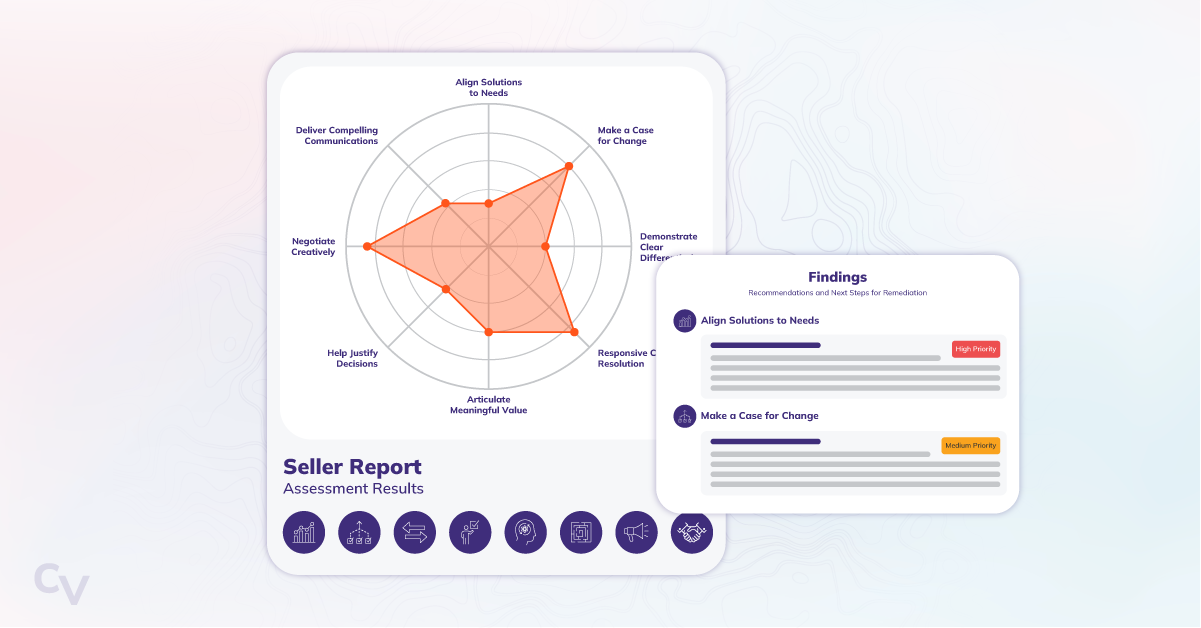
Individual feedback or skill-gap reports delivered after completion let each seller see where they stand and what to develop, which gives them a reason to take the process seriously rather than just get through it.
The communication around the assessment matters as much as the assessment itself. Sellers who understand clearly that this is a development tool, not an evaluation mechanism, engage more honestly and get more out of the results. Ambiguity about intent tends to produce strategic behavior instead of authentic responses.
The Leader Experience
For revenue leaders and enablement teams, strong post-assessment reporting should surface a cohort view of strengths and gaps, identify which competencies represent the largest performance opportunities across the team, show patterns by team, segment, region, or role, and point to where coaching should start—rather than requiring leaders to do that interpretation themselves.
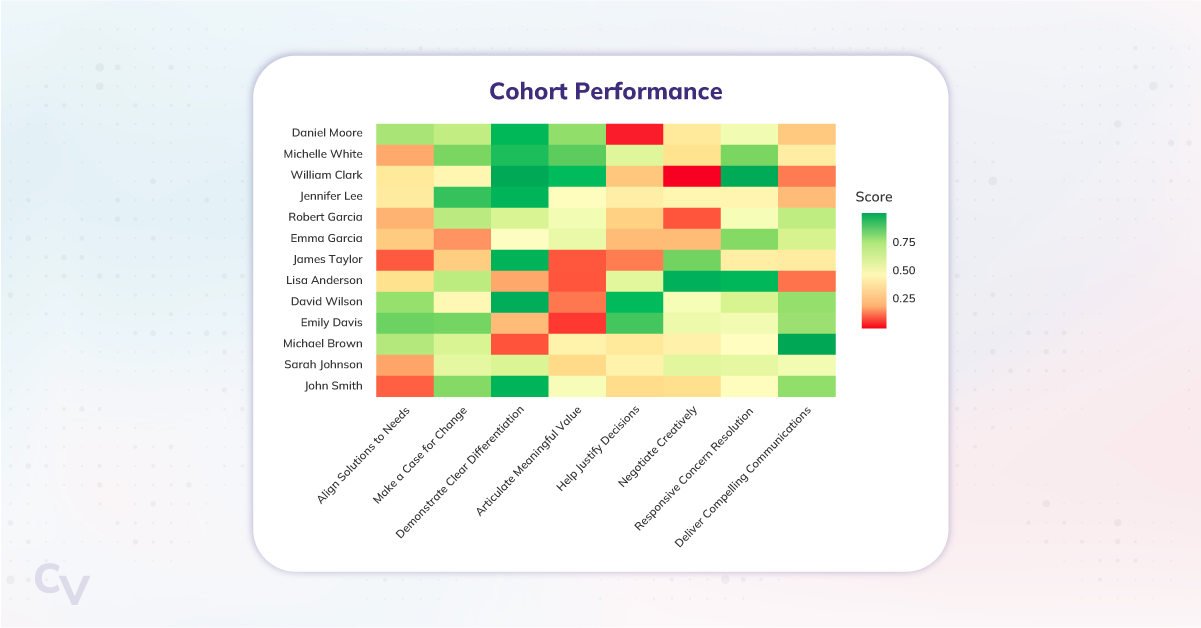
The goal is to remove the translation step. Leaders should get an org-level view of aggregated results they can slice by team or segment, with individual reports that include coaching recommendations built in. Managers shouldn’t have to figure out what the data means before they can use it. They should be able to start coaching and planning training immediately.
Your Action Plan
Assessment data that doesn’t lead to decisions is expensive market research. Before you launch, align on what you’ll do with the results:
- Which training paths correspond to which skill gaps?
- How will managers use the data in one-on-one coaching conversations?
- How will results shape SKO content, field events, or workshop design?
- What commercial metrics will you track to measure improvement
- When will you reassess?
The organizations that get the most from an assessment investment don’t treat the data as the destination. They treat it as the diagnostic that tells them where to focus the work that follows.
What to Know About Confidentiality and Communications
How you launch an assessment determines the quality of data you get from it. Sellers who aren’t sure what results will be used for respond more carefully than honestly, which produces noisier data and less useful output.
Three decisions, made before launch, determine whether the rollout builds trust or erodes it. Here’s what to settle before you launch:
Confidentiality. Decide whether individual results are visible only to the participant, shared with their direct manager, available to HR, or visible to senior leadership. There’s no universally right answer, but ambiguity creates more problems than any specific policy. In many rollouts, individual results stay confidential for development purposes while aggregated cohort data is accessible to leaders. Whatever you decide, make it known before sellers take the assessment.
Access governance. Decide who sees individual versus aggregate results before the assessment launches—not after sellers start asking. Retroactive changes to access policy tend to create the kind of trust erosion that’s hard to recover from.
Communication plan. A development tool introduced as a performance evaluation will produce defensive participants and noisier data. Be specific in your internal communications: why the assessment is happening, what will be done with the results, and who can see what. Sellers who know this is about development, not judgment, engage more authentically.
What Revenue Leaders Often Get Wrong
The most common sales assessment mistakes happen before purchase, not after. Revenue leaders often choose assessments based on convenience—speed of deployment, LMS integration, vendor bundling—rather than coaching value. But with that kind of decision, you tend to get assessment data that doesn’t change how managers coach or where training budgets go.
Choosing based on convenience rather than coaching value. The fastest assessment to deploy is often the one that produces the least useful coaching data. Selecting an assessment because it’s already connected to your LMS, or because a vendor bundled it into a broader purchase, is a reasonable procurement shortcut but a weak basis for a diagnostic that’s supposed to shape how managers coach and where training budgets go.
Confusing confidence scores with capability data. A seller who rates themselves highly on negotiation is telling you how confident they feel about negotiation, not how effectively they negotiate when a deal is on the line. Many buyers don’t fully account for this distinction until they receive assessment data that doesn’t match their intuition about individual sellers. At that point, the question becomes whether to trust the data or the intuition—and without a validated measurement model underneath, it’s hard to know which to follow.
Underinvesting in reporting and rollout evaluation. It’s easy to spend most of the buying decision evaluating the assessment experience, the scenarios, the interface, how long it takes and too little evaluating what leaders actually receive on the other side. Ask for sample reports before you commit. Ask who helps you interpret cohort data. Ask what the implementation timeline looks like for an organization your size. The post-assessment experience is where most of the value either shows up or doesn’t.
Not deciding what happens after results arrive. The organizations that get the most from an assessment are the ones that determine before launch what they’d do with the data. Without that plan, results tend to generate interesting conversation rather than changed coaching priorities.
Treating the assessment as a one-time event. A single assessment tells you where sellers stand today. It doesn’t tell you whether training is working, whether coaching is shifting behavior, or whether you’re closing the gaps with the highest commercial impact. An assessment used once is a snapshot, while an assessment used as part of an ongoing cycle is a diagnostic system.
What You Can Learn with the Right Assessment
The most important thing an assessment can do is reduce the ambiguity about where to focus and that’s harder than it sounds when perception data is running the show.
When sellers and buyers describe the same deal outcome differently, leaders who rely on perception-based assessment data are working from a distorted map. They’re investing in areas their sellers say are weak, not necessarily the areas buyers say determined the outcome. The result is coaching that feels productive and training investments that don’t move win rates.
The right assessment changes that equation. When an assessment measures what sellers actually do, scores behavior against a model tied to real buyer decisions, and produces output specific enough to act on, it stops being a diagnostic exercise and starts being a strategic input. Revenue leaders can see where the gaps are, rank them by commercial impact, and decide where to invest with something other than intuition guiding the decision.
That’s a fundamentally different position than most organizations are in today. And it’s available to any team willing to be more deliberate about what they measure, how they measure it, and what they do when the data comes in.
Assessment isn’t a one-time checkpoint. When used well, it becomes the foundation of a repeatable improvement cycle: establish a baseline, run development programs, measure again, identify where progress has and hasn’t transferred, and decide what comes next. That cycle is how coaching stops being reactive and starts being targeted. It’s how training investments get defended with evidence instead of anecdote. And it’s how organizations close the gap between where their sellers are now and where their buyers need them to be.