Durable revenue systems start with discipline, not heroics.
When markets move fast, growth comes from systems that compound—how you retain and expand customers, how you frame value when price pressure spikes, how you professionalize selling, and how you spot early signals before numbers slip.
Across four Emblazers Show conversations with leaders at Ping Identity, Nelnet Campus Commerce, the Institute of Sales Professionals, and K1X, a common thread emerges: Move from activity to evidence.
Customer success carries real commercial accountability—renewals, value realization, and executive-level narratives that show impact, not ticket counts.
Sellers win by pausing, diagnosing bias, and documenting outcomes buyers can trust.
Standards and certification reduce performance swings and build confidence beyond “we trained on it.”
And growth behaves like a pattern, not an event—one you can read and bend when you question assumptions, instrument the right metrics, and trade vague “best practices” for deliberate operating models.
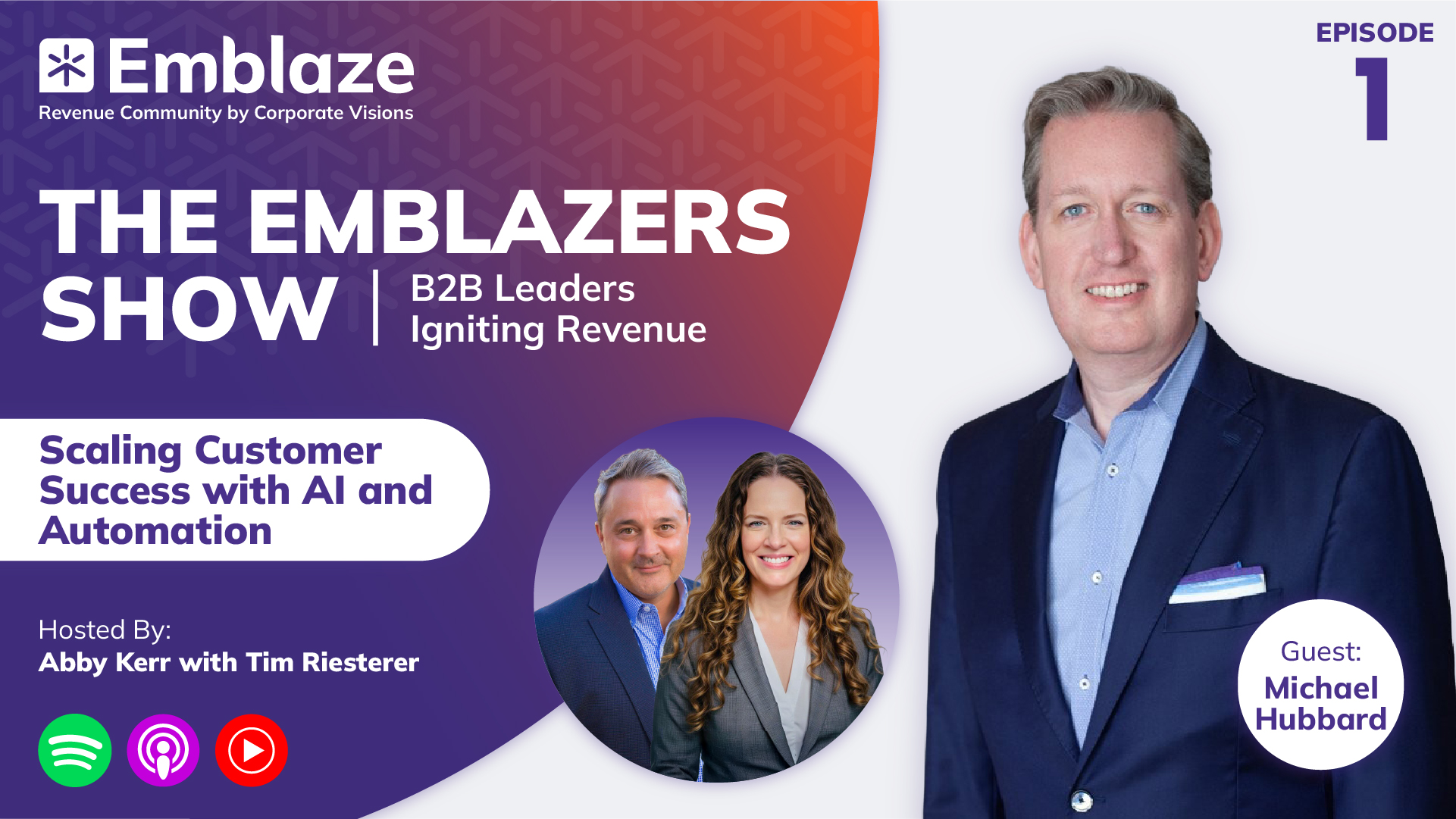
CS as a Growth Engine, Not a Cost Center – Michael Hubbard, CCO, Ping Identity
Ping CCO Michael Hubbard frames customer success as a first-class growth function: accountable for renewal rate, logo retention, price uplift, and on-time execution.
His team runs a pod model—success, renewals, and account management “rotate chairs” based on the commercial moment—so value realization stays visible from onboarding to business review.
Data and AI help, but what earns renewal is human: Clear “triple metric” narratives (user KPI → functional outcome → company result), telemetry-driven benchmarks, and executive business reviews that present insights, not activity.
The mandate is to reduce cost-to-serve while improving experience—standardize workflows, apply AI where data is rich (support, next best action), and raise renewal productivity per rep.
In a world of tool sameness, your differentiator is the outcome story your team can credibly tell.
Listen to the full episode on Spotify, Apple Podcasts, or YouTube.
Winning When Price Pressures Peak – Mike Rogers, National Sales Director, Nelnet Campus Commerce
Mike Rogers, National Sales Director at Nelnet Campus Commerce, sells in a red-ocean, RFP-driven market where price is the default tiebreaker.
His counterintuitive move: Hit the brakes. That pause creates space to unpack how the buyer is thinking, surface blind spots, and shift from product talk to decision science—guiding a modern, pre-convinced buyer who’s overwhelmed, not just informed.
Discipline shows up in pipeline quality and deal selection: Be willing to walk when facts don’t support a win.
Inside the team, he builds a “triple metric” habit for every opportunity, delays demos until value hypotheses are aligned at multiple levels, and insists on documenting outcomes so customer success can “scream results” beyond testimonials.
The effect is less magical thinking and more rigor—a sales motion that competes on business value so price isn’t the only story left on the table.
Listen to the full episode on Spotify, Apple Podcasts, or YouTube.
Professional Standards That Elevate Selling – Rob Durant, CEO US, Institute of Sales Professionals
CEO Rob Durant argues that sales has operated without the professional guardrails other high-stakes fields rely on. The Institute of Sales Professionals (ISP) addresses that with a validated Sales Capability Framework and third-party certifications—backed by Ofqual in the UK—that assess ethics and core competencies for individuals, programs, and companies.
Why it matters for durable revenue: Standards reduce reinvention and variability; leaders invest in the right skills at the right time; and buyers gain confidence when a seller’s conduct and capability are audited beyond “we say so.”
The ISP partners with universities and training providers to align curricula and certify outcomes, and early clients report meaningful performance lifts.
Certification isn’t just attendance, but rather it’s a measurable commitment that raises consistency, ethics, and trust across the customer experience.
Listen to the full episode on Spotify, Apple Podcasts, or YouTube.
Pattern Recognition for Predictable Growth – Ken Powell, CRO, K1X
K1X CRO Ken Powell treats growth as a pattern, not a moment: It compounds when systems align and stalls quietly when they don’t.
Watch for leading signals—slower velocity despite a “healthy” pipeline, rising effort without proportional output, new entrants reframing problems, or DIY solutions changing expectations.
His “bend the trend” mindset asks: What has to change before we stall, or if we want to surge? Often the answer isn’t “more activity” but redesign—reset ICP, instrument better leading metrics, or retool value realization so business reviews stay at executive altitude.
Ken expects a services-plus future: forward-deployed engineers, workflow redesign, human enablement, and ongoing measurement that proves impact, not just usage.
In an AI era where content homogenizes, differentiation lives in how well your teams orchestrate change and tell the value story.
Listen to the full episode on Spotify, Apple Podcasts, or YouTube.
Durable Beats Dramatic
Durable revenue isn’t the result of a heroic quarter; it’s the compounding effect of reliable systems.
Make customer success accountable for outcomes, not tickets. Teach sellers to pause, diagnose bias, and document value so price stops running the room. Put standards and ethics on objective footing to reduce execution variance. And practice foresight: Read early signals and redesign before effort becomes your only lever.
That’s how teams build resilience in a market that rewards proof over promises.