Choose your role to see what that looks like in practice.

and Fine-Tune Your Approaches
Find insights, articles, webinars, and more evidence-backed resources to grow revenue.

For years, Sales Enablement has dutifully served as a sidekick to in-person, acquisition-focused sales conversations. But that needs to change.
Selling and buying behaviors have drastically changed over the last decade. Buyers today are engaging with your marketing and sales enablement content further down the funnel. They’re doing research, forming opinions, and narrowing their options all on their own, without talking to a sales rep. And when buyers do speak to your reps, those conversations are happening remotely.
Buyers control their decision-making process. And to serve those buyers effectively, sales enablement content can’t just be a sidekick to an in-person sales conversation—it needs to be able to stand on its own, address your buyer’s big questions, and showcase your unique value.
You need to provide the right information, in the right context, at the right time, to help your buyers and sellers have more productive conversations. And because existing customers make up the majority of company revenue, sales conversations need to happen on both the acquisition and expansion sides of the customer lifecycle.
Sales enablement teams also need to respond to an unpredictable and constantly changing business environment. When faced with an urgent competitive threat, economic crisis, or strategic opportunity, you can’t wait six months or more to train and enable your team—you need to equip your organization with the right messages, content, and skills to respond and win the moment.
As revenue teams continue to adapt to this new reality, it’s clear that Sales Enablement is the linchpin for Sales and Marketing effectiveness.
As a Sales Enablement leader, you can choose to seize these trends and lead the charge toward this new reality of selling. This collection of science-backed resources will help you do just that.

People are more willing to learn (and will learn best) when they’re in a deficit—a moment of need. This kind of learning is what I call “Deficit Learning.” For example, do you remember the last time you had to change…

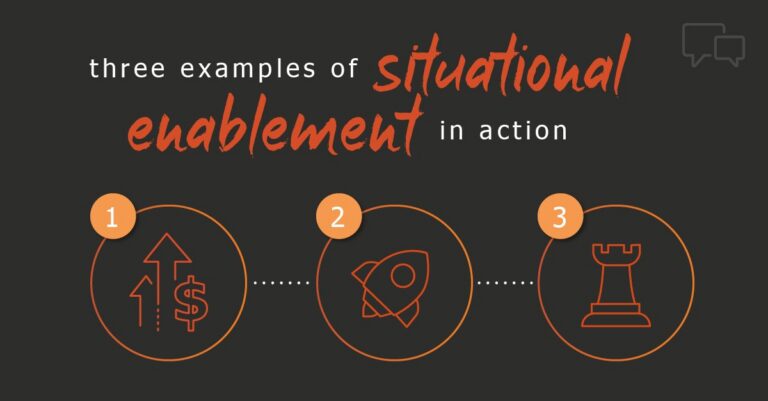
This article describes three examples of Situational Enablement in action. What is Situational Enablement? Situational Enablement programs are flexible and responsive sales enablement initiatives you can roll out to quickly address must-win business challenges and market opportunities. At the core…

In Alvin Toffler’s book, “The Third Wave,” he talks about society’s transition from the Industrial Age (Second Wave) to the Information Age (Third Wave). Toffler considered the Agricultural Age as the First Wave transition from our hunter-gatherer origins. You can…

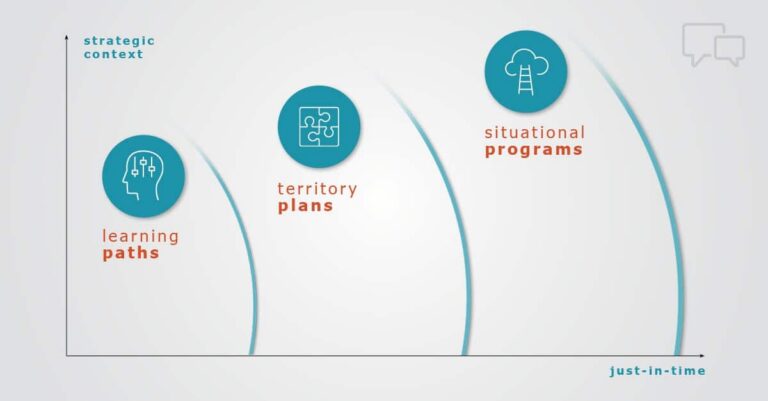
Too many organizations plan their enablement with a “just-in-case” mindset. They lean on competency maps and learning paths to plot out an annual plan, only to scrap those initiatives and start from scratch when confronted with unexpected events or executive…

Turns out, training effectiveness scores are impacted by “room quality,” even in a virtual environment. “Training leaders were refusing to teach in the basement classrooms because their scores were lower versus when they would teach in the top floor classrooms…

See how to deploy situational sales enablement at scale when you need it most.

You don’t need to focus your sales messaging on your prospect's title, position, or persona. Instead, speak to your prospect’s situation. Help your buyers realize that their current approach is so limiting that it puts their strategic objectives and/or their desired outcomes at risk.

When it comes to creating lasting behavior change, most sales leaders assume that online sales training is just a pale imitation of the in-person classroom. But what if you could roll out an online sales training program that was proven…