Solutions and such do some things and some other things here Maecenas sed diam eget risus varius blandit sit amet non magna. Aenean lacinia bibendum nulla.
You’re measured on different outcomes—but your success depends on the same buyer decisions. This is where you find the programs and proof built for your goals.
Choose your role to see what that looks like in practice.
When teams rely on opinions, content gets noisy and inconsistent. Our resources are grounded in buyer evidence—so you can sharpen decisions, messaging, and execution.
Find insights, articles, webinars, and more evidence-backed resources to grow revenue.
Who doesn’t? That rollercoaster you ride when a trick is well performed. Curiosity and skepticism quickly turn to surprise and wonder.
And then the inevitable question: “How’d they do that?”
If you’ve ever been in a Corporate Visions workshop, you know these feelings well. A roomful of smart people grappling with a challenging, counterintuitive concept. And then, poof. An expert consultant waves a magic wand—or in this case, magic marker—and everybody’s unstuck, excited to go wherever the session will take them.
Back in the 90s, a series called “Breaking the Magician’s Code: Magic’s Biggest Secrets Finally Revealed” ran on primetime TV. In each episode, a masked magician would perform a classic illusion (think sawing a person in half). Then they would immediately take the viewer behind the curtain and show how the trick worked.
In this article, I’ll be your masked man. I’m going to reveal the secrets behind a bit of magic called set-piece storytelling. What it is, and how you and your teams can use it to improve conversations with prospects and customers.
But first, it’s important to start with why. Why it’s less of a trick, and more of a fundamental skill every seller needs. And why it’s more important now than ever.
Are you ready? I hope so. Because I’m uncovering these secrets at great personal risk. And it’s likely I’ll be ostracized by my consulting peers forever.
More Buyer Chaos Demands More Sales Magic
Enterprise selling has never been messier or more complex. You’ve seen many of the stats:
B2B buying committees now involve people from a wide variety of departments.
More than 72% of B2B purchases involve buying groups that span functions like IT, finance, operations, and end users (Demandbase)
Modern buying committees average 10 to 15+ stakeholders (6Sense)
B2B decision-makers are 60-70% through their buying journey before they engage with a sales rep (Gartner)
And everyone’s using AI. In fact, AI search is growing at a rate of 40% month over month (Forrester)
This all means sellers need to win over more stakeholders, from more departments, each coming in with strong opinions about what their challenges are—and what solutions will work best.
How do you efficiently navigate this chaos?
Behold, the mega-deck!
Some teams build a kind of narrative mega-deck that includes slides for a variety of buyers, industries, use cases, and so on. Before each meeting, sellers down-select what they believe will be relevant based on their research, piecing together a linear narrative for that audience.
This approach is supposed to balance consistency with customization. But when buyers ask unexpected questions or bring up topics sellers don’t have a slide for, they’re often left scrambling. Do they “wing it” or push the conversation back onto familiar ground?
AI-powered Personalization for Everyone
Other teams are leaning into AI to create personalized outreach and talk tracks for every individual buyer and meeting. But there are a couple of problems here.
One, buyers are using those same AI tools for their research, so you risk adding to the noise and telling them things they already know. And two, if every message to every buyer is totally different, you’re not getting them to align around common challenges and outcomes—which has been shown to accelerate committee decision-making.
One Meta-Skill to Rule Them All
The mega-deck is too clunky and pre-planned. The AI hyper-personalization is too scattered and bland. What sellers really need is situational fluency: the ability to read the room, adapt to specific buying situations, and respond with empathy and insight to the conversation that’s actually happening—not the one they hoped for.
Situational fluency is arguably the number-one meta-skill sellers must master to thrive in an increasingly challenging B2B buying landscape. But it raises the question: How can sales messaging support situational fluency?
Enter set-piece storytelling.
What is Set-piece Storytelling?
To explain set-piece storytelling, I’m going to whisk you out of the conference rooms and Zoom calls where buyer conversations happen and put you in a Corporate Visions messaging workshop.
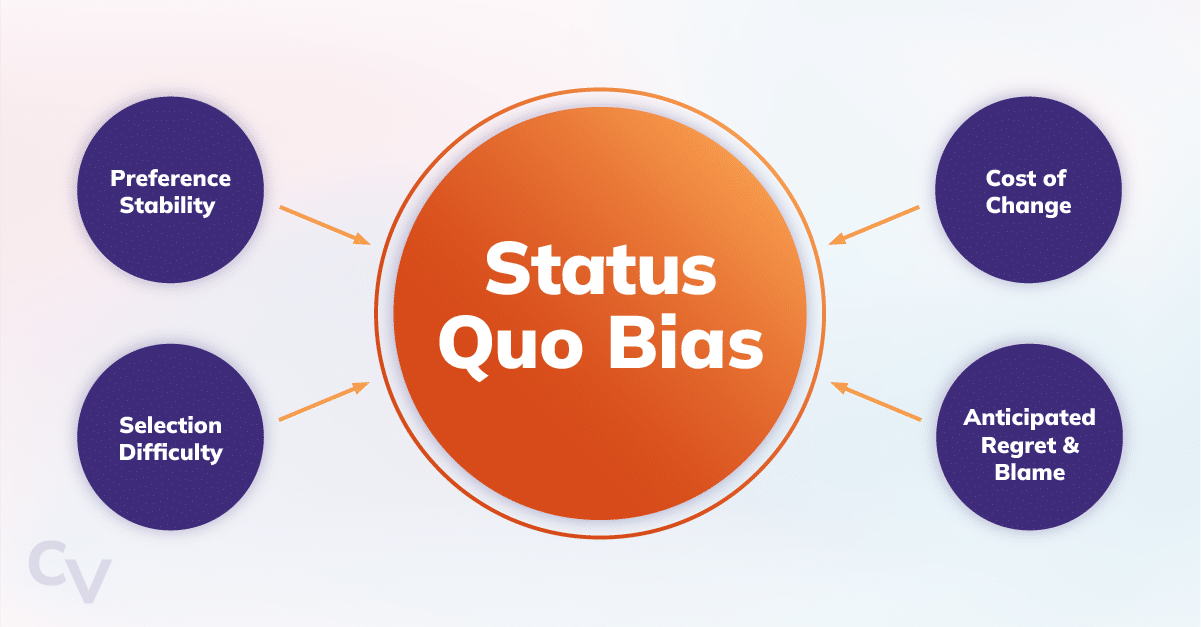
You’re sitting around a U-shaped table with a half dozen peers from marketing, sales, and product. You’ve just learned about the concept of Status Quo Bias: the inherent psychological forces that make buyers resistant to change.
There are four causes of Status Quo Bias.
The burnt taste of your coffee reminds you of the inexplicable sign you spied while filling your cup: Proudly serving Folgers.
Now your Corporate Visions facilitator is asking the group to brainstorm all of the challenges, risks, and consequences associated with your buyers’ status quo. The idea is to create enough pain around their current state that they can’t help but consider a new approach (i.e., your solution).
Why So Negative?
After a few minutes of tentative idea sharing, one of your marketing colleagues asks, “Why are we spending so much time on the negative? It feels like we should be focusing more on the positive: the benefits and outcomes of working with us.”
That makes sense to you. And as you look around the room, you can tell others are thinking the same thing.
Remember that magic marker I teased earlier? Here’s where it makes its grand entrance. It turns out the “negative versus positive” question is one Corporate Visions consultants get often. And we’ve designed a whiteboard set-piece for this exact moment.
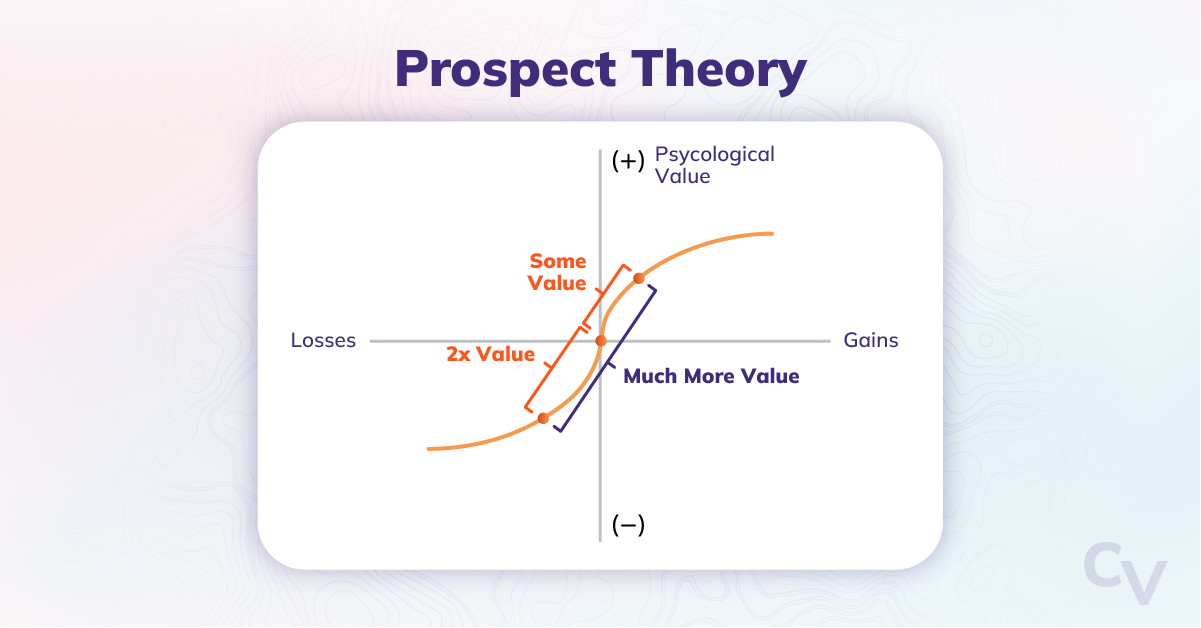
It’s affectionately called “the Kahneman curve,” in reference to Daniel Kahneman and his Nobel Prize-winning research on Prospect Theory. And it perfectly illustrates why it’s so important to bring pain and risk into your messaging.
The Power of Prospect Theory
Kahneman proved that humans associate psychological values to both losses and gains. And it turns out that we suffer losses about twice as strongly as we enjoy gains.
So, to maximize the psychological value of your messaging, you should include both: the negative consequences of the status quo and the positive outcomes of the new approach. If you only talk about upside, you’re actually fighting human nature instead of working with it.
People feel the pain of losing about twice as strongly as the pleasure of winning.
Every time the Kahneman curve is sketched out, the effect is the same: nodding heads and renewed energy for brainstorming. It’s a powerful example of set-piece storytelling for a few reasons:
It meets customers where they are with a sense of empathy (i.e., it acknowledges that humans do value benefits and gain)
It challenges common thinking—and offers evidence for the new thinking (i.e., the 2x value associated with losses)
It makes this contrast visual, concrete, and memorable (i.e., the Kahneman curve whiteboard itself)
But as powerful as this set-piece is, it doesn’t get used in every workshop.
Why? Because some groups are more open to messaging pain and risk than others (they may have been in Corporate Visions workshops before). Part of the “magic trick” is having a handful of these set-pieces in your back pocket—but then only delivering them as needed based on how conversations evolve.
There’s that situational fluency thing again!
Making the Magic Your Own
Here’s the definition of set-piece storytelling: equipping business-development teams with a curated collection of sharp, modular, reusable narratives—often supported by visuals—designed for winning critical moments in buyer conversations.
Set-pieces can be used to:
Grab (and recapture) attention
Offer a disruptive point of view
Explain a confusing concept
Address a recurring objection
Contextualize a product demo
Hopefully, you can see how set-piece storytelling is a more balanced approach compared to mega-decks and hyper-personalization. It’s not a single giant story to power through (whether it’s resonating or not). And it’s not a bespoke talk track every time.
Set-piece storytelling leans into the best intentions of each: the preparation, tuning into your buyers’ specific challenges and needs, etc. And it gives sellers the autonomy and space to make each conversation their own.
So now you know all the secrets of this powerful magic trick. Will you use it for good or evil? Whatever you do, please don’t say who taught you how to do it.
If you’re excited about the idea of set-piece storytelling, but unsure how to unleash its potential, I’ll offer some practical tips and how-tos in a follow-up article.
As a Content Consultant, Evan has co-facilitated more than 100 workshops with dozens of global B2B brands. With Evan’s help, Corporate Visions customers create differentiated, buyer-centric messaging that helps revenue teams win the most challenging commercial conversations.