Most sales training decisions start with a hunch. A manager notices deals stalling, a leader hears complaints about discovery calls, and suddenly the team is enrolled in a workshop that may or may not address the actual problem.
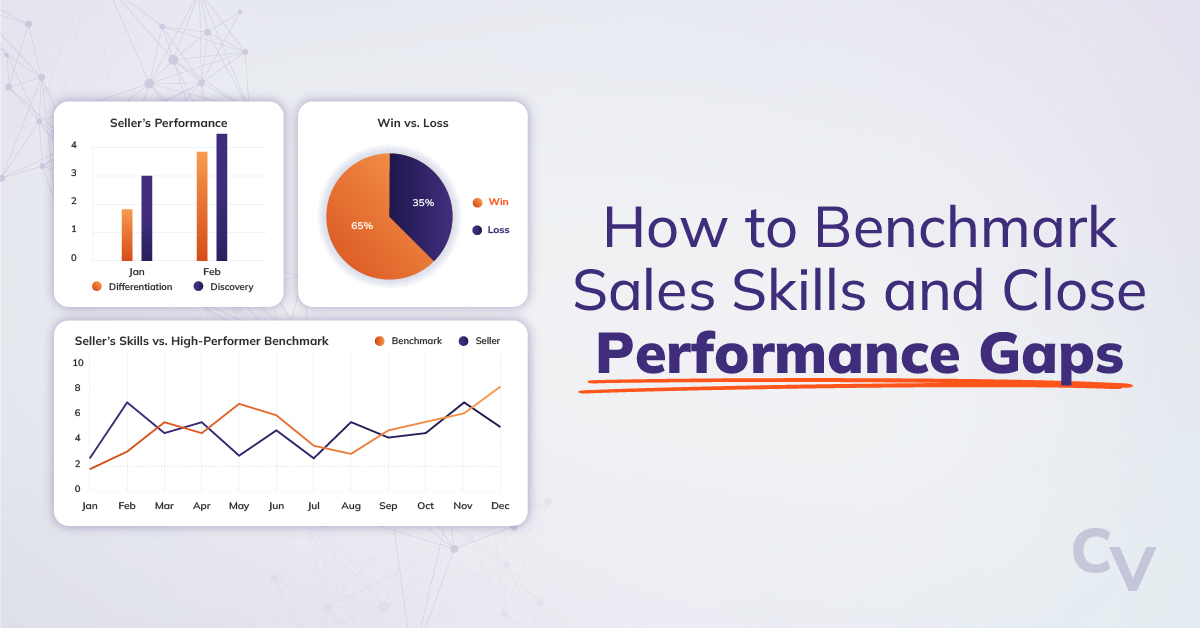
Benchmarking sales skills replaces that guesswork with evidence—measuring how sellers perform in realistic selling scenarios and comparing those behaviors against a standard tied to win rates.
This article walks you through what benchmarking involves, which competencies predict deal outcomes, and how to turn assessment data into coaching priorities that close performance gaps.
What Is Sales Skills Benchmarking?
Benchmarking sales skills means measuring how your sellers perform in their conversations with buyers, then comparing that performance against a validated standard tied to win rates. You’re not checking whether reps can recall product features or asking them to rate their own confidence. Instead, you’re looking at observable behaviors in the moments that shape buying decisions.
What’s the Difference Between a Sales Skills Assessment and Skills Benchmarking?
A sales skills assessment is how you measure individual seller performance. A skills benchmark compares that performance against a meaningful rubric, like top-performer patterns or a sales competency framework. Without that comparison point, you’re collecting data with no way to interpret it.
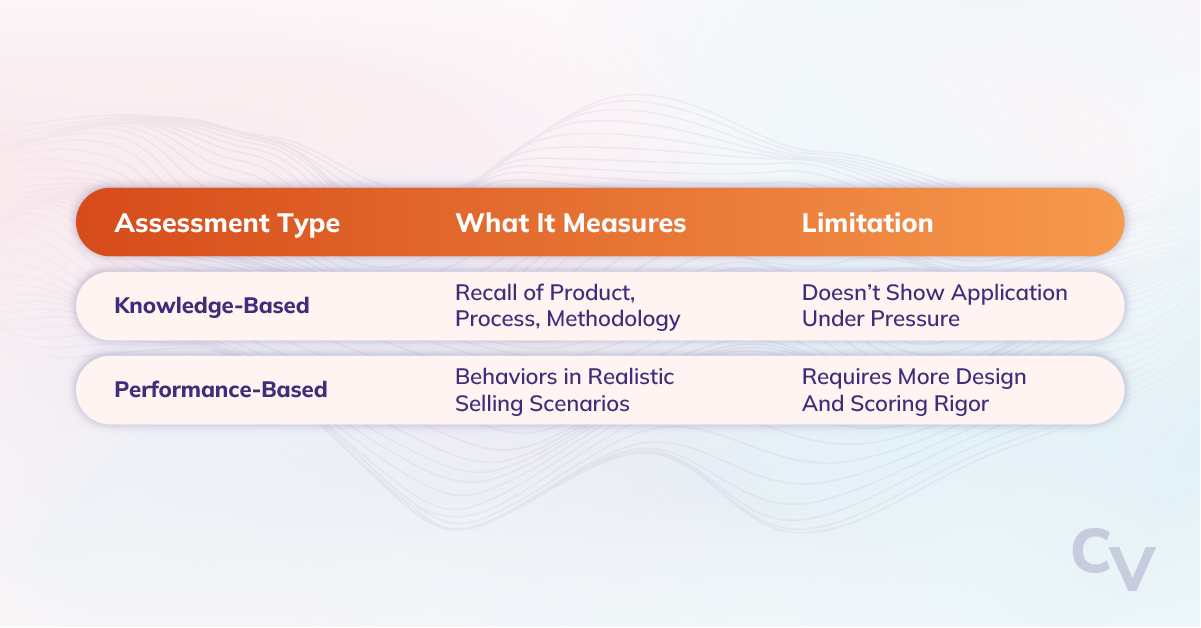
Performance-based assessments are the most accurate sales assessments. In these assessments, sellers perform in simulated deal scenarios, and you score their responses against criteria that predict wins vs. losses. Knowledge-based tests, by comparison, check recall but miss whether someone can apply what they know under pressure. The goal is to see how reps think, decide, and communicate when it counts—not just whether they memorized the pitch deck.
Why Benchmark Sales Skills?
Without objective measurement, you’re left guessing about the causes of inconsistent performance. Is it a specific skill? Messaging? Price? Product-market fit? By benchmarking your sales reps’ skills, you get objective evidence to determine what is going wrong and to focus your coaching where it will actually impact win rates.
Diagnose the Real Cause of Inconsistent Performance
Many teams assume the problem is one thing when the evidence shows another. A sales team assessment reveals whether gaps are caused by weak discovery skills, poor differentiation, unclear value articulation, or something else entirely. When you can see the pattern, you stop treating symptoms and start addressing root causes.
Replace Self-Ratings with Objective Evidence
Self-assessments and manager opinions often reflect confidence rather than competence. Sellers tend to overestimate their abilities in areas where they feel comfortable—even if buyers experience those conversations differently. Simulation-based measurement removes that bias and shows you what’s really happening in high-stakes moments.
Focus Coaching on the Skills That Predict Wins
Without benchmark data, coaching gets spread too thin. Managers end up working on whatever feels urgent or visible, rather than the competencies that correlate with deal outcomes. When you know which skills separate top performers from the middle, you can direct coaching time where it will have the greatest impact.
Prove the ROI of Sales Training Investments
Finance and skeptical leadership teams want to see a connection between enablement spend and revenue results, yet only 33% of sales leaders use assessments to measure training ROI. With benchmark data, you get a before-and-after measurement that makes that connection visible. You can show which skills improved, by how much, and what happened to win rates as a result.
Sales Skills and Competencies That Predict Win Rates
Not all sales skills matter equally. Some correlate strongly with wins while others don’t influence outcomes as much. The difference often comes down to whether the competency reflects what buyers really value in their decision-making process.
Our analysis of buyer feedback from 150,000+ B2B deals identified the competencies that predict wins and losses across acquisition and expansion motions. Not generic skills, but the precise behaviors that buyers say influenced their decision to choose the vendor, go with a competitor, or do nothing.
Discovery and Diagnosing Buyer Needs
This competency involves uncovering the real problem buyers need to solve, not just surface-level pain. Strong performers co-create a shared problem statement with the buyer, which builds alignment and urgency. Weak discovery often looks productive but leaves the buying group without a clear reason to act.
Differentiation and Building Urgency
Top sellers introduce needs the buyer hasn’t fully considered. This creates separation from competitors and gives the buyer a reason to change. Without this skill, deals stall because the status quo feels safer than any alternative.
Articulating Value and Protecting Margin
Quantifying impact and building a defensible case for change is especially critical in multi-stakeholder deals. When sellers can’t articulate value in terms the buyer cares about, price becomes the only differentiator—and margins erode.
Executive and Multi-Stakeholder Conversations
Complex deals involve multiple decision-makers with different priorities. Strong sellers navigate these dynamics and speak credibly and confidently to senior stakeholders. Weak performers lose deals because they can’t get above their initial contact.
Expansion and Renewal Conversations
The skills that win new business don’t automatically transfer to protecting and growing existing accounts. Expansion requires proving realized value, reinforcing the partnership, and navigating critical customer moments—a different set of competencies than acquisition.
How to Benchmark Sales Skills in Five Steps
The sequence here is important. Skipping steps or doing them out of order leads to wasted effort and misleading data.
Step 1: Define the Competencies That Drive Wins
Start with a competency model tied to buyer evidence, not internal assumptions or opinions. If you benchmark against the wrong competencies, you’ll optimize for skills that don’t ever influence deal outcomes.
Step 2: Choose a Performance-Based Sales Skills Assessment
What makes an assessment performance-based? Realistic scenarios and behavioral responses—not multiple-choice knowledge checks. You want to see how sellers respond when they’re in the moment, not whether they can recall the right answer on a quiz.
Corporate Visions’ Precision Skills Assessments use simulation-driven scenarios tied to the full deal cycle. Sellers are scored against competencies that predict wins, and the results reveal each rep’s strengths and gaps.
Step 3: Collect Data Across Roles and Segments
Benchmark by role (AE vs. AM vs. CSM), by segment, and by tenure. Aggregate data reveals patterns that individual scores miss. You might find that your mid-market team struggles with executive conversations while your enterprise team has gaps in discovery. That insight changes how you allocate coaching resources.
Step 4: Interpret Results Against Top-Performer Patterns
Compare results against your own top performers and, where available, external benchmarks. The goal is to identify the gaps that separate high performers from the middle. A small difference in a competency score might not matter—but a large gap in a skill that correlates with win rates is worth more attention.
Step 5: Translate Findings into Coaching Priorities
Benchmarking only matters if it changes what happens next. The output of this process should be a clear set of “coach this next” recommendations—specific competencies, for specific reps or cohorts, with clear guidance for managers on what to reinforce.
How to Close Sales Performance Gaps After Benchmarking
Measurement without follow-through is wasted effort. The real value of benchmarking shows up in what you do with the data.
Build Targeted Learning Paths by Role
Use benchmark data to assign training that addresses each rep’s specific gaps—not generic curriculum. A seller who struggles with differentiation doesn’t benefit from more discovery training. Personalized learning paths accelerate skill development and reduce time spent on content that doesn’t apply.
Equip Managers to Coach Around Skill Gaps
Managers often share the same gaps as their teams. If a manager scores low on a competency, asking them to coach it won’t work. Give managers visibility into individual skill gaps, practical coaching frameworks, and, where needed, support from internal experts or outside coaches who can model the skill.
Reinforce New Behaviors with Just-in-Time Enablement
87% of sales professionals forget training content within a month without reinforcement in the flow of work. Just-in-time enablement is an approach that delivers guidance at the moment of need—inside the CRM, during meeting prep, or in pipeline reviews. When learning is close to application, retention improves and skills show up in your sellers’ conversations.
For enablement to be “just-in-time,” as opposed to “just-in-case,” it must be:
- Where sellers already work: Plug playbooks, product knowledge, and micro-learning directly into your CRM, in the context of specific deals
- What they personally need: Personalize recommendations based on a seller’s performance data and skill gaps
- When they need it most: Integrate fluency coaching into the workflow so reps can practice, get feedback, and apply new skills on real deals
Re-Benchmark to Track Skill Progression
When you periodically reassess your sellers’ skills, you can see whether coaching and training are working. This creates an accountability loop: you can see which competencies improved, which didn’t, and where to adjust your approach. Without re-benchmarking, you’re hoping for results instead of measuring them.
How to Measure the Impact of Sales Skills Benchmarking on Revenue
The connection between skill changes and business outcomes is where benchmarking proves its value. Agree on the scorecard upfront, then track how your sellers’ skills change alongside commercial results.
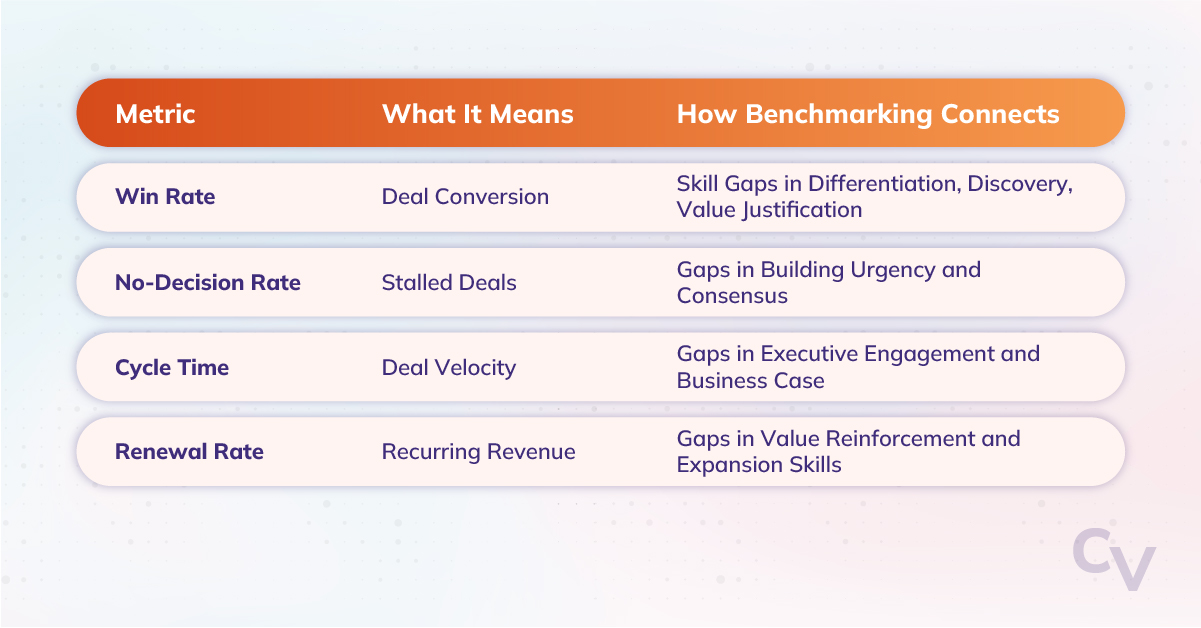
When you can show that a 15-point improvement in differentiation skills correlated with a measurable lift in win rate, the ROI conversation becomes much easier.
Turn Benchmark Evidence into Seller Performance
When you benchmark your sellers’ skills, you gain evidence to stop guessing where the problem lies and start improving the competencies that change deal outcomes. You can see where gaps exist, focus coaching on the competencies that predict wins, and measure whether your investments are paying off.
The alternative—training on assumptions, coaching on intuition, and hoping the numbers move—is how most teams operate. It’s also why most training doesn’t stick.