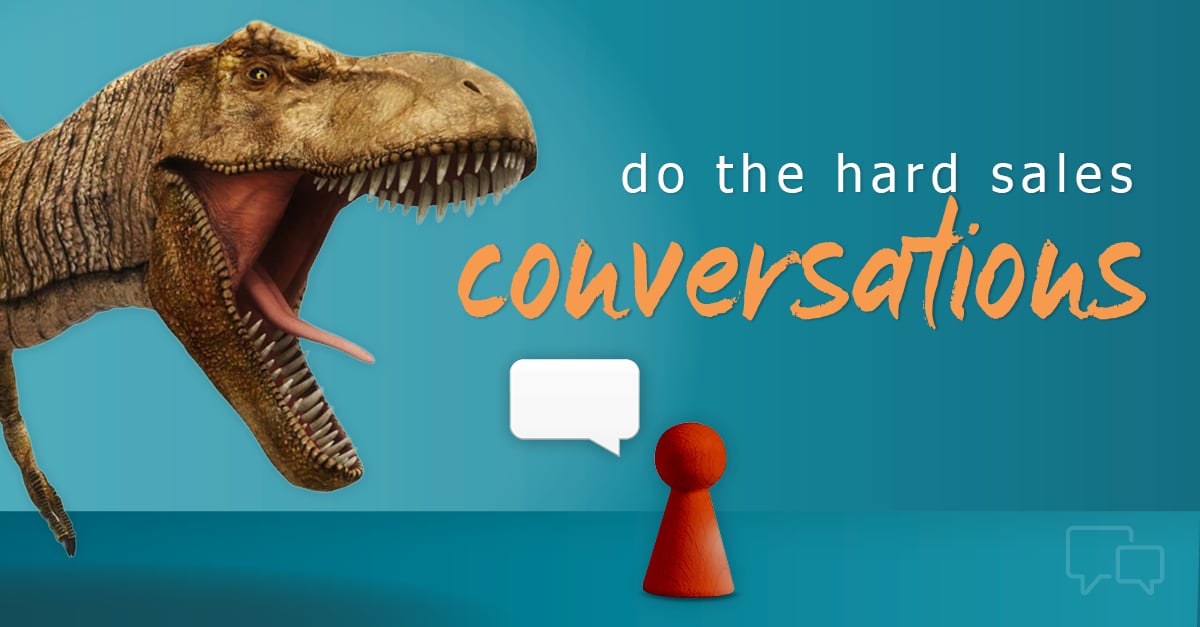
“Do the hard things.”
Fitness sites and inspirational posts often encourage tackling the most challenging exercises and the hardest tasks because it makes the rest of life easier.
But what of selling? What are the consistently hard things to address in sales?
Selling is never easy, but some conversations are definitely harder than others.
Fortunately, just like fitness instructors and life coaches offer strategies to deal with adversity, there are a few research-backed frameworks that you can use to tackle the hardest sales conversations.
“Sorry, we messed up.”
Apologizing to your customer for a service failure might be the hardest conversation.
Your customer is upset. You need to find some way to salvage the relationship, and their business. But it’s tricky to navigate such a sensitive conversation. If you don’t phrase an apology the right way, a lukewarm relationship with your customer can get very heated, very quickly.
Not only do you risk losing the customer you’ve wronged, but you also risk all potential revenue from the relationship. Losing the customer also means not only losing the current payments, but also the opportunity for future growth or expansion within the account.
It doesn’t have to be that way.
In a study with more than 500 participants across North America and Europe, researchers at Emblaze discovered the best way to apologize to a customer, using these message elements, in this specific order:
- Offer of Repair: Describe how you’re going to fix the problem and work toward rebuilding trust with your customer
- Acknowledgement of Responsibility:Demonstrate you understand your part in the service failure
- Declaration of Repentance: Promise to not repeat the problem
- Explanation of the Problem: Explain the reasons for the failure
- Expression of Regret: Express how sorry you are for the problem
Mistakes are inevitable. Lost business doesn’t have to be. Following this framework can allow you to preserve the relationship as much as possible.
Get the report, Sorry Shouldn’t Be the Hardest Word, to see the research behind the message.
“We need you to pay more.”
This might be the worst possible time to initiate a price increase discussion.
Economic headwinds, supply chain issues, logistical bottlenecks, and ongoing staffing shortages are not only inevitable—they’re happening with alarming regularity.
You can’t risk disrupting the health and longevity of customer relationships already strained by these external factors. But to stay profitable, you don’t have a choice. This is a conversation you need to have, and you need to win.
How can you persuade your customers to pay more without losing their loyalty?
More than half of sellers we surveyed felt unsure of the appropriateness or effectiveness of their price increase messaging. And nearly four out of five wanted more structure around this critical conversation.
Research from Emblaze uncovered the most effective Why Pay More message, which follows a specific sequence of steps that appeals to your customer’s psychology and motivations during price increase conversations:
- Document Results: Highlight points of progress toward their strategic goals because of your partnership.
- Review Prior Decision Process: Review how much effort went into their decision and validate the success of that decision.
- Mention Risk of Change: Underscore the risks of losing momentum in the event of a change.
- Highlight Cost of Change: Mention the potential costs of bringing in another vendor— costs they avoid by staying with your solution.
- Detail Competitive Advances: Show how you’ve kept their solution up-to-date with any advances in the market.
- Anchored Price Increase with Justification: Provide a high anchor for the price increase before offering a justification-based loyalty discount.
By following these steps, you’ll not only improve your chances at getting them to pay more, but the research also indicates you’ll also strengthen your customer’s loyalty and the relationship overall.
Get this e-book to learn the science behind effective price increase messaging.
“I know you dropped us, but can you please come back?”
Churn happens. Customers leave your company for lots of reasons, and some that may even be valid.
Unlike the hard conversations above, there isn’t yet one best message framework for asking a lost customer to return.
What you must determine first is why the customer left. Based on that information, you can then build a message that the research shows motivated buyers in similar situations to return.
Here’s how you should respond to the most common reasons why a customer chooses to leave:
- Pushed away (due to service or inventory issues): Your customer will respond best to a “We’ve Changed” message, highlighting how you—thanks to the customer’s feedback—have taken steps to fix problems that might have caused the customer to leave.
- Pulled away (because of a competitor): In these situations, your former customer wants to hear a provocative re-acquisition message that introduces previously unconsidered risks and costs associated with their choice to switch away from your solution to their current vendor.
- Priced away: There are a few ways to approach this scenario. Highlighting either how you have changed or why they should change can be successful. Additionally, a “grass isn’t greener” approach—phrased as a check-in with the customer to see whether their current vendor is meeting their expectations and whether there’s an opportunity to help fill in any service gaps—can also be effective.
Your former customers aren’t motivated by the same messages as existing customers, so it’s especially important to tailor your approach based on the situation.
We’re conducting new research on the Why Return conversations in 2023, so be on the lookout for more research, coming soon.
Get this behavioral research report to learn more about effective win-back messaging.
Just like how it’s easier to lift heavy weights if you follow your coach’s instructions, hard sales conversations are easier if you follow the prescribed steps.
So, sellers, get out there and do the hard conversations. But get the research first!