Solutions and such do some things and some other things here Maecenas sed diam eget risus varius blandit sit amet non magna. Aenean lacinia bibendum nulla.
You’re measured on different outcomes—but your success depends on the same buyer decisions. This is where you find the programs and proof built for your goals.
Choose your role to see what that looks like in practice.
When teams rely on opinions, content gets noisy and inconsistent. Our resources are grounded in buyer evidence—so you can sharpen decisions, messaging, and execution.
Find insights, articles, webinars, and more evidence-backed resources to grow revenue.
How to Apologize to a Customer: The Science-Backed Sequence That Increases Loyalty
Tim Riesterer /
July 27, 2026 /
Messaging, Retention
A poorly sequenced apology costs you more than one deal. According to research from Corporate Visions and Warwick Business School, a service failure handled in the right order doesn’t just recover the relationship. It can leave customers more loyal than if the failure never happened. Most B2B teams treat apologies as damage control, defaulting to whatever sounds professional in the moment. But when you follow a specific, research-backed sequence, you turn a moment of risk into a measurable loyalty gain.
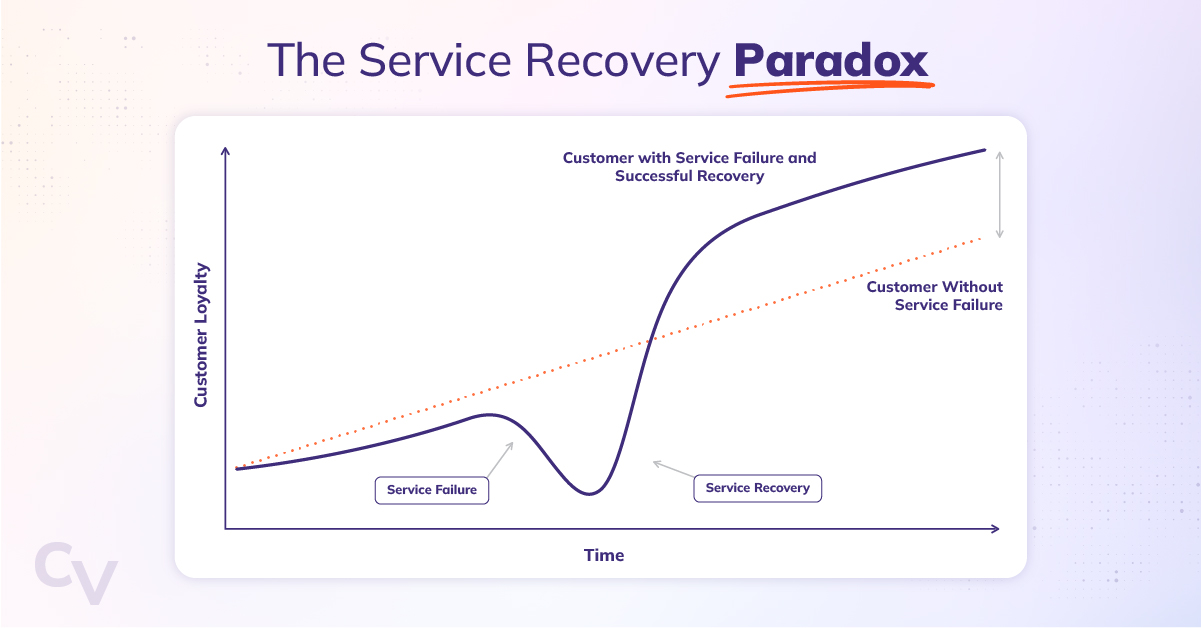
The underlying principle is called the Service Recovery Paradox: a situation in which customers rate their supplier more highly after a corrected failure than they would have without the incident.
For revenue teams managing complex accounts, you’re looking at a retention and expansion opportunity hiding inside your worst customer moments. Are you sequencing that apology in the order that rebuilds trust fastest?
The Service Recovery Paradox: Why a Service Failure Can Increase Loyalty
The Service Recovery Paradox describes a counterintuitive pattern in buyer behavior: When you resolve a failure well, customers often become more loyal than they were before the problem occurred.Hübner, Wagner, and Kurpjuweit (2018), published in the Journal of Business & Industrial Marketing, explored conditions that enable this effect in B2B relationships, proposing that the paradox extends to complex, multi-stakeholder commercial environments. The mechanism is straightforward. A strong recovery signals competence, accountability, and investment in the relationship—three qualities buyers can’t observe when everything goes smoothly.
In B2B, the commercial implication is sharper. You’re not protecting a single transaction. You’re protecting recurring revenue, expansion potential, and the internal champion who went to bat for your solution. A well-executed apology reinforces that champion’s decision and gives them evidence to defend the relationship internally. A poorly handled one hands ammunition to the people inside the account who preferred a different vendor.
The Service Recovery Paradox: Increase customer loyalty after a service failure.
What Research Says About Effective Apologies
Lewicki, published in Negotiation and Conflict Management Research in 2016, studied apology effectiveness across two experiments and identified six components present in the most successful apologies. Five of those six are most relevant in B2B service recovery:
Acknowledgement of Responsibility: Demonstrate you understand your role in the failure
Offer of Repair: Describe how you’re going to fix the problem and rebuild trust
Explanation of the Problem: Explain the reasons behind the failure
Expression of Regret: Communicate that you’re sorry for the impact
Declaration of Repentance: Commit to preventing a recurrence
Researchers named the components, but this doesn’t tell you which combination or sequence produces the strongest recovery, especially in B2B contexts where buyers often expect a “just-the-facts” approach over anything that sounds emotional. (Corporate Visions’ research methodology is designed to answer exactly these kinds of applied questions.) The gap between knowing the parts and knowing the order is where most apologies lose their impact.
The Science-Backed Sequence for Customer Service Apologies
To identify the most effective sequence for customer apologies in a B2B setting, Corporate Visions partnered with Dr. Nick Lee, Professor of Marketing at Warwick Business School, on a controlled study with over 500 participants across North America and Europe. The study placed B2B buyers into realistic service-failure scenarios and measured their responses across multiple outcome variables.
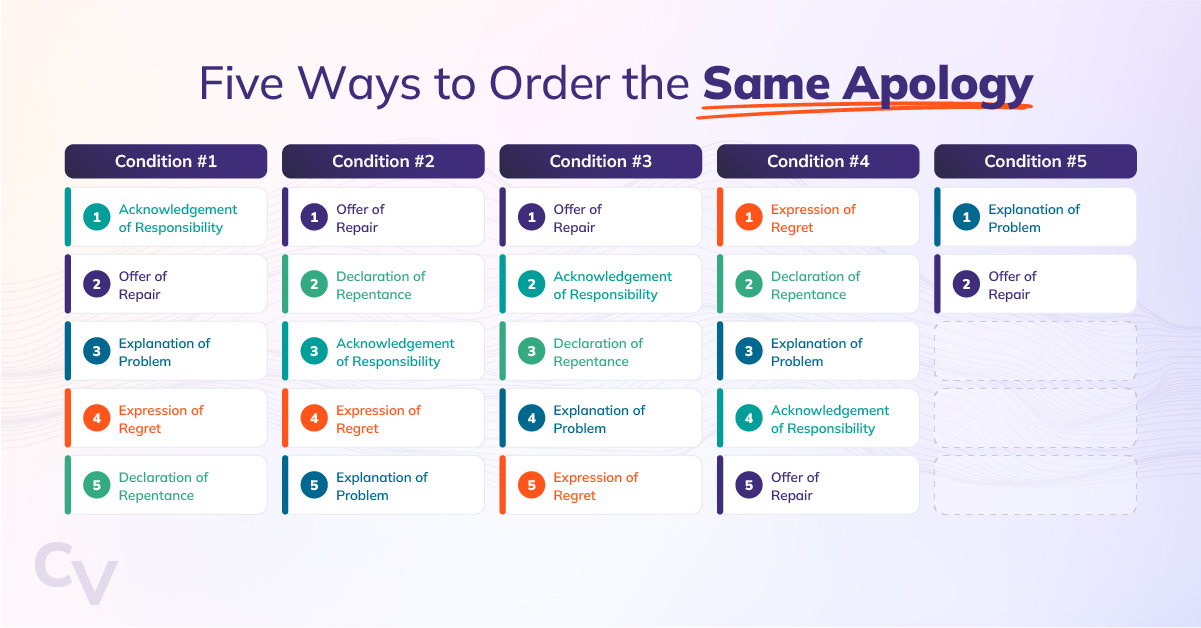
Participants in the study were told about a supplier’s catastrophic service failure, then each read one of five variations of the apology response. The research measured behavioral outcome questions—willingness to continue buying, willingness to recommend, and confidence in resolution—rather than generic satisfaction scores.
Five apology messages were tested in Corporate Visions research.
You might not expect subtle ordering changes to shift outcomes significantly. After all, the only difference across conditions was the sequence of phrases. Every condition used the same core language.
But the results were decisive. When participants answered follow-up questions (how likely are you to buy more from the supplier, recommend them, or feel confident the incident was fully addressed), one apology framework consistently outperformed the rest.
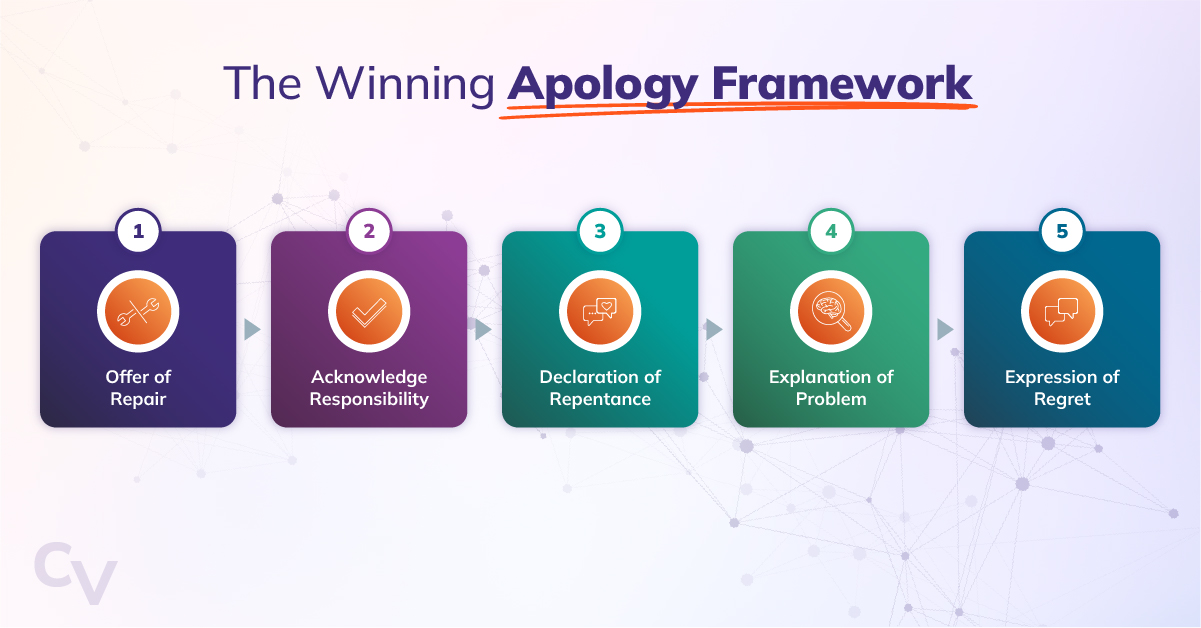
The winning science-backed sequence for effective apologies: Offer of Repair, Acknowledge Responsibility, Declaration of Repentance, Explanation of Problem, and Expression of Regret.
The best customer apology message framework, backed by research.
This order works because it front-loads what the buyer needs most in a high-stakes moment: evidence that the problem will be fixed. Leading with repair signals competence and reduces anxiety before the emotional components land. The “emotionless” condition, which included only factual components, consistently landed at or near the bottom on every measure.
For B2B teams, stripping emotion out of an apology doesn’t project professionalism as many companies might assume. Instead, it projects indifference. Buyers need to hear both the fix and the accountability before they’ll re-engage with confidence. And the order matters: repair first, regret last. Reversing the sequence, even with identical words, weakens the recovery effect.
Examples: How to Apply the Framework to Common Scenarios
Each example below follows the science-backed sequence: Offer of Repair first, then Acknowledge Responsibility, Declaration of Repentance, Explanation of Problem, and Expression of Regret. Notice how leading with the fix immediately lowers the buyer’s anxiety and creates space for the emotional components to land. You can adapt the specific language to your industry, but keep the structural order intact.
Delayed Delivery or Missed Deadline
“We’ve already escalated this to our fulfillment team, and your revised delivery is confirmed for Thursday. The delay was our responsibility. We had a scheduling conflict in our logistics queue that we failed to flag early enough. We’re adding a secondary check to prevent this from recurring. The root cause was a system migration that temporarily disrupted our order routing. I’m sorry for the disruption this caused to your team’s timeline.”
Billing or Pricing Error
“Your account has been credited for the overcharge, and the corrected invoice is in your inbox now. This was our mistake, a configuration error during your contract renewal that we should have caught in review. We’ve added a verification step to our billing workflow so this type of error doesn’t reach customers again. The issue originated from a field-mapping error between our CRM and billing platform. I regret the time your finance team spent tracking this down.”
Product or Service Failure
“Our engineering team deployed a patch this morning, and the functionality you reported is fully restored. The downtime was our fault, a regression in our last release that bypassed our test coverage for your integration type. We’re expanding our regression suite to cover this scenario going forward. The failure was triggered by a database query change that affected accounts using your API configuration. I’m sorry for the productivity your team lost during the outage.”
Poor Support Interaction
“I’ve assigned a senior account manager to your case, and they’ll contact you by end of day with a full resolution plan. The experience you had with our support team fell below the standard we owe you, and I take responsibility for that gap. We’re retraining the team on escalation protocols for enterprise accounts this quarter. The breakdown happened because your ticket was routed through our general queue instead of your dedicated support tier. I apologize for the frustration and wasted time.”
Customer Service Apology Phrases That Work (and What to Avoid)
Phrases That Demonstrate Each Component
Use these as starting templates, then customize with the specific details for your situation. Generic versions of these phrases still outperform well-phrased alternatives delivered in the wrong order.
Offer of Repair:
“Here’s what we’ve already done to fix this…”
“Your account has been corrected, and here’s the timeline for full resolution…”
“We’ve implemented [specific action] to restore your service.”
Acknowledge Responsibility:
“This was our mistake, and I take full ownership.”
“We failed to [specific action], and that’s on us.”
“The responsibility for this sits squarely with our team.”
Declaration of Repentance:
“We’re changing [specific process] to make sure this doesn’t happen again.”
“Here’s the structural fix we’re putting in place…”
“We’ve added [specific safeguard] to prevent a recurrence.”
Explanation of Problem:
“The root cause was [specific, honest explanation].”
“This happened because [factual cause], which we should have anticipated.”
Expression of Regret:
“I’m sorry for the impact on your team’s [specific consequence].”
“I regret the time and frustration this cost you.”
Phrases to Avoid
These phrases appear in customer service scripts across industries. Each one undermines recovery because it violates one or more components of an effective apology.
“We apologize for any inconvenience.” Too vague and minimizing. It signals you don’t understand the actual impact on the customer’s operations.
“Unfortunately, this is outside our control.” Deflects responsibility, which the research shows reduces recovery outcomes regardless of whether the deflection is technically accurate.
“Per our policy…” Shifts the conversation from accountability to bureaucracy. Buyers hear “I won’t fix this.”
“We’re sorry you feel that way.” Implies the problem is the customer’s perception, not your failure. This phrasing scores poorly on every recovery metric.
“This rarely happens.” Irrelevant to the customer experiencing it right now, and it can sound dismissive of their specific situation.
“Let me look into this and get back to you.” Without a specific timeline or committed action, this reads as a delay tactic that leaves the buyer uncertain about resolution.
B2B Customer Apologies: When the Stakes Are Higher
B2B apologies carry weight that consumer apologies don’t. You’re often addressing multiple stakeholders: the daily user who experienced the failure, the manager who approved the purchase, and the executive who signed the contract. Each audience needs a slightly different emphasis, but the sequence remains the same. The daily user wants to know the fix is in place. The manager wants confidence it won’t recur. The executive wants to know their vendor decision still looks sound.
The recurring revenue dimension adds pressure. Corporate Visions data from thousands of B2B customers shows only a 54 percent correlation between NPS and retention likelihood—barely better than a coin flip. Surface-level satisfaction scores won’t warn you that a poorly handled failure has eroded the relationship underneath. A single mishandled incident can shift a renewal conversation from routine to contested, or give a competitor an opening they didn’t have a week ago. In enterprise accounts, a botched apology can travel through a buying committee faster than the original failure.
There’s also the “emotional vs. factual” debate that persists in many B2B cultures. Leaders who pride themselves on “just-the-facts” communication might instinctively strip the emotional components from an apology. But the Corporate Visions and Warwick research found this approach consistently underperformed. Factual-only responses ranked at or near the bottom on likelihood to repurchase, recommend, and confidence in resolution. Removing emotion doesn’t project strength—it projects disengagement at the moment when your customer most needs to know you’re invested.
The takeaway for customer success and account management teams is to follow the full five-component apology sequence regardless of how “data-driven” your customer culture claims to be. The research is clear that buyers across industries respond to accountability and empathy, not just technical resolution. If you manage strategic accounts, train every customer-facing team member on the sequence so your recovery quality doesn’t depend on who picks up the phone. Resolving concerns responsively is one of eight expansion competencies that drive retention and account growth.
After the Apology: Following Up and Preventing Repeat Failures
The Declaration of Repentance only builds trust if you follow through. Within 48 hours of the initial apology, confirm the specific changes you committed to. Two weeks later, check in to verify the customer hasn’t experienced a recurrence. This follow-up cadence does two things: it proves the commitment was structural, not just verbal, and it gives you a natural moment to re-engage on commercial terms.
Document every failure and resolution in a shared system your team can reference. Patterns that show up twice become systemic risks, and they supply the data to justify operational investments that prevent the third occurrence. When your team can point to a documented pattern and a structural fix, the Declaration of Repentance stops being a promise and becomes a track record.
The broader opportunity is this: a customer who watched you diagnose, fix, and prevent a problem has stronger evidence for your value than one who never saw you under pressure. Sharing your recovery process visibly—not just with the affected customer but with other stakeholders who can observe it—reinforces the Service Recovery Paradox effect because it demonstrates organizational vulnerability and reliability simultaneously. You’re demonstrating the Service Recovery Paradox in practice. That’s available to any team willing to treat apologies as a discipline, not a scramble. And the customer who saw you perform under pressure becomes a stronger internal advocate when renewal or expansion conversations arrive.
FAQs
How do you professionally apologize to a customer?
Lead with the fix. State what you’ve already done or will do to resolve the issue, then take clear responsibility for the failure. Follow the research-backed sequence from the Corporate Visions and Warwick Business School study: Offer of Repair, Acknowledge Responsibility, Declaration of Repentance, Explanation of Problem, and Expression of Regret. Specificity signals competence; vagueness signals avoidance. A professional apology names the problem, owns it, and describes what changes structurally so the customer sees evidence of follow-through.
What are the five parts of an effective apology?
Lewicki et al. (2016) identified six components of effective apologies. The five most relevant to B2B service recovery are: Acknowledgement of Responsibility, Offer of Repair, Explanation of the Problem, Expression of Regret, and Declaration of Repentance. The Corporate Visions and Warwick Business School study found that the sequence in which you deliver these components significantly affects customer recovery outcomes. Of the five, Offer of Repair had the highest individual effect on buyer confidence.
Should you offer compensation when apologizing?
Compensation can reinforce an apology, but it shouldn’t replace the sequence. Buyers in the Corporate Visions study responded most strongly to accountability and committed prevention, not financial gestures alone. If you offer compensation without following the full framework, you risk signaling that money substitutes for operational change. Lead with the fix and the commitment first; compensation works best as a supporting gesture, not the centerpiece.
Tim Riesterer, Chief Strategy Officer at Corporate Visions, is the sought after expert on evidence-based revenue growth using counterintuitive approaches. Known for his candid thought leadership and engaging keynotes, he’s spent decades testing and refining go-to-market strategies that put buyers squarely at the center. Tim is the author of four insightful books, including Customer Message Management, Conversations that Win the Complex Sale, The Three Value Conversations, and The Expansion Sale.