In my previous article, I revealed the secrets of a magic trick called set-piece storytelling.
- What it is: Equipping business development teams with a curated collection of sharp, modular, reusable narratives—often with a visual (but not always)—designed for winning critical moments in buyer conversations.
- Why it’s needed: Because enterprise sales cycles are increasingly chaotic, loaded with more informed stakeholders and unpredictable twists and turns. Sellers need resources and tools that support the all-important meta-skill known as situational fluency (i.e., your sellers’ ability to adapt to specific buying situations with insight, empathy, and confidence).
Today, you’re going to go beyond the what’s and why’s of set-piece storytelling and dive into the how’s and when’s. In other words, you won’t just know what the trick is and why it works—you’ll learn how to perform it yourself. So grab your top hat and let’s go!
Matching the Right Set-Piece Stories to Critical Moments
Before getting too deep into the mechanics, I want to highlight a key phrase in the definition of set-piece storytelling: “designed for winning critical moments in buyer conversations.”
The goal isn’t to load teams down with dozens of set-pieces that cover any and all possible situations. You want to prioritize and be selective.
It’s also important to realize that set-pieces come in different sizes and shapes—just like magic tricks. There are the big illusions that must be expertly choreographed and practiced. And there are the simple card tricks anyone could perform in 30 seconds.
The key is to identify the moments you need to win, and match the right set-pieces to those moments based on their importance and timing in the sales cycle.
Finding Where You Need to Win
Finding the moments that are worthy of set-pieces often involves a mix of old-school investigative research and new-school technology muscle. Here are a few reliable avenues to explore:
- Ask your revenue teams: Sit down with BDRs, AEs, and CSMs, and ask questions like, “What do prospects always seem to get stuck on? What are the most common objections you keep running into? When these come up, what has worked—and what hasn’t?” If you have really large teams, you could also do a survey to capture ideas at scale.
- Ask your customers: If you’re doing any kind of voice-of-customer research or win/loss analysis, look for recurring themes. What’s most important to buyers? What win drivers can you lean further into? What loss drivers can you proactively adjust for?
- Ask your AI: Many companies use call recording or conversation intelligence tools, such as Gong. Take sequences of call transcripts that have led to wins and losses, and ask AI to look for trends. What were common issues in losses? What were focal points in wins? And if there are themes that regularly appear in both wins and losses, what makes the conversation go one way or the other? You can even ask AI to spot examples of elegant responses that helped create momentum (Protip: Capture those and save for later).
Once you gather enough intel, you can triangulate and land on a prioritized list of moments that are high frequency, high impact on wins and losses, and emotionally charged.
Now that you have your list, it’s time to build some set-pieces!
Different Needs Across the Sales Cycle
While this isn’t a hard and fast rule, the type of set-piece you need can often be determined by where the critical moment appears in the overall sales cycle.
Early-stage conversations are when your teams are setting the vision, challenging buyers’ mindsets and biases, and positioning unconsidered or undervalued needs. Visual storytelling is incredibly powerful here, whether drawing on a whiteboard or clicking through animations in slides.
For these moments, consider a set-piece that visualizes contrast between the as-is (i.e., the pain and risk of their status quo) and the to-be (i.e., the new possibilities and outcomes of working with you). This helps make your point of view more credible, memorable, and persuasive.
- Example: Corporate Visions sellers and consultants use a whiteboard set piece called the “Sideways T” to illustrate the need for a different kind of sales conversation.
Mid-stage conversations are often when you need to demonstrate your solution: how it works, the value it provides, etc.
Classic demos typically speed through the 50 cool things your product can do. How do you turn that into a set-piece? By putting your capabilities into the context of buyer challenges by using the Messaging Pyramid to translate what’s cool about your product into what the buyer can do differently and better with it.
So instead of one long demo, you break it up into chunkier set-pieces organized around common pain points (that you likely unearthed during your earlier research).
- Example: I recently worked with a software company that identified unique pain points that their solution addresses at different altitudes within client organizations:
- Leaders with limited visibility of activities
- Cross-functional teams struggling to collaborate
- Individual contributors wasting time gathering needed information
The same core functionality solves for all three, but they’re reorganizing what use cases they highlight, what features they demo, etc. based on the unique pain points of each audience.
Mid-to-late stage conversations are when buyer objections tend to surface most frequently (though they can appear anywhere). Most enablement teams do a great job of cataloging objections and providing FAQ-like responses for revenue teams. That works well when objections are logical and rational. But when they’re emotional, no amount of information is going to unstick a stubborn buyer.
These kinds of objections can’t just be responded to—they need to be reframed. How? First, put your objections into two buckets: rational and emotional. Continue to use FAQs for the rational ones, but take a more careful approach with the emotional ones. For these, you want to follow a tested framework: acknowledge the objection, step into it with facts, then reframe it using a story, analogy, or turn of phrase.
Remember I told you to bank any elegant responses from your call transcript research? Use them here!
- Example: A medical devices company kept running into the same objection from doctors. Patients were complaining about some bleeding that occurred after a certain procedure. Even though this side effect was normal and not severe, the bleeding was affecting patient satisfaction. Some doctors worried that this reflected poorly on their reputation, which made them hesitant to schedule more procedures. How could we tell this was an emotional objection and not a rational one? Because the vast majority of patients experienced excellent long-term outcomes. The logical choice would be to just deal with a bit of bleeding to get the great results, but doctors kept getting stuck. In our workshop, one of this company’s best sellers told a story about how he handles the objection. He uses an analogy, which helps doctors (and patients) view the bleeding differently: not as a negative side effect, but as a positive sign that the therapy is working as intended. We were then able to turn his reframe into a short talk track that every seller would learn at the medical devices company’s sales kickoff.
A Shortcut for Creating Set-Piece Stories
These are just a few examples of the critical moments your team faces and the types of set-pieces that can help them win over buyers. Once you start looking for them, you’ll see opportunities everywhere.
But I don’t want you to get overwhelmed! If you’re looking for guidance on where to start, Corporate Visions has an evidence-based sales competency framework for that.
Using insights from more than 150,000 B2B buying decisions in our win/loss database, we’ve isolated the seller behaviors in buyer-critical moments that predict wins and losses for both acquisition and expansion motions.
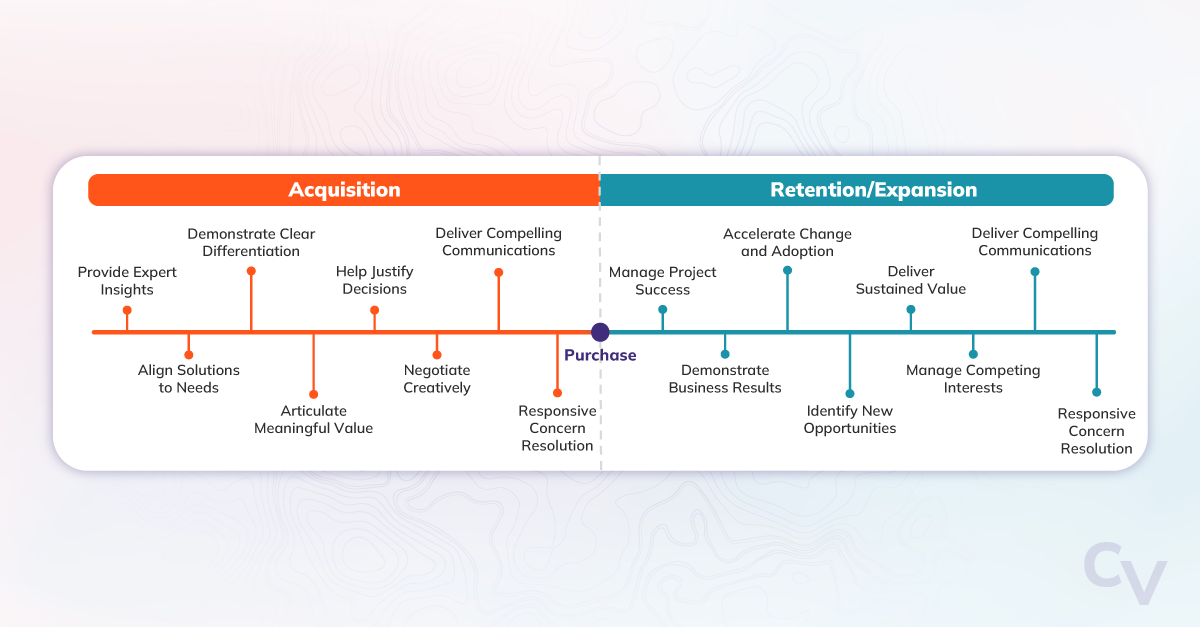
The set-piece examples from earlier easily slot into this framework: The “Sideways T” whiteboard fits into “Make a Case for Change,” the contextual demos would be included in “Demonstrate Clear Differentiation,” and the objection reframe in “Resolve Concerns Responsively.”
Looking at this list, you might immediately know where your teams are strong—and where they could use some additional support. And now that you know about set-piece storytelling, you can decide what kind of magic will do the trick.
Voilà! [Throws smoke bomb and disappears in a haze of fluorescent light.]