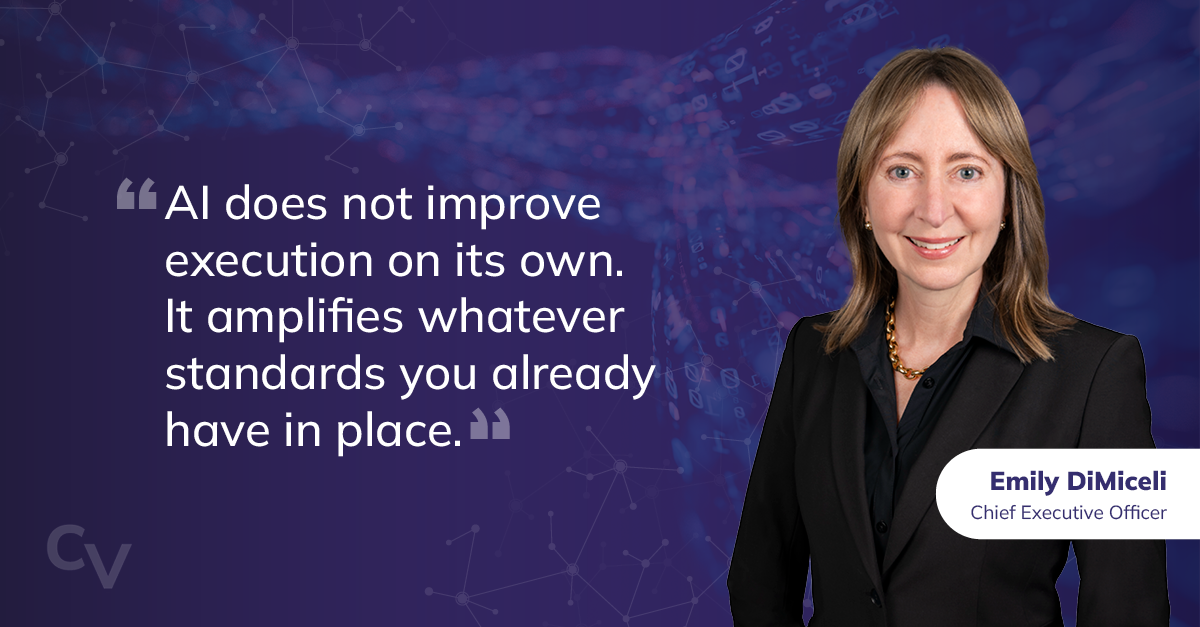
A photo of Emily DiMiceli and her quote: "AI does not improve execution on its own. It amplifies whatever standards you already have in place."

Who Governs What Good Looks Like When AI Starts Shaping Seller Behavior?

Revenue leaders are feeling the pressure to move quickly on AI.

Over the past few weeks alone, Microsoft released Agent Framework 1.0 with support for agent interoperability. Seismic added AI agents and MCP support to its platform. And Gong is pushing further into proactive AI agents for revenue teams.

This has moved well beyond experimentation.

AI is being woven into the workflows that determine how sellers prepare for conversations, engage buyers, and decide what to do next. It will inevitably influence what sellers do and say in their conversations with your buyers.

But AI does not improve execution on its own. It amplifies whatever standards you already have in place. 

If you have a clear, evidence-based view of which seller behaviors move deals forward, AI can help reinforce that standard. If you don’t, AI can spread inconsistency just as quickly.

Revenue leaders need to take this seriously because you’re introducing systems that will ultimately shape sellers’ judgment, execution, and consistency across your organization.

So, who governs what good looks like when AI starts shaping seller behavior?

That responsibility belongs to CROs. They’re the ones who have to decide what good looks like, and whether the standard behind it holds up with buyers.

The problem is that many sales organizations already have a gap here.

One recent survey found that most sales organizations have a defined sales process, but only 36 percent say their teams follow it consistently.

That should get every CRO’s attention. If there’s already a disconnect between the standard you defined and the way your team executes, AI will not solve it. Once AI starts influencing more of those moments, the gap becomes harder to ignore.

Now more than ever, you need a governed standard for what good selling looks like in your business.

That means being able to answer a few important questions with confidence:

  • What seller behaviors are you trying to reinforce?
  • What evidence tells you those behaviors improve outcomes?
  • How are you connecting methodology, coaching, and execution in a way that holds up across deals?
  • How are you updating that standard as buyer expectations, market conditions, and commercial pressures change?

Without that kind of governance, AI can’t be trusted to make sellers more effective.

AI will keep getting better at generating recommendations, guidance, and next steps. The hard part is deciding which of those recommendations reflect the way you want your team to sell.

That’s where leadership has to be explicit about what it wants sellers to reinforce in the field.

As AI becomes more embedded in revenue execution, the advantage will go to organizations that know how sellers should engage buyers, support that standard with evidence, and keep it current as conditions change.

If you have a clear standard, grounded in evidence, and actively maintained, AI can reinforce it at scale.

If you don’t, AI will only make the gaps easier to see.

Do these questions resonate with you? If so, let’s talk!

Related Posts
Feedback Is the New Forecast: How Buyer Feedback Improves Sales Performance
Buyer feedback reveals why deals are really won or lost and how to improve the next one. Learn how sales...
Leading with Precision: The Discipline Behind Predictable Revenue Performance
Explore how precision in systems, buyer psychology, messaging, and leadership drives predictable revenue...
Elevating Performance in a Changing Market: Advice from Four Revenue Leaders
Learn from sales executives and academics as they share practical insight on strengthening talent, refining...
About the Author
Emily DiMiceli

Emily DiMiceli

Emily DiMiceli, Chief Executive Officer, has experience leading large-scale, global, and multi-functional transformational change initiatives to drive growth. Her experience includes rewiring all aspects of customer-facing operations, including sales and service operations, marketing, professional services, and data delivery to create lasting customer and business impact. Emily is passionate about developing future leaders, encouraging a growth mindset in her teams, and championing global and inclusive ways of working to create great company cultures.