For revenue leaders, today’s market feels, at times, unprecedentedly unpredictable.
Your buyers feel it. Your sellers feel it. And if you’re trying to explain how the business will still deliver predictable growth, you definitely feel it.
That pressure creates a familiar trap.
When growth gets harder to find, revenue teams often respond by tightening the process, adding more inspection, and looking for more leverage from AI.
That might seem logical, but it’s like trying to improve a restaurant by reorganizing the kitchen while ignoring what happens at the table. The back of the house is important. But nobody leaves talking about how efficiently the line was stocked.
Revenue growth works the same way.
You still need efficiency behind the scenes, but your number depends on what happens at the table—in the conversations between sellers and buyers.
AI Can Scale the Process But It Can’t Secure the Decision
Gartner predicts that by 2030, 75 percent of B2B buyers will prefer sales experiences that prioritize human interaction over AI at critical decision points in complex, high-stakes transactions.
For the last few years, many teams have been marching toward digital, self-serve, and rep-free buying. And for simpler, low-stakes transactions, that’s probably where things will keep heading.
But when the decision is complex, high-stakes, and muddled by competing opinions, buyers still want human engagement.
As AI takes over more routine work, those conversations carry more weight. They have to do more work, and right now, most sales teams aren’t nearly good enough at them.
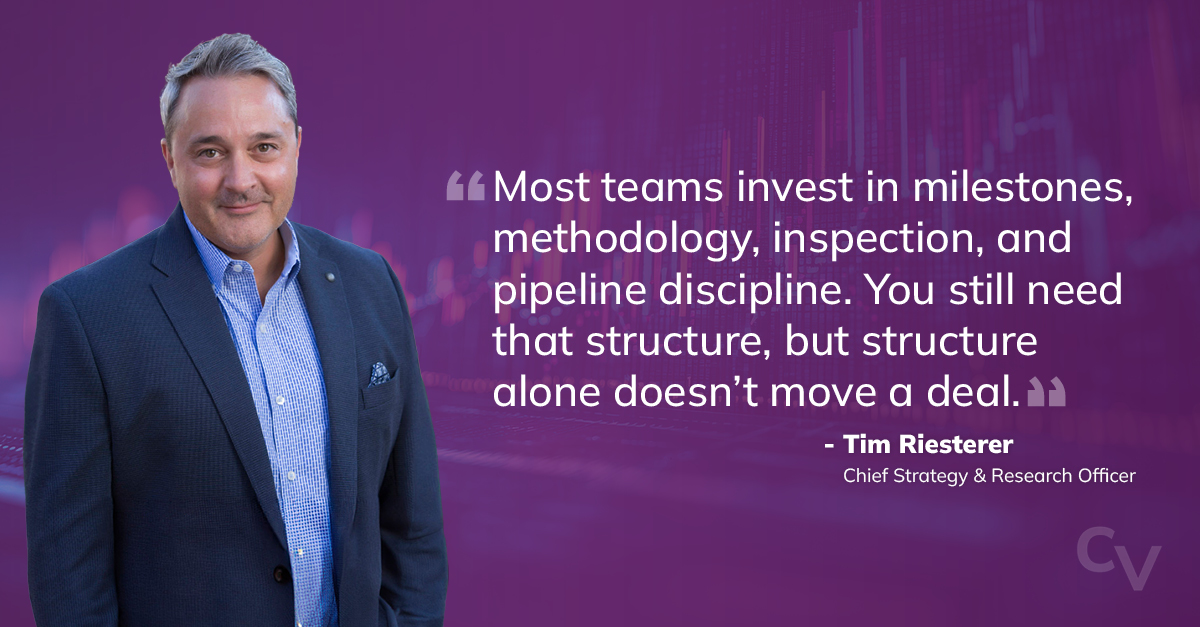
Most teams invest in milestones, methodology, inspection, and pipeline discipline. You still need structure, but structure alone doesn’t move a deal.
Know the Moments
The first job is to stop guessing which interactions make a difference.
Not what your reps say. Not what your CRM says. But what buyers say shaped the outcome.
That’s a higher standard. And it’s the right one.
In our analysis of more than 150,000 B2B decisions across industries, buyers and sellers gave different reasons for why the deal was won or lost in up to 70 percent of deals.
If your goal is understanding what predicts wins and losses, the buyer’s version matters more. And buyers don’t describe vague competencies. They describe specific moments in the sales experience that sway their decisions.
Did your team align to the real problem? Make a credible case for change? Articulate value in a way decision-makers could use? Help justify the decision?
Those are the moments that shape outcomes.
Improve the Moments
The second job is improving performance in those moments.
This is where one-size-fits-all enablement starts to break down. Broad training might feel scalable. It’s also a very efficient way to teach a lot of people things they don’t need while missing the interaction gaps that are costing you deals.
What works better is precision.
Assess who is strong at what. Identify where teams or cohorts are struggling. Then intervene with targeted learning, practice, coaching, and reinforcement.
Training should work more like sunlight than a seminar—continuous exposure in small, useful doses, not a one-time event you hope will somehow stick.
Scale the Moments
Knowing the right interactions is useful. Coaching individuals against them is helpful. But predictable growth requires a revenue engine that can produce those interactions consistently across teams, roles, and stages.
That only happens when three things work together:
- The steps your teams follow
- The skills they need to execute those steps
- The stories they tell in those moments
When those three are disconnected, the customer experience feels fragmented. When they work together as a system, conversations become more relevant, more consistent, and easier to scale.
Predictable growth doesn’t come from making the process look tighter on paper. It happens in the moments where buyers decide whether to move forward, slow down, or start looking for the exit.
That’s where deals advance. Or don’t.