Solutions and such do some things and some other things here Maecenas sed diam eget risus varius blandit sit amet non magna. Aenean lacinia bibendum nulla.
You’re measured on different outcomes—but your success depends on the same buyer decisions. This is where you find the programs and proof built for your goals.
Choose your role to see what that looks like in practice.
When teams rely on opinions, content gets noisy and inconsistent. Our resources are grounded in buyer evidence—so you can sharpen decisions, messaging, and execution.
Find insights, articles, webinars, and more evidence-backed resources to grow revenue.
It’s a quarterly business review about 90 days before renewal.
The customer’s been live for two years. Adoption is solid. There are real wins you can point to.
The first part of the call is going fine.
The account manager walks the numbers. Usage is up. Time-to-resolution is down. Ticket volume dropped. The sponsor even throws in a couple “yeah, we’ve seen that too” comments. It’s the kind of recap that makes renewal feel like a formality.
Then you hit the pivot.
The expansion idea comes up. Your team proposes a new module, an add-on, and the next phase of the relationship. Muscle memory kicks in, and you reach for the same story that works in new-logo deals: the market’s shifting, the old way is “broken,” and anyone who doesn’t change is already behind.
Nobody calls it out. No one gets angry. Someone nods politely.
But the vibe changes anyway.
The sponsor stops volunteering stories. Questions get colder and more comparative. Finance leans in and asks the one question you were hoping not to invite:
“How does this stack up against other options?”
That’s the moment where expansion turns into re-evaluation.
Expansion Is Not Acquisition
Acquisition and expansion are two entirely different commercial situations, involving different buyer psychology and different perceived risks.
Yet, nearly two-thirds of companies don’t differentiate their messaging and content between acquisition and expansion.
Most teams talk about customer acquisition and customer expansion like they’re just different pipeline stages.
They’re not.
In fact, using a disruptive/challenger message with existing customers makes them at least 10 percent more likely to leave than messaging that reinforces the status quo with you.
So if you’re using the same story for both motions, you’re putting your revenue at risk.
Think of It Like Switching Gears
Acquisition and expansion aren’t two versions of the same drive. They’re different gears.
Acquisition is first gear. You need torque. You’re pulling a buyer out of inertia.
Expansion is a higher gear. You need momentum. You’re keeping traction while asking for a lane change.
Same car. Same engine. Totally different physics. All driven by one force that few sales teams plan around: Status Quo Bias.
The Two Sides of the Status Quo
Status Quo Bias is the psychological phenomenon where people prefer not to change what they’re already doing, even when change is objectively better.
It plays very different roles for buyers, depending on whether you’re trying to win a new logo or grow an existing account.
In acquisition, you’re outside the status quo.
Your prospect is biased toward what they already do, what they already buy, or who they already use. Even if they don’t love it.
So your job is to defeat Status Quo Bias.
This is where a disruptive, challenging story earns its keep: you make the current path feel unsafe, insufficient, or quietly expensive—and you give them a credible reason to take action.
In expansion, you are the status quo.
Now you’re the incumbent. You’re the known quantity. You have, what we call, the Incumbent Advantage. Meaning, your customer invested time, budget, and political capital in you, and they don’t want to change if they don’t have to.
So your job becomes evolving the relationship (without disrupting it).
This is where most expansion motions blow a tire, because you’re trying to do two things at once:
protect the existing preference, and
introduce change
If you deliver a disruptive, provocative, acquisition pitch in an expansion conversation, you’re more likely to lose the deal—and the customer relationship.
What Causes Status Quo Bias?
In his 2003 paper The Psychology of Doing Nothing, political scientist Christopher J. Anderson provides a detailed review of decision avoidance behaviors, including Status Quo Bias.
Building on earlier research, Anderson’s work highlights four key factors that contribute to people’s natural resistance to change.
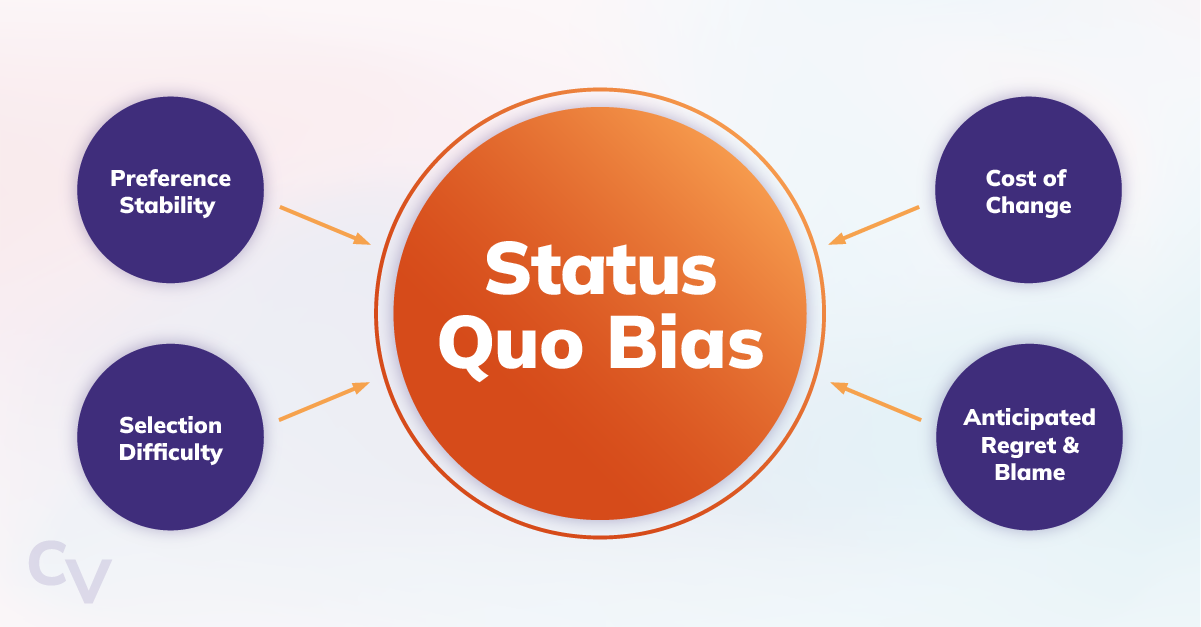
The four underlying causes of Status Quo Bias.
Preference Stability: People don’t like changing their minds once they’ve formed an opinion
Anticipated Regret/Blame: People worry they’ll regret making a change that goes wrong
Cost of Action/Change: Switching to something new feels like too much work
Selection Difficulty: Having too many options makes people tend to stick with what they know
Now watch what happens when you adapt your approach for acquisition vs. expansion conversations.
Acquisition: Defeat the Status Quo
In acquisition, those four forces are holding the buyer in place. So you have to apply pressure in the right spots.
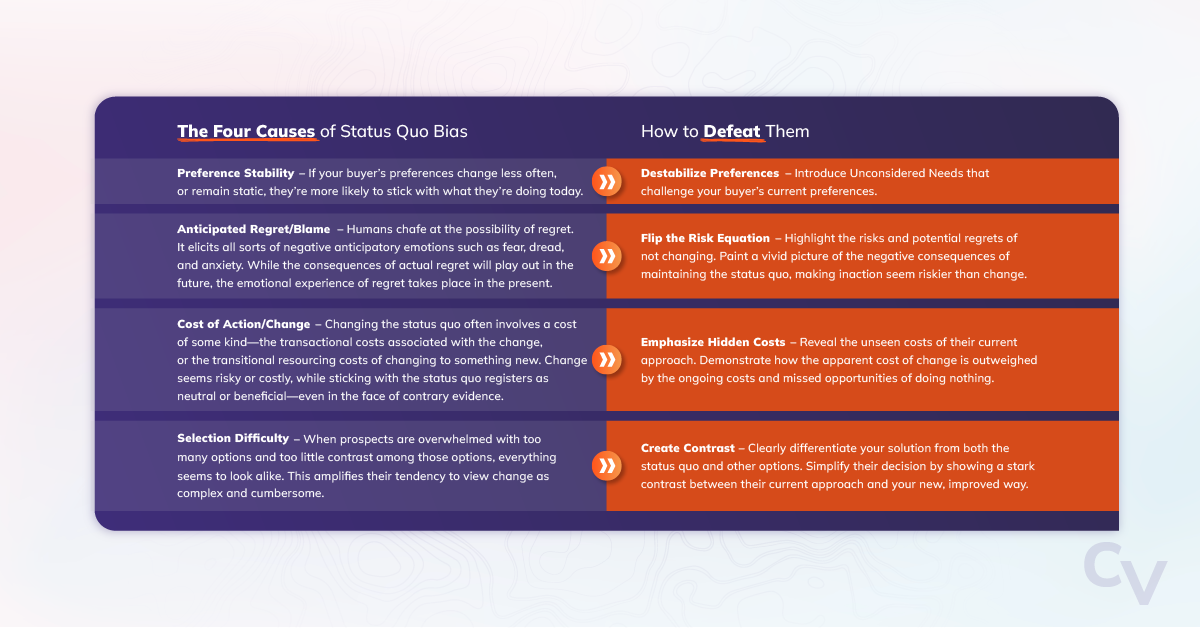
Acquire new customers by defeating the four causes of Status Quo Bias.
Destabilize preferences – Introduce Unconsidered Needs that challenge your prospect’s current preferences
Flip the risk equation – Highlight the risks and potential regrets of not changing. Paint a vivid picture of the negative consequences of maintaining the status quo, making inaction seem riskier than change.
Emphasize hidden costs – Reveal the unseen costs of their current approach. Demonstrate how the apparent cost of change is outweighed by the ongoing costs and missed opportunities of doing nothing.
Create contrast – Clearly differentiate your solution from both the status quo and other options. Simplify their decision by showing a stark contrast between their current approach and your new, improved way.
That’s a disruptive motion, and it’s supposed to be.
If you’re too gentle in acquisition, prospects don’t see a compelling enough reason to change, which leads to pricing pressure, stalled deals, and more “no decision” outcomes.
Expansion: Defend the Status Quo
In expansion, the four forces can be your tailwind if you frame the customer’s next step as a logical next step, instead of a reset.
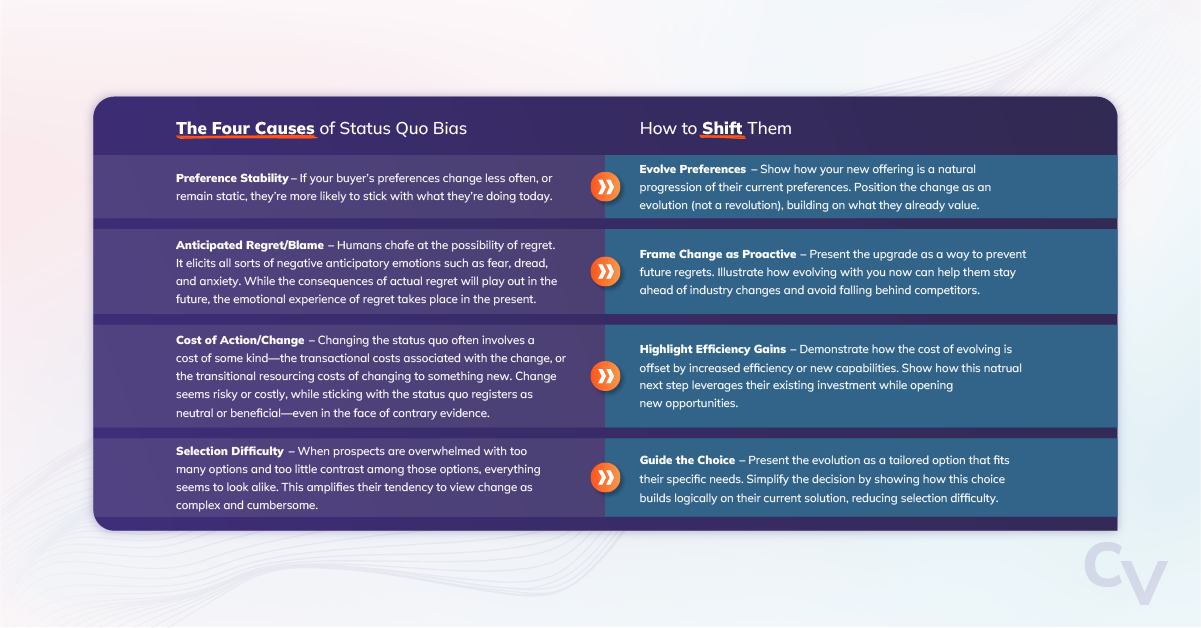
Expand with existing customers by reinforcing the four causes of Status Quo Bias.
Evolve Preferences – Show how your new offering is a natural progression of their current preferences. Position the change as an evolution (not a revolution), building on what the customer already values.
Frame Change as Proactive – Present the upgrade as a way to prevent future regrets. Illustrate how evolving with you now can help them stay ahead of industry changes and avoid falling behind competitors.
Highlight Efficiency Gains – Demonstrate how the cost of evolving is offset by increased efficiency or new capabilities. Show how this natural next step leverages their existing investment while opening new opportunities.
Guide the Choice – Present the evolution as a tailored option that fits their specific needs. Simplify the decision by showing how this choice builds logically on their current solution, reducing selection difficulty.That’s the difference between “buy more from us” and “keep winning with us.”
Expanding relationships requires a delicate touch. You need to guide your customers toward new solutions and opportunities without undermining the trust you’ve built.
Avoid Disrupting Your Customer Relationships
When you use a disruptive, acquisition message with existing customers, they might be motivated to consider all their options. And once that door opens, their questions shift from “what’s next with you?” to “what else is out there?”
Instead:
Anchor on outcomes before you talk about change. Start with the progress they’ve made so far, in their words and their metrics, so the next step feels like momentum—not correction
Frame the new capability as an extension, not an indictment. Instead of a message that implies “what you have is wrong,” frame it as “what you’ve built is working—and this is the next logical layer to stay competitive”
Name the new condition, not the past decision. If something changed (market pressure, new goals, new constraints), make that the reason to evolve, so you’re not implying their past decision was flawed
Customer acquisition is about pulling someone away from what they already trust.
Customer expansion is about protecting what they already trust while asking for more.
Same product. Different situation.
Same Buyer. Different psychology.
If you don’t adapt to your buyer’s unique, situational motivations in acquisition vs. expansion moments, you’re putting your revenue at risk.
Anton Rius, Sr. Director of Content Marketing, leads all content marketing strategy and production at Corporate Visions. Anton’s extensive experience supporting B2B revenue growth with insightful content has been featured in publications like SalesPOP! and Relevance. Anton writes regularly at Long Tail Thinking.