Solutions and such do some things and some other things here Maecenas sed diam eget risus varius blandit sit amet non magna. Aenean lacinia bibendum nulla.
You’re measured on different outcomes—but your success depends on the same buyer decisions. This is where you find the programs and proof built for your goals.
Choose your role to see what that looks like in practice.
When teams rely on opinions, content gets noisy and inconsistent. Our resources are grounded in buyer evidence—so you can sharpen decisions, messaging, and execution.
Find insights, articles, webinars, and more evidence-backed resources to grow revenue.
Sales Competencies: What They Are and How to Improve Them
Madeline Cunningham /
July 16, 2026 /
Core Concepts, Sales Skills
A lot of sales teams can tell you the skills they want sellers to develop. Communication. Product knowledge. Active listening. A list of skills that look reasonable on paper, and easy enough to turn into a training plan.
The problem is that skills don’t always show up in isolation. You need to see how sellers apply them in the context of live deals, understanding how skills come together to move an opportunity forward. Competency fills the gap between knowing what to do and doing it well in a sales conversation.
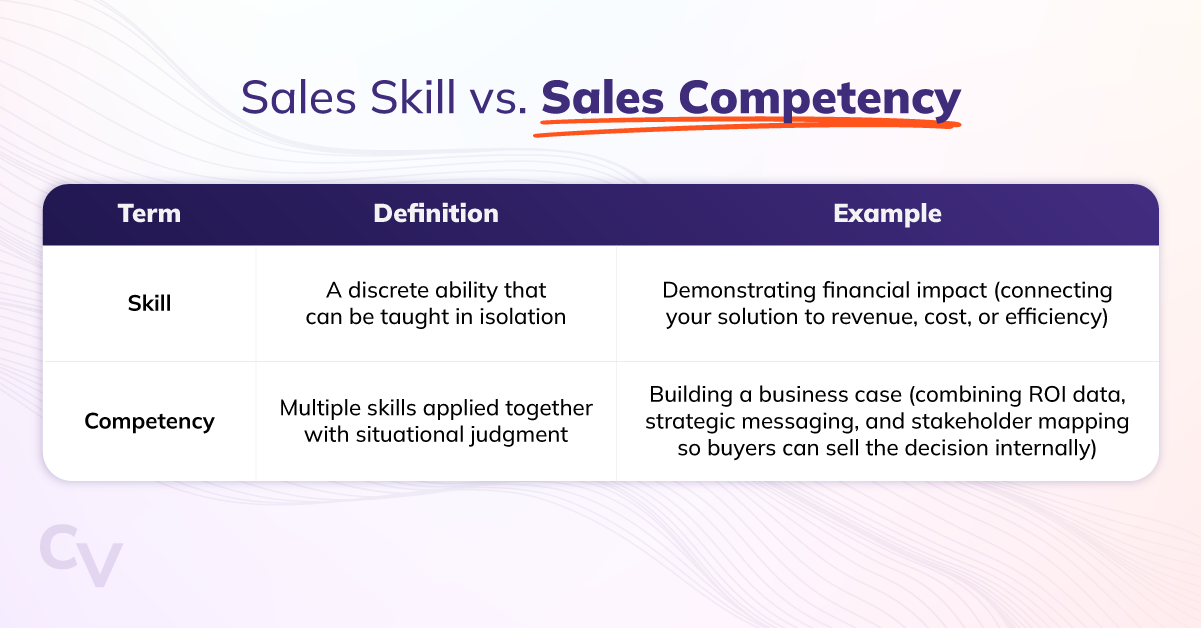
A sales competency is a specific, observable selling behavior that can be measured, coached, and linked to deal outcomes. What distinguishes a competency from a standalone skill is situational judgment—the ability to combine multiple skills in the right way at the right moment in the buyer’s journey.
The Difference Between a Sales Skill and a Sales Competency
People use the terms “skills” and “competencies” interchangeably, but the distinction shapes how you design training and how you develop your sellers.
Think of a sales competency as the ability to bring multiple skills together in context. A seller might know how to demonstrate financial impact—connecting the solution to revenue, cost, or efficiency in the buyer’s own numbers. That’s a skill. A seller demonstrates competency when they combine that financial business case with a strategic narrative, map it to the right stakeholders, and package it in a way that makes the internal approval process feel manageable rather than risky.
Sellers can score well on individual skills assessments and still fall short in competency. Those competency gaps typically surface under actual deal pressure, when the conversation goes somewhere unexpected and the seller has to adapt in real time.
Teaching standalone skills rarely produces the behavioral change you’re after. Developing competencies requires realistic practice, feedback grounded in actual performance, and reinforcement applied close to the moment of application.
One of the clearest signals that a competency framework is working is that coaching conversations change. Managers, sellers, and enablement leaders start using the same vocabulary to describe what happened in a deal and what needs to happen differently next time.
When competencies are defined against what buyers say influenced their decisions, that shared language becomes the foundation for everything you do. It’s not a taxonomy of skills someone built from the inside out. It’s an evidence-based performance standard that your buyers validated.
It’s also worth distinguishing a competency framework from a sales methodology. A sales methodology is how your sellers engage buyers—the systematic connection between skills, messaging, and process that moves a deal forward. A competency framework provides the foundation for your methodology. You can follow a methodology precisely and still lose deals if the underlying competencies aren’t strong. The two work together. Neither replaces the other.
Which Sales Competencies Predict Deal Outcomes
Most competency lists are built from what managers observe in the field, what top reps say they do well, or what someone finds in a popular best practice and adapts for internal use. They don’t come from what buyers say influences their decisions. And that gap matters more than most programs account for.
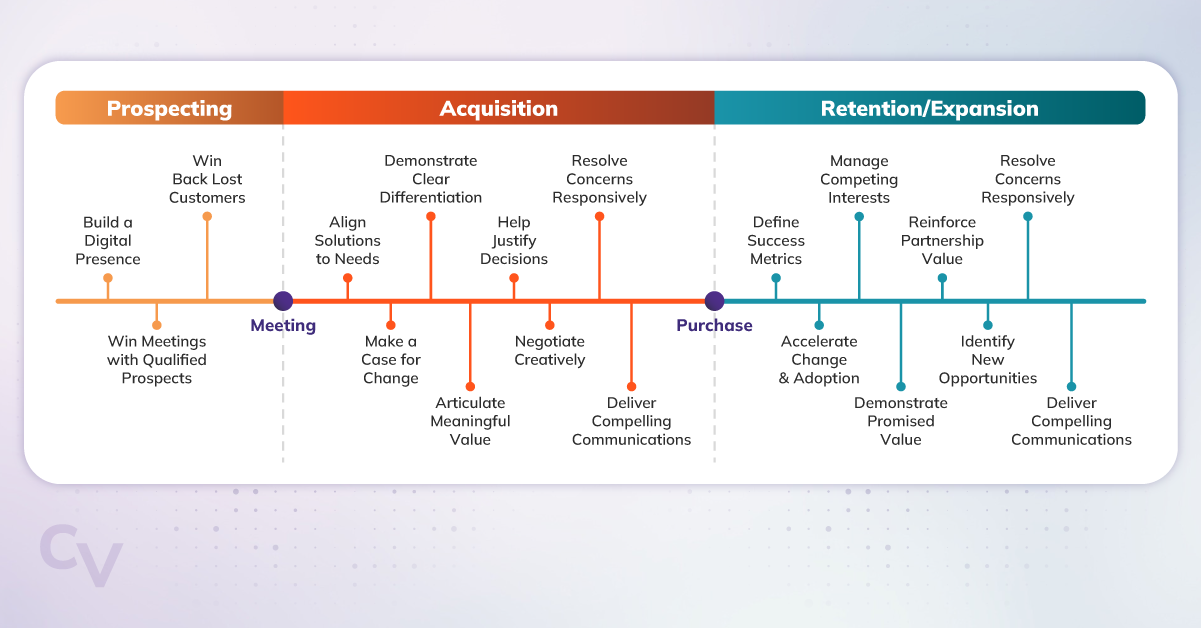
Corporate Visions analyzed buyer feedback from more than 150,000 B2B buying decisions to identify the competencies for prospecting, acquisition, and expansion sales most associated with wins versus losses.
For acquisition and expansion specifically, that research found eight acquisition sales competencies and eight expansion sales competencies that reliably separate deals that close from those that stall or go to a competitor. Each one maps to a critical moment in the buyer’s decision-making process.
Traditional competencies like product knowledge and industry expertise are up to 31 percent less predictive of success than the competencies that buyers say influenced their decisions, according to Corporate Visions research.
Why Sales Competencies Matter for Revenue Performance
In Corporate Visions’ analysis of more than 150,000 B2B deals, buyers reported that over half of deals that sellers marked as “lost” were winnable, if not for a misstep in the sales experience. The difference came down to fixable seller behaviors in critical moments.
Sellers and buyers also cite different reasons for those losses 50–70 percent of the time. So if you’re coaching based on only what sellers report is working, you aren’t addressing the root cause behind win rate problems.
When you plan your training around what buyers say influences deals (not what sellers report), you can expect to shift some significant business outcomes, like:
Higher win rates on competitive deals
Shorter sales cycles through sharper qualification and urgency-building
Larger deal sizes from stronger value justification and pricing defense
More defensible forecasts based on skill-based deal inspection rather than gut feel
How to Improve Sales Competencies Across Your Team
Knowing where your team’s gaps are is the starting point. Closing those gaps requires a structured approach to enablement and reinforcement, not just a training calendar.
1. Benchmark Skill Gaps with Performance-Based Assessments
Before designing any training, measure the current state. If you start coaching without a performance baseline, you end up directing time and budget toward gaps you’ve assumed exist, which might not be where deals are breaking down.
You can’t assess math skills by asking someone if they feel good about algebra. You ask them to do math and demonstrate their stills. Sales competency should work the same way, yet most organizations still rely on self-assessments and manager ratings.
Self-assessments measure confidence, not competence. Manager ratings can reflect recency bias, relationship dynamics, and a limited sample of observed behavior. Both are filtered through perception rather than evidence. And when sellers aren’t sure how results will be used, they tend to respond more carefully than honestly, which makes the data noisier and the coaching decisions less precise.
When you put sellers in realistic situations and score their responses against competencies that predict wins, you get a clear picture of where each person stands. The goal is to get a read on how someone performs under pressure, not whether they can recite the textbook answer.
Precision Skills Assessments are built on performance-based scenarios and scored against the competencies buyers say shape their decisions. With those results, you can focus learning and development for your team where it will have the most commercial impact.
2. Target Training to the Gaps That Cost You Deals
Not all gaps carry the same commercial weight. Focus investment on the competencies where your team scores lowest and where the spread between top and bottom performers is widest. When you line up competency scores with win-rate data, the highest-leverage targets become clear—you can see which gaps show up most often in losses and which ones most reliably separate sellers who close from those who stall.
In one global sales organization, sellers who scored highest in three specific competencies had win rates more than 15 percent higher than those who scored lowest. They compared assessment scores against win-rate data to expose the gap between sellers who reliably moves deals forward and those who lose ground in critical moments.
When you try to design training to cover everything equally, sellers tend to walk away with nothing that sticks. When you focus on two or three critical competencies, you can focus your efforts and drive meaningful behavior change.
3. Reinforce Behaviors in the Flow of Work
One-time training doesn’t change how sellers behave under pressure in a deal. Reinforcement needs to happen close to application—not weeks later in a follow-up session. Put coaching prompts, playbooks, and examples where sellers already work: your CRM, pipeline reviews, and meeting prep.
Just-in-time enablement is the practice of making the right guidance available at the moment a seller needs it. When sellers can reach the right resource when they need it, they can apply it immediately instead of trying to remember training from last quarter.
4. Coach to the Competencies Through Frontline Managers
Without manager reinforcement, training fades fast. Managers are the last mile of competency development, and they need the tools, shared language, and coaching standard to make it stick.
Keep in mind that managers often carry the same gaps as their teams. If a manager scores low on a specific competency, asking them to coach it produces inconsistent results at best. The better move is to tap internal experts or outside coaches who can demonstrate the competency while developing the manager in parallel, rather than around the problem.
How to Measure the Impact of Sales Competencies on Win Rates
Revenue leaders face consistent pressure to justify investment from training programs. With a competency-based approach, you have a credible, concrete answer.
Measurement runs on two tracks.
Competency score progression. Reassess sellers at set intervals after training to see whether competency scores have moved. Score improvements confirm that behaviors are shifting. This tells you whether development is producing the behavioral change you designed it for.
Buyer feedback. Sellers who receive structured feedback from their buyers have 40 percent higher win rates than those who don’t, according to Corporate Visions research. Buyer feedback closes the loop on how sellers show up in the moments that decide deals—not just how they performed on an assessment.
Together, those two measurement sources tell you what’s working and where to direct the next investment. You see whether behaviors are shifting with assessment scores, and how those new behaviors land through buyer feedback.
When both are moving in the right direction, you have something credible to bring to leadership. Not just a training recap, but evidence that skill development is showing up in commercial results.
From Sales Competency Data to Commercial Results
When you anchor your programs to a buyer-validated competency model, you change the training investment question.
Instead of “What training should we run this quarter?” you start asking, “Which competencies are dragging down win rates for which cohorts, and what’s the fastest path to closing those gaps?” That’s a more productive question, and a more defensible one when you’re making the case for where budget should go.
Most sellers claim to sell with insights, but few do it well. See what separates visionary insights from recycled analyst data, and how to deliver them so buyers act.
Learn how precise sales prospecting helps sellers build better pipeline by building a digital presence, earning qualified meetings, and winning back lost customers.
Madeline Cunningham, Content Marketing Manager, is a content and communications leader with a track record of helping organizations strengthen communications, improve processes, and drive revenue impact. With experience supporting multimillion-dollar RFPs and enterprise-level marketing initiatives, Madeline brings a strategic, revenue-focused lens to storytelling.
Scale the Sales Behaviors That Decide Deals
Learn how to build a revenue performance system around the sales competencies that predict wins and renewals