Solutions and such do some things and some other things here Maecenas sed diam eget risus varius blandit sit amet non magna. Aenean lacinia bibendum nulla.
You’re measured on different outcomes—but your success depends on the same buyer decisions. This is where you find the programs and proof built for your goals.
Choose your role to see what that looks like in practice.
When teams rely on opinions, content gets noisy and inconsistent. Our resources are grounded in buyer evidence—so you can sharpen decisions, messaging, and execution.
Find insights, articles, webinars, and more evidence-backed resources to grow revenue.
Most AI Gives Plausible Advice. Methodology-Governed AI Delivers Sales Judgment.
Tim Riesterer /
September 15, 2026 /
Thought Leadership
A CRO asked me a question last week that I’m now hearing on almost every call:
“My sellers already use ChatGPT, Claude, and whatever copilot is bolted onto our CRM. Why do I need an AI sales coaching “agent” on top of that?”
It’s a fair question. And the honest answer is that yes, most AI can produce sales advice. It can write an email, summarize a call, suggest objection responses, and recommend next steps.
The output will be coherent and confident. It will sound like the kind of guidance a senior seller might give. And that’s exactly the problem.
AI can generate coaching and guidance. But when an LLM lacks deal context, company context, or a validated selling standard, it fills the gaps with plausible-sounding inference.
Sellers get advice that sounds right but isn’t aligned to the sales situation, your buyer’s needs, or any evidence-backed methodology. Multiply that across thousands of seller decisions a day and you get a coaching liability—an upgrade.
The same CRO came back a few weeks later with a follow-up: “OK, generic AI isn’t enough. But every platform we use now has its own coaching agent. They each have their own opinion about what good selling looks like. How do I tell my sellers what to listen to?”
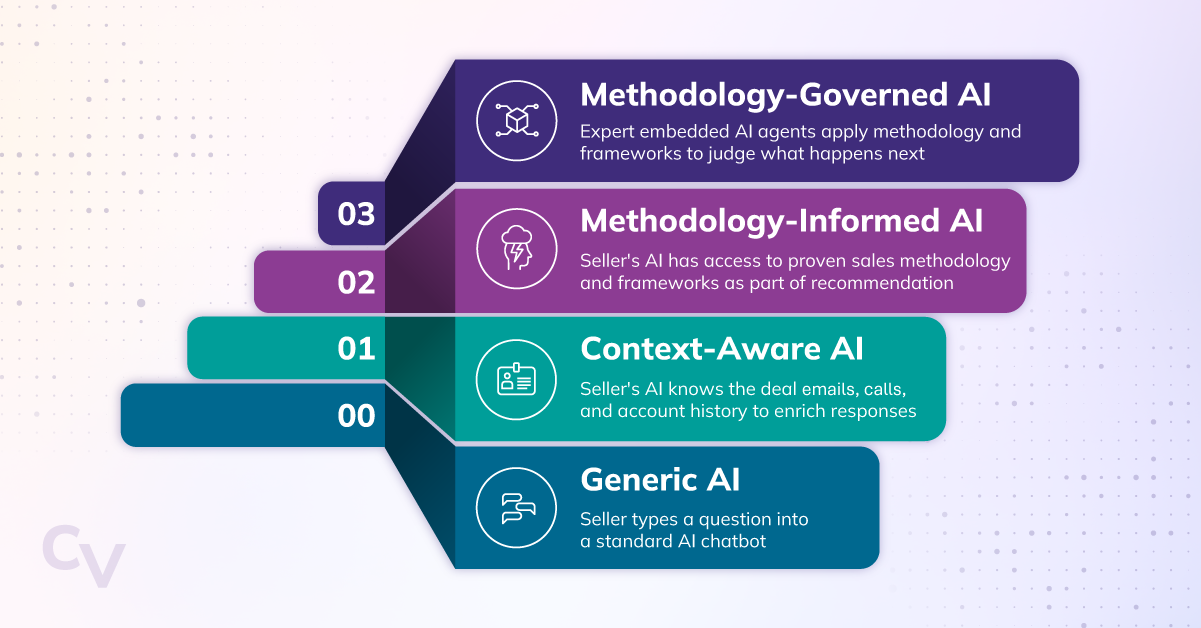
Here’s a new way to think about the value progression in agentic sales coaching.
The Four Tiers of Agentic Sales Coaching
The four tiers of agentic sales coaching.
Tier 0: Generic AI
A seller types a question into a standard chatbot. The model has no deal facts, no account history, and no sales expertise. It responds based on whatever it was trained on, plus the seller’s prompt. Quality depends entirely on the prompt. The advice is sometimes useful, sometimes generic, and usually confidently wrong.
Tier 1: Context-Aware AI
The AI now has access to the seller’s deal data through emails, calls, CRM records, and account history. The model can see what’s happening on the account.
This is where platform-native AI naturally excels. Your CRM, conversation-intelligence tool, and sales-engagement platform all own the data layer, and they’re rapidly building agents on top of it. It’s a noticeable upgrade over Tier 0 but the AI is still applying a generic notion of “good selling” (i.e., whatever pattern it learned from public training data, lightly tuned by the platform vendor).
It can spot the obvious. But it can also diagnose the wrong problem and fall back on cookie-cutter advice. Quality depends on whether the AI happens to pick the right approach.
Tier 2: Methodology-Informed AI
The AI now has access to a sales methodology—frameworks, competency models, and research-backed selling standards. The methodology is exposed via secure protocols, so the underlying selling strategies stay controlled.
This is the level most “AI for sales coaching” tools are racing to reach. Some methodology providers are publishing their frameworks for retrieval. Some platforms are partnering with methodology vendors and embedding the content. This model has a stronger sales standard to draw from.
But there’s a catch.
Access to a methodology is not the same as judgment about how to apply it. A model can find the right rubric and still reach the wrong conclusion. Quality varies based on the AI tool the seller happens to use, the quality of the prompt, and whether the model retrieves the right content and context for the situation.
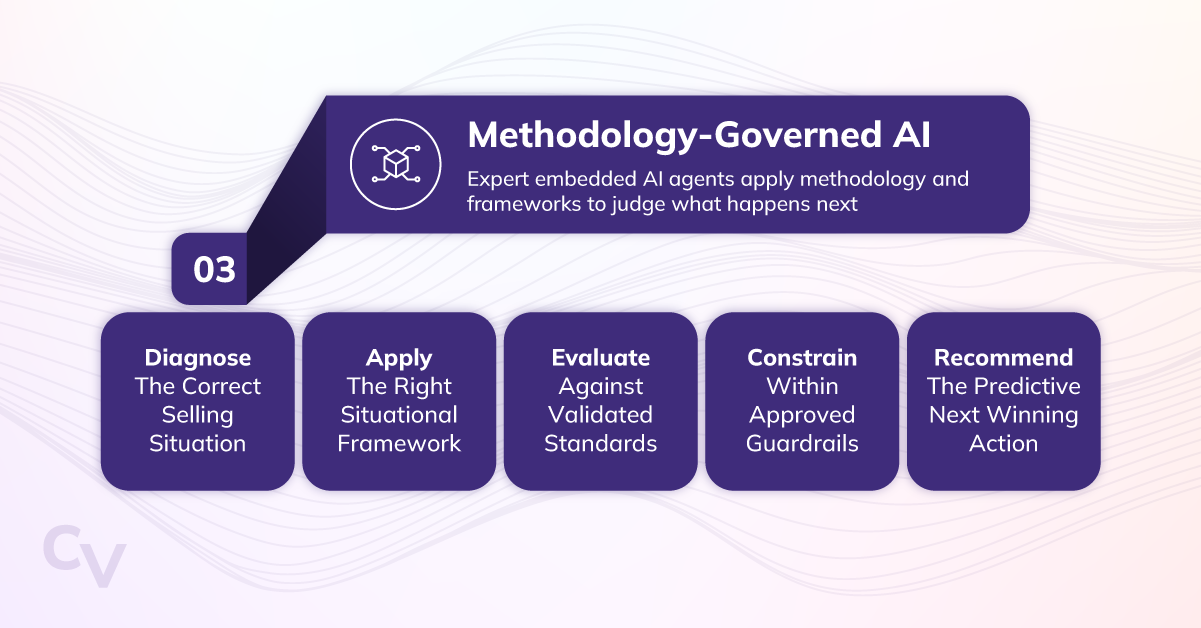
Tier 3: Methodology-Governed AI
At this top tier, the methodology isn’t just available to the AI. The methodology governs the AI.
Before this methodology-governed system answers the seller’s question, it first decides:
What selling situation is this?
Which framework applies?
What evidence is missing before providing an answer?
What does “good” look like in this specific moment?
What guardrails apply to this kind of recommendation?
What is the next best action and why?
The thinking happens on the methodology side, not the AI side. The same seller, asking a poorly-worded question on a Tuesday afternoon, gets the same high-quality coaching as the most experienced rep in the company asking the same question precisely. Tier 3 enforces a single standard across humans and agents.
If you’re going to scale AI coaching across an enterprise, you have to scale a standard of performance excellence. Otherwise, you’re just scaling variance.
Why This Is Hard to Build Inside a Platform
There’s a structural reason platform-native AI naturally lands at Tier 1 or Tier 2 and rarely reaches the top Tier 3, and it has nothing to do with engineering capability.
Methodology has to be opinionated. Platforms have to be neutral. A platform serving thousands of buyers across dozens of industries can’t deeply embed one methodology—it has to offer all of them, lightly. It makes sense as a product decision for a platform.
It’s also why platform-native coaching stays in Tier 1. The methodology only delivers value when it’s specific, evidence-backed, and tuned to the situation.
The system that judges quality has to be independent of the system being judged. When the same vendor that owns your seller’s workflow is also the sole judge of whether they’re selling well, you’ve created a conflict of interest by design. The point of governance is that the standard is enforced by something independent of what it measures. That’s true in financial reporting, true in clinical trials, and true in sales coaching.
The standard has to be portable across the seller’s full surface. A typical enterprise sales motion runs across CRM, conversation intelligence, sales engagement, content management, and learning tech. Each of those platforms is now building its own AI coach. If every platform coaches in its own way, you don’t have a coaching standard, you have five competing ones. A methodology-governed system must ride above the platforms, not be locked inside one of them.
Methodology grounding requires buyer-side evidence, not just seller-side data. Most platform AI is trained on what sellers do. But what makes a methodology evidence-backed is that it’s based on what buyers do. What they respond to, what makes them switch, what makes them stall, and what makes them say yes. That data layer is the unique asset, and it has to be held by whoever is setting the standard, not by whoever is recording the calls.
None of this is an argument against platform AI. Platform-native agents can be useful, especially at Tier 1. But there’s a reason the methodology-governed layer has to sit above the platforms, not inside them.
Getting Governed AI Right
Sellers and AI agents are about to be working side by side on every deal. Some of the most consequential moments in a sales cycle, the framing of a discovery call, the response to a competitive threat, the decision about when to escalate, are going to be partly or fully shaped by an agent.
If those agents are operating on generic patterns, your sellers and your AI will pull in different directions. Worse, your AI will pull confidently in the wrong direction, with no signal to anyone that it’s done so. Plausible-sounding bad advice scales fast. Inconsistent, vendor-led coaching scales even faster.
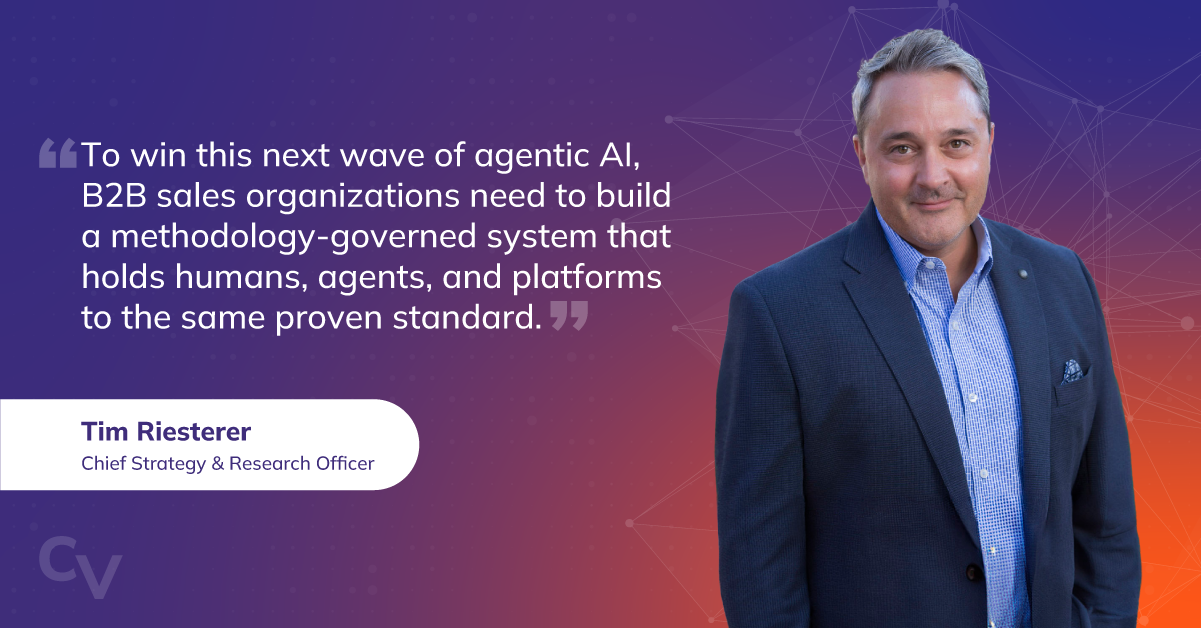
To win this next wave of agentic AI, B2B sales organizations need to build a methodology-governed system that holds humans, agents, and platforms to the same proven standard.
Generic AI gives plausible-sounding advice. Methodology-Governed AI delivers situational sales judgment based on predictive, evidence-backed intelligence.
The selling standard that governs the AI is the differentiator.
Buyers want seller guidance in complex deals, just not at every touchpoint. Here's what 150,000 win-loss decisions reveal about those moments and what it takes for sellers to deliver in them.
Tim Riesterer, Chief Strategy Officer at Corporate Visions, is the sought after expert on evidence-based revenue growth using counterintuitive approaches. Known for his candid thought leadership and engaging keynotes, he’s spent decades testing and refining go-to-market strategies that put buyers squarely at the center. Tim is the author of four insightful books, including Customer Message Management, Conversations that Win the Complex Sale, The Three Value Conversations, and The Expansion Sale.