Solutions and such do some things and some other things here Maecenas sed diam eget risus varius blandit sit amet non magna. Aenean lacinia bibendum nulla.
You’re measured on different outcomes—but your success depends on the same buyer decisions. This is where you find the programs and proof built for your goals.
Choose your role to see what that looks like in practice.
When teams rely on opinions, content gets noisy and inconsistent. Our resources are grounded in buyer evidence—so you can sharpen decisions, messaging, and execution.
Find insights, articles, webinars, and more evidence-backed resources to grow revenue.
What Buyer Data Reveals About Sales Pursuit Strategies and Win Rates
Abby Kerr /
September 17, 2026 /
Sales Coaching
What strategy should a seller take into a deal?
Every seller has to answer that question before engaging with a buyer. The answer shapes what they ask, what they share, and what they recommend next.
That overall approach is a sales pursuit strategy. Every seller uses one, whether they name it or not. But sellers often fall back on the same familiar play. A repeatable approach can make selling easier. Left unexamined, it can also become a default that limits the conversation.
An Emblaze research study examined how sellers use these strategies, how results differ across performance tiers, and what the findings mean for sales leaders.
About the Study
Research led by Dr. Leff Bonney, Associate Professor of Sales and Marketing in the Florida State University Sales Institute, examined how sellers pursue specific deals and whether recurring patterns in those pursuits were associated with seller performance.
Instead of relying on sellers to describe their own behavior, the study went directly to buyers. Over three years, researchers assessed roughly 4,300 frontline sellers from 17 B2B companies. After each deal closed, the buyer rated the seller on specific activities. A total of 4,035 buyers responded, and the feedback was analyzed anonymously.
How Sales Pursuit Strategy Choice Shapes Results
The study found four distinct sales pursuit strategies that sellers consistently use. Each one reflects a different pattern in what sellers emphasize and how they shape the buyer’s decision:
Product-focused: Sellers lead with features, company credibility, competitive differentiation, and price. They spend less time scoping the problem and lean on discounting or relationships when the deal gets hard.
Consultative: Sellers invest in understanding the buyer’s situation before making recommendations. They tailor value by balancing core and peripheral benefits throughout the conversation.
Perspective: Sellers bring market insight about problems buyers might not recognize. They guide buyers through how to evaluate the issue and make a purchase.
Vision: Sellers explore the buyer’s desired outcomes and the solutions under consideration. They shape expectations and coach buyers through implementation realities.
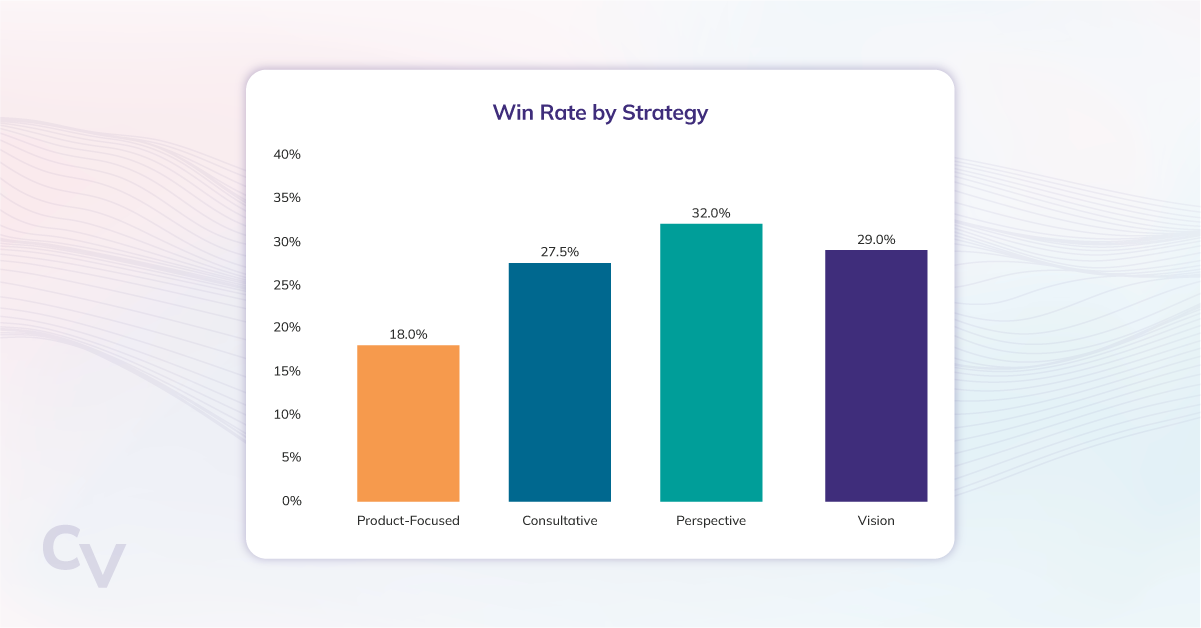
Researchers then compared each strategy with win rates. Across the full dataset, product-focused selling had the lowest overall win rate at 18 percent. Sellers won with consultative, perspective, and vision selling at roughly similar rates.
Product-Focused sellers produced the lowest win rate of any pursuit strategy in the study.
Even with the lowest win rate, product-focused selling remained the most common approach. Sellers using it also relied on discounting significantly more than those using any other strategy in the study.
High Performers Use a Wider Range of Strategies
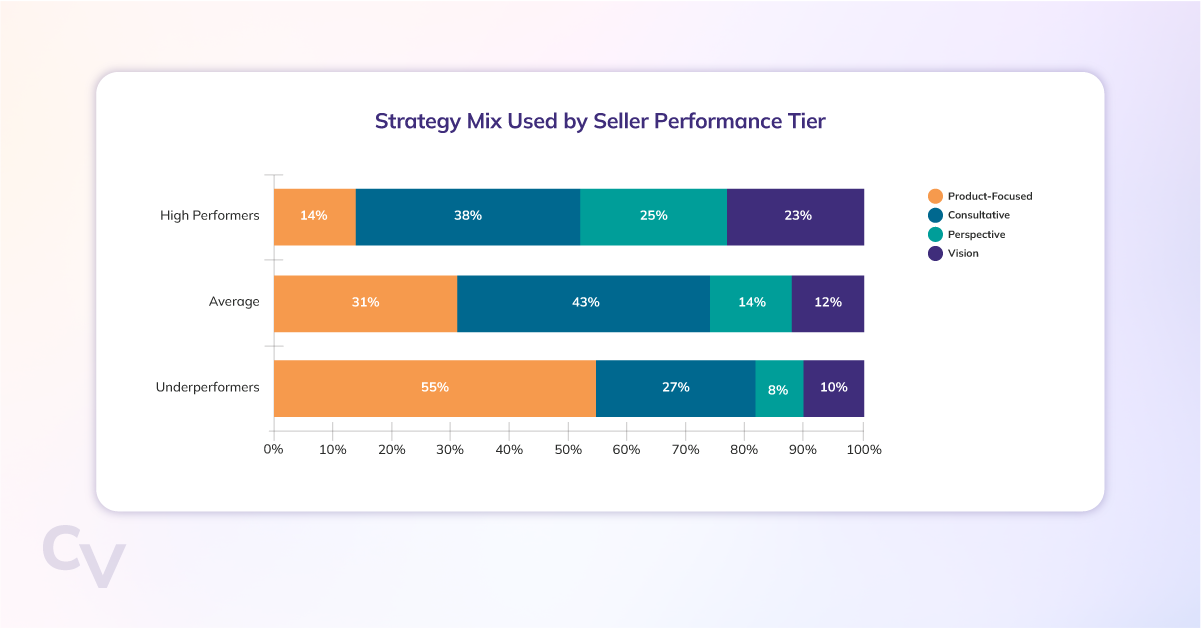
The strongest sellers did not simply replace product-focused selling with one preferred alternative. They used all four strategies, adjusting their approach to the deal in front of them.
Underperformers ran 55 percent of their deals as product-focused pursuits. High performers used that approach in only 14 percent of deals but used perspective or vision selling in 48 percent of deals.
Average performers sat between those groups, using product-focused selling in 31 percent of deals and perspective or vision selling in 26 percent.
High performers tailored their strategy to each deal more than any other performance tier.
The difference appears to be is less about knowing one winning strategy and more about having the flexibility to choose among several approaches.
The Best Strategy Depends on the Seller Running It
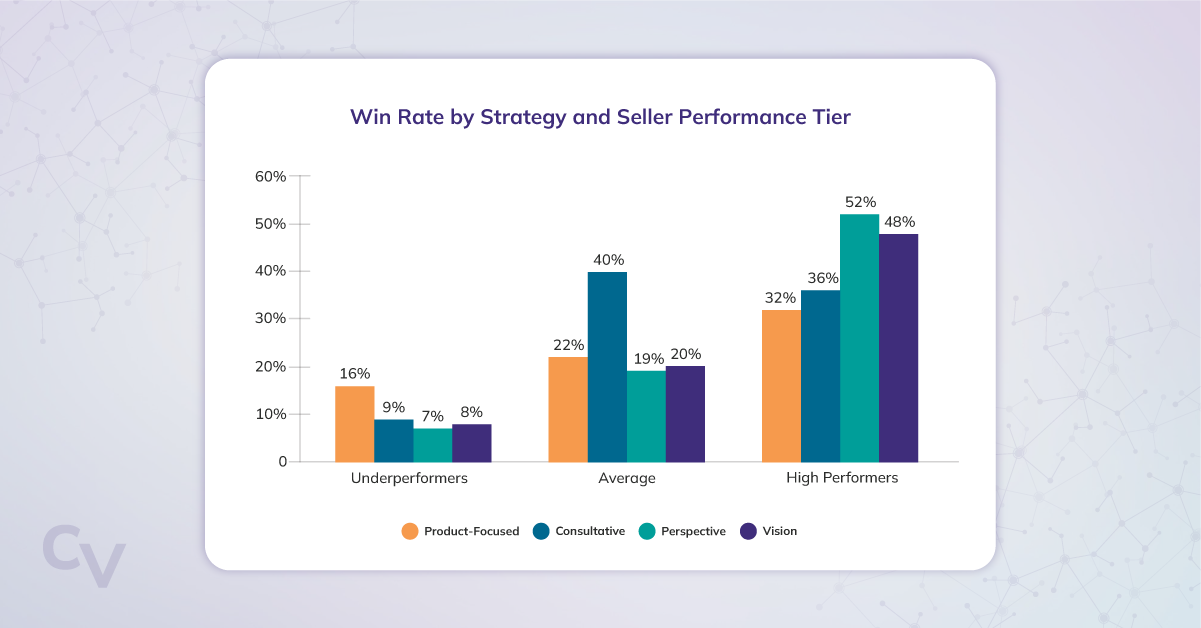
Among underperformers, product-focused selling produced the highest win rate for that group at 16 percent. The other three strategies won between seven and nine percent, showing why these sellers need stronger core skills before they can consistently adapt.
Average performers saw their strongest results with consultative selling, which won 40 percent of their deals. Perspective and vision selling both won around 20 percent, suggesting that these approaches require skills average sellers have not fully developed.
High performers won across all four strategies. Perspective and vision selling produced the strongest results for this group. Skilled sellers can create more value by teaching buyers to see a new problem or guiding them toward a future state.
The strategy that wins most depends on the seller who is running it.
Giving every seller access to every strategy will not produce the same result. Coaching must match the seller’s current capability.
Strategy Fit Is a Coaching Issue
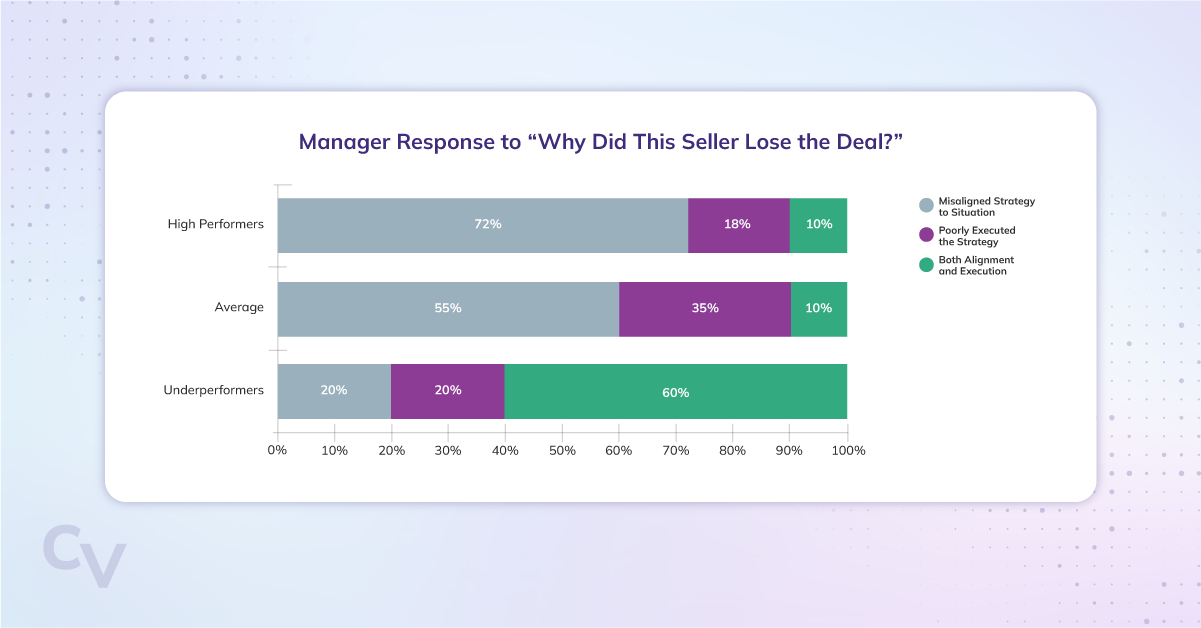
The study also examined why managers believe sellers lose deals. For high performers, managers attributed 72 percent of losses to a misaligned strategy, compared with 18 percent to poor execution. Average performers showed a similar pattern, with strategy fit emerging as the more common issue.
For high performers and average sellers alike, managers point to strategy choice as the primary reason deals are lost.
Underperformers presented a different coaching challenge. In 60 percent of loss responses, managers cited both strategy misalignment and poor execution.
Make Strategic Agility Coachable
Sales leaders do not need every seller to use the same strategy for every deal. Instead, they need to coach sellers so they can read the deal, choose an approach that fits, and change course when the situation calls for it. When leaders do that, strategic agility stops being a trait of top performers and becomes a capability every seller can build.
Amanda DeVlugt and Tim Riesterer sat down with Dr. Stefanie Boyer, a professor at Bryant University, to talk about building resilience, the magic of AI in coaching, and why your sellers probably need a little more “yes, and” in their lives.
Learn what a sales skills assessment is, how to use assessments to measure sales competencies, and how to turn results into coaching that improves performance.
As Director of Content and Community for Emblaze, Abby shapes membership programming to connect senior B2B revenue growth leaders with evidence-based insights, experiential learning, and meaningful networking. Her background encompasses content direction at a B2B marketing agency, small business ownership, and high school teaching. She loves OrangeTheory, the Pacific Northwest, and writing and reading fiction.
See What Else the Study Reveals
Read the full Emblaze report for the complete findings on sale pursuit strategy choice, seller performance, and margin risk.