The test of whether sales training worked happens long after the workshop—when a seller freezes on the message, face-to-face with a skeptical buyer who has no patience for a stumbling pitch.
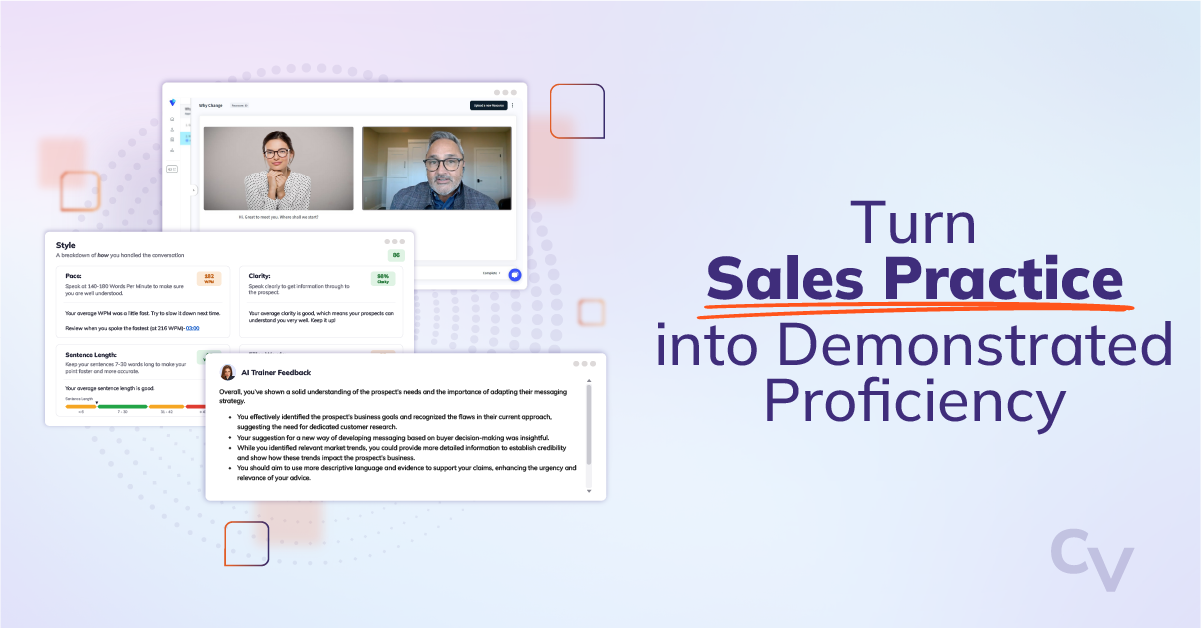
Fluency Coaching is a way to avoid those costly mistakes. Corporate Visions describes it as the practice-and-proof component of just-in-time enablement, in which sellers record video challenge assignments and receive documented, scored feedback. They repeat the process until they demonstrate a defined level of proficiency on a skill or message.
It’s designed for sales enablement managers, L&D teams, and sales leaders who need evidence that their sellers can perform to a standard. For teams already building toward just-in-time enablement, Fluency Coaching is where practice turns into proof.
In this article, you’ll see what the approach is, why it builds readiness, and how to measure and scale it.
What Is Fluency Coaching?
Fluency Coaching is a fit-for-duty practice exercise for sellers to gain proficiency in new skills and messages. The seller records a video response to a challenge assignment, such as delivering a new value message or handling a specific objection. The seller then receives detailed, scored coaching feedback and repeats the assignment until their performance meets a defined proficiency standard.
Two structural features set Fluency Coaching apart from classroom role-play.
First, it’s individual, so each seller completes the full assignment alone and is scored on their own performance. No one hides in a group of three or four.
Second, every seller walks away with a documented record of proficiency. Sellers who complete a Fluency Coaching assignment leave behind a scored video and a documented feedback trail—a record that proves the seller can deliver to your standard when they’re in front of a buyer.
Traditional “Stand & Deliver” vs. Fluency Coaching
The figures below reflect how Corporate Visions describes typical classroom events and its own program, so read them as typical patterns rather than industry measurements.
|
Traditional “Stand & Deliver” |
Fluency Coaching |
| Assignments |
Partial. Sellers split into triads or quads, so each person might cover only a quarter of the assignment, not the whole thing. |
Complete. Every individual completes the full assignment on their own, responsible for the entire presentation. |
| Practice |
Insufficient. Sellers might get 30–45 minutes in a hallway, shared across a group. Each participant gets very little rehearsal time. |
Repetitive. Sellers record a video challenge and practice as many times as needed. Corporate Visions reports that the average seller records more than six times before hitting submit. |
| Coaching |
Fuzzy. Fast, verbal feedback from the facilitator. It often isn’t written down, so there’s no avenue for follow-up. |
Documented. Detailed written feedback with specific recommendations, time-stamped and available to both the seller and their manager. |
| Proficiency |
Untested. Learning ends when the day ends. Sellers might receive a certificate of completion just for showing up, with no way to certify mastery. |
Demonstrated. Sellers know exactly how they scored. Companies can require a passing grade for “fit for duty” certification. |
| Scale |
Limited. Workshops often hold about 20 people at a time. |
Flexible. Individual and online, so Corporate Visions says it can scale as fast and as far as you need it to. |
Why Traditional Sales Training Falls Short
Traditional stand-and-deliver training is organized around logistics: get people in a room, run through the content, and document that it happened. But the format was never designed to test whether any seller can execute their new skills when it counts in the field.
Here are five structural failure points that explain why traditional stand-and-deliver methods fall short.
Partial Assignments
Sellers practice only a fraction of the material. In the typical workshop Corporate Visions describes, facilitators split the room into groups of three or four. Each person runs one slice of the assignment while the others watch.
A seller might rehearse the opening and never touch objection handling. They leave training having practiced only part of what the job requires.
Insufficient Practice
A few minutes of practice won’t build a skill. Workshop agendas are packed, so each participant might get only a few minutes of active practice per session.
Those few minutes also have to last until the seller meets a buyer. Trained skills decline with nonuse, according to a 1998 meta-analysis of 53 studies by Arthur and colleagues in Human Performance. Cognitive skills faded more than physical ones.
Spacing practice out offers some protection. Among students, practice spread across multiple sessions produced moderately stronger retention than practice concentrated in a single block (d = 0.54), according to a 2025 meta-analysis of 22 classroom studies (N > 3,000) published in Behavioral Sciences.
Undocumented Coaching
Verbal feedback disappears the moment it’s spoken. In a live workshop, facilitator feedback arrives in real time, and then it’s gone. Often, nobody writes it down, and the seller who received it heads to the next activity before they’ve had a chance to absorb what was said.
There’s no record to review afterward, no written notes for the seller to return to, and nothing to verify whether the feedback changed behaviors. The manager responsible for that seller’s development probably wasn’t in the room, and even if they were, nobody documents what they heard.
Untested Proficiency
A completion certificate doesn’t prove proficiency. Attendance records show who showed up. But during the workshop, it’s hard to verify whether any individual seller can perform the skill on their own, without a group to lean on or a facilitator guiding the scene.
Leaders know the training happened, but how can they tell if what happened in that room was enough to hold up when a buyer pushes back? A completion record can’t answer that question, since it only shows who was in the room.
Limited Scale
Classroom workshops cap how many sellers you can reach. Corporate Visions notes that a room-based session often trains just 20 people at a time. For a globally distributed team, that means running the same workshop across multiple cohorts.
The sellers who attend in one cohort aren’t the same group who attend in the next. If you’re rolling out a new go-to-market narrative, the story can get fragmented across those cohorts.
How Fluency Coaching Works
With Fluency Coaching, you can address each of these failure points, because it’s built to improve individual performance.
Individual Assignments
Every seller completes the full assignment. Each seller records the entire challenge on their own, start to finish, without handing off a piece to someone else in the room.
Workshop role-play is built around observation: two or three sellers watch while one delivers. Watching someone else handle an objection doesn’t mean you can handle it yourself. In a Fluency Coaching assignment, every seller works through delivery in one continuous take, because a live conversation requires exactly that.
When the coach scores the submission, they’re evaluating how that individual performed across the full arc of the conversation.
Repetitive Practice
Repetition improves fluency. Because sellers can re-record before submitting, they rehearse and tighten their delivery with each retake. In “The Necessity of Fluency Coaching,” Corporate Visions reports that the average seller records their assignment more than six times before submitting.
Documented, Time-Stamped Feedback
Feedback becomes a durable coaching asset. After a seller submits their practice assignment, they receive detailed, documented, time-stamped feedback with specific recommendations. Both the seller and their manager can see it.
Because that feedback gets time-stamped and stored, managers can draw on it in ongoing coaching programs, and reference it long after the first conversation. Managers can compare their seller’s first attempt to their latest and see where performance has improved.
Demonstrated Proficiency with Pass/Fail Standards
Some teams require a passing score before a seller can deliver to buyers. Organizations can set a defined threshold and require sellers to resubmit until they clear it.
This is the fit-for-duty standard: a seller earns the right to carry your message into a live deal only after demonstrating that they can execute it well. It’s a result, on record, before the story reaches buyers.
You measure readiness by how sellers perform. Session counts and logged practice rounds stop standing in for it.
Fluency Coach AI
Corporate Visions describes the AI-powered simulations in Fluency Coaching as realistic role plays that mirror actual buyer conversations.
Keep in mind that leaning heavily on AI practice has drawbacks. Corporate Visions commissioned research with Dr. Leff Bonney of Florida State University that followed 119 new inside-sales hires at one company for 18 months.
New sellers in the AI-Heavy group led on execution, but their adaptability dropped to 25.4 out of 50 when buyers changed course. The Observation-Heavy group scored highest on adaptability but drew lower manager ratings on execution. The Integrated group, which combined AI practice and observation, posted the strongest balance (46.2 on execution and 34.7 on adaptability).
How Fluency Coaching Scales
Because Fluency Coaching is individual and online, teams escape the scheduling bottleneck that limits classroom training. A globally distributed team can roll out a new message or skill without waiting for a room-based roadshow. Sellers complete assignments on their own timeline.
Managers review submissions asynchronously, across time zones, whenever the work lands. Corporate Visions says the approach can scale as fast and as far as you need it to.
Adding people doesn’t add scheduling complexity, because there’s no room to fill and no date everyone has to hit. You can certify the whole team before you roll out the new message or presentation deck, including sellers who never made it into the last cohort.
How to Measure Fluency Coaching Results
Fluency Coaching produces evidence you can track on three levels.
- Seller-level proficiency: whether the seller reached the pass threshold and how many attempts it took
- Manager visibility: a documented history of each seller’s submissions, scores, and coaching notes over time
- Business impact: certification rates tied to time to quota, win rates on new messages, and field consistency
Look at all three together and you see which sellers are ready now and which need another round of coaching before a launch.
Set the Bar at Fit-for-Duty
If your training plan ends when the workshop ends, you’re certifying attendance. You won’t know whether any individual seller can deliver the message under live conditions, when a buyer pushes back, redirects, or asks a question that was never addressed in the workshop.
Fluency Coaching raises the bar for performance. Every seller is graded to one standard, and the grade comes from an assignment they completed and resubmitted until they cleared it. Either the seller can run the conversation or they can’t, and the record shows which.they can’t, and the record shows which.