Solutions and such do some things and some other things here Maecenas sed diam eget risus varius blandit sit amet non magna. Aenean lacinia bibendum nulla.
You’re measured on different outcomes—but your success depends on the same buyer decisions. This is where you find the programs and proof built for your goals.
Choose your role to see what that looks like in practice.
When teams rely on opinions, content gets noisy and inconsistent. Our resources are grounded in buyer evidence—so you can sharpen decisions, messaging, and execution.
Find insights, articles, webinars, and more evidence-backed resources to grow revenue.
The Challenger Sales Model: What It Gets Right, Where It Falls Short, and What to Do About It
Tim Riesterer /
July 27, 2026 /
Acquisition, Expansion, Sales Skills
The Challenger sales model is a B2B selling methodology built on one core premise: sellers who teach buyers something new about their business outperform those who simply build relationships or solve stated problems. Developed by Matthew Dixon and Brent Adamson based on a CEB (now Gartner) study of more than 6,000 sales reps, the model argues that the highest-performing sellers don’t just respond to buyer needs. They reframe them.
But the model’s popularity has created a blind spot. If challenging buyers works so well in acquisition, why does the same approach backfire when you’re trying to retain and grow existing accounts?
What Is the Challenger Sales Model?
The Challenger sales model emerged from research Dixon and Adamson published in their 2011 book, The Challenger Sale. Their study, conducted through CEB (now Gartner), analyzed the behaviors of more than 6,000 B2B sales reps to identify which selling styles consistently won complex deals.
The methodology draws on the concept of Provocation-based Selling, popularized by Geoffrey Moore, Philip Lay, and Todd Hewlin in their 2009 HBR article, In a Downturn, Provoke Your Customers. The authors argued that sellers must show buyers their competitive challenges in a new light that makes addressing painful problems unmistakably urgent.
Dixon and Adamson built on this foundation and distilled the Challenger approach into three core skills:
Teach customers something new and valuable about how to compete in their market.
Tailor their sales pitch to resonate with specific decision-makers and get buy-in across the organization.
Take Control of pricing discussions by focusing on value and applying constructive pressure to close.
The model’s central claim is that sellers who lead with commercial insight, rather than relationship-building or problem-solving, win more often in complex B2B environments.
The Five Challenger Sales Rep Profiles
Dixon and Adamson’s research identified five distinct selling profiles based on observable behaviors and attitudes. Every seller in the study mapped to one dominant profile.
The Challenger
Challengers push buyers’ thinking. They bring a distinct point of view, aren’t afraid of constructive tension, and lead conversations with commercial insight rather than questions about pain.
The Hard Worker
Hard Workers show up early, stay late, and make more calls than anyone on the team. They’re self-motivated and always looking for feedback, but their effort doesn’t always translate into complex deal performance.
The Lone Wolf
Lone Wolves follow their own instincts and resist process. They can deliver strong individual results but are difficult to manage and nearly impossible to replicate across a team.
The Problem Solver
Problem Solvers are detail-oriented and responsive. They focus on resolving post-sale issues and ensuring every stakeholder’s concern is addressed, but they tend to react to stated needs rather than reframe them.
The Relationship Builder
Relationship Builders invest time in personal connections and internal advocacy. They’re well-liked and accessible, but the CEB research found this profile consistently underperformed in complex sales environments.
Dixon and Adamson’s data showed the Challenger profile outperformed all others by a significant margin in complex B2B deals, where multiple stakeholders, long cycles, and competing priorities made relationship-building alone insufficient.
How the Challenger Sales Process Works
The Challenger methodology is structured around three sequential seller actions. Each one builds on the last to move buyers from complacency to commitment.
Teach
You deliver a commercial insight the buyer hasn’t considered. Rather than asking questions to uncover pain, you lead with a perspective that reframes how the buyer thinks about their situation. The goal is to show them a cost, risk, or missed opportunity they didn’t see before your conversation.
Tailor
You adapt that insight to the specific stakeholder you’re speaking with. A CFO cares about different risks than a VP of Operations. Tailoring means adjusting the commercial story so each decision-maker sees themselves in it and can champion it internally.
Take Control
You guide the buying process forward, especially around pricing and next steps. Instead of deferring to the buyer’s timeline or caving on discounts, you anchor the conversation on value delivered and apply constructive tension to prevent stalling.
Why the Challenger Sales Model Works
The Challenger model gained traction because it addressed a persistent problem in complex B2B sales: buyers stalling. When six or more stakeholders need to agree, consensus becomes the enemy of action. Challengers cut through that inertia by introducing a sharp point of view buyers can’t ignore.
The CEB research showed that in complex selling environments, Challengers outperformed Relationship Builders by nearly 2:1. The reason is structural. Complex deals require sellers who can create urgency where none existed. Asking great questions and building rapport won’t overcome Status Quo Bias when the buyer’s default is to do nothing.
This is also why the model resonates with sales leaders under pipeline pressure. It gives teams a repeatable way to disrupt inaction rather than wait for buyer motivation to appear on its own.
What the Challenger Sales Model Gets Wrong
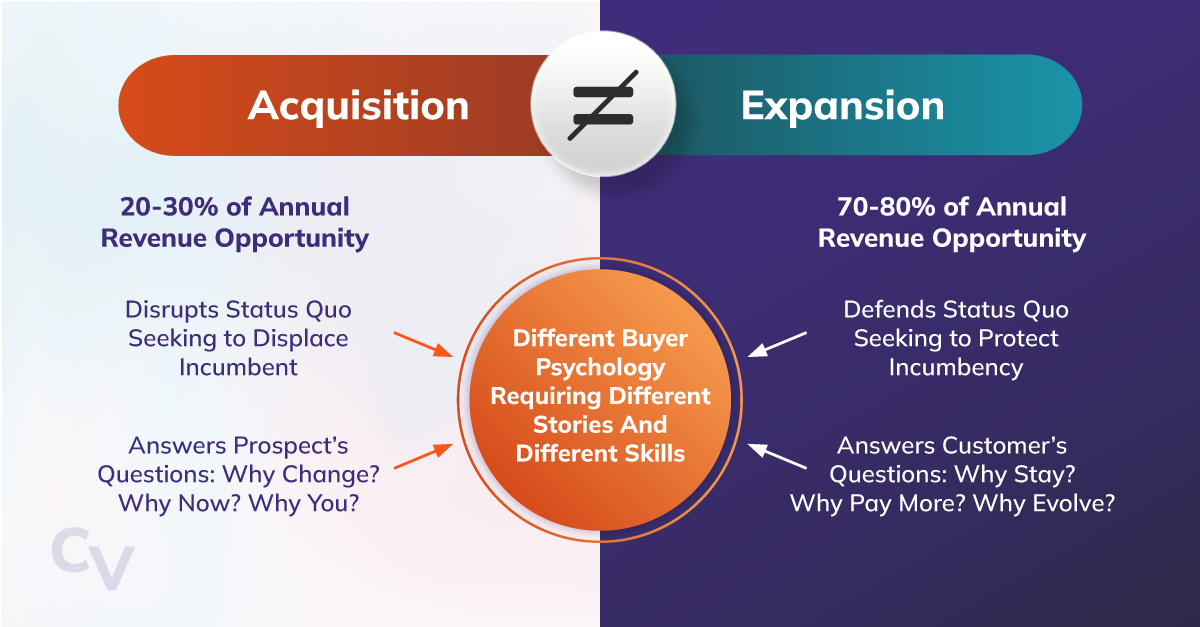
The economy has shifted since the model’s publication. Most B2B companies now generate the majority of their revenue from existing customers. According to a 2024 Forrester survey, 73 percent of B2B revenue comes from existing customers through renewals, cross-sells, and upsells.
Provoking prospects and leading with unexpected insights are effective when you’re trying to convince a buyer to change their status quo. But Corporate Visions research shows that using a provocative, challenging message with existing customers when you’re trying to renew or expand business will backfire, increasing your risk of losing them to competitors by at least 10 percent. In the same study, conducted with academic research partners, the provocative messages also increased the likelihood of a customer switching by 10 percent relative to a status quo reinforcement message.
Nearly two-thirds of companies don’t differentiate their messaging between acquisition and expansion. They use the same provocative approach regardless of the customer relationship, inadvertently opening the door for competitors.
So if challenging existing customers isn’t effective, what is?
When to Challenge and When to Reinforce
The Challenger model was designed for acquisition. But acquisition represents only a fraction of most companies’ revenue growth. When you’re protecting and expanding existing relationships, buyer psychology shifts. Your customer already chose you. They’ve invested time, budget, and internal credibility in that decision. So a provocative message that questions their status quo doesn’t feel like insight. It feels like a threat to the choice they already made.
You need different stories and skills for keeping and growing revenue with existing customers.
Selling to existing customers requires an entirely different approach than selling to new prospects.
Know When to Reinforce the Status Quo
There’s nothing inherently wrong with using a provocative message or introducing Unconsidered Needs to disrupt a prospect’s status quo. But this messaging approach only works when you’re an outsider trying to acquire new customers. Status Quo Bias is your competitive advantage when convincing existing customers to renew or pay more for your solutions, and it’s foundational to your upsell conversations.
Train Your Team for Situational Fluency
Situational fluency means being able to engage differently with prospects versus customers, knowing how to adjust for the different decision moments across the customer lifecycle. Most marketing and sales teams take a one-size-fits-all approach with every buyer in every type of deal. Instead, you need stories and skills specifically designed for customer expansion conversations to maximize your company’s ability to keep and grow your business.
The best upsell message is something of a hybrid between a Why Change and a Why Stay message, in that it borrows some of the provocative elements needed to disrupt Status Quo Bias, as well as some of the techniques that are best for reinforcing the status quo. You’ve got to find the middle ground between these approaches to get customers to evolve their solution.
Work Closely with Customer Success
Renewals and upsells require unique alignment between marketing, sales, and customer success organizations. All three teams play a role in winning critical commercial moments with your existing customers. The right messaging, content, and skills training will improve your ability to align these departments for better retention and expansion results.
How the Challenger Sales Model Compares to Other Methodologies
Sales teams often evaluate Challenger alongside other established methodologies. Here’s how they differ in focus and application.
Challenger vs. SPIN Selling
SPIN Selling (Neil Rackham, 1988) is built on a question-based discovery process: Situation, Problem, Implication, Need-payoff. Sellers using SPIN uncover pain through structured questioning. Challengers, by contrast, lead with insight before asking questions. Where SPIN assumes the buyer knows their problem, Challenger assumes they don’t.
Challenger vs. Solution Selling
Solution Selling focuses on diagnosing a buyer’s acknowledged pain and mapping your product to that pain. Challenger was positioned as a direct evolution of this approach. Dixon and Adamson argued that in a world where buyers arrive “informed,” diagnosing known problems isn’t enough. You need to reframe the problem itself.
Challenger vs. MEDDIC
MEDDIC (Metrics, Economic Buyer, Decision Criteria, Decision Process, Identify Pain, Champion) is a deal qualification framework, not a selling style. It tells you whether a deal is real and winnable. Challenger tells you how to sell once you’re in. Many organizations evolve their sales methodology by using MEDDIC for qualification and Challenger for execution. They’re complementary, not competing.
Think Beyond the Challenger Sales Model
There’s no doubt that challenging your buyer to take decisive action works in specific sales situations. But you don’t want to provoke your hard-won customers so much that you accidentally open the door for your competition. Research suggests that the Challenger model might only be effective for new logo acquisition, which represents just 20 to 30 percent of the customer journey.
Check out the e-book, To Challenge or Not to Challenge, to discover research-backed insights into when you should (and shouldn’t) challenge your buyer’s status quo.
Only with Corporate Visions do you get science-backed sales skills training and messaging approaches for choosing youon both the acquisition and the expansion sides of the customer lifecycle.
Frequently Asked Questions About the Challenger Sales Model
What Are the Three Ts in the Challenger Sales Model?
The three Ts are Teach, Tailor, and Take Control. Teach means delivering commercial insight the buyer hasn’t considered. Tailor means adapting that insight to specific stakeholders. Take Control means guiding the buying process, particularly around pricing and decision timelines.
What Are the Five Types of Challenger Sales Reps?
Dixon and Adamson identified five rep profiles: the Challenger, Hard Worker, Lone Wolf, Problem Solver, and Relationship Builder. Their CEB research found the Challenger profile outperformed all others in complex B2B selling environments.
What Is the Difference Between MEDDIC and Challenger?
MEDDIC is a deal qualification framework that assesses whether an opportunity is real and winnable. Challenger is a selling style that dictates how you engage buyers once you’re in the deal. Most organizations use them together rather than choosing one over the other.
Does the Challenger Sales Model Still Work?
For new customer acquisition, particularly in complex B2B environments with multiple stakeholders, the core principles remain effective. However, Corporate Visions research shows that using a challenging, provocative approach with existing customers during renewal or expansion conversations increases the likelihood of switching by at least 10 percent. You need a different strategy for protecting and growing existing accounts.
Most sellers claim to sell with insights, but few do it well. See what separates visionary insights from recycled analyst data, and how to deliver them so buyers act.
Learn how precise sales prospecting helps sellers build better pipeline by building a digital presence, earning qualified meetings, and winning back lost customers.
Tim Riesterer, Chief Strategy Officer at Corporate Visions, is the sought after expert on evidence-based revenue growth using counterintuitive approaches. Known for his candid thought leadership and engaging keynotes, he’s spent decades testing and refining go-to-market strategies that put buyers squarely at the center. Tim is the author of four insightful books, including Customer Message Management, Conversations that Win the Complex Sale, The Three Value Conversations, and The Expansion Sale.
To Challenge or Not to Challenge?
See how to match your message to the buying moment, and tailor your approach for acquisition vs. expansion conversations.