When pipeline pressure rises, teams add tools, sequences, channels, and activity targets. Sellers make more calls, send more emails, and book more meetings.
All that activity can feel like momentum, but it rarely translates to forecast confidence.
Activity numbers show you what your sellers did. Every one of those calls, emails, and meetings becomes a number somewhere: opportunities created, stage movement, next steps, or CRM updates. All of it proves sellers are working. None of it proves a deal is moving. But they don’t tell you what buyers are doing in response. How do you know whether the people in the deal are moving toward a decision or just fielding more outreach? That question is what every forecast is really trying to answer, and activity metrics can’t answer it.
Buyer evidence can.
Buyer evidence means something the buyer does or decides, not something a seller checks off. For example, a decision-maker might agree to change, commit to a timeline, or bring the right people into the room. Each buyer decision provides evidence that the deal is advancing.
Instead of looking at activity alone, pipeline reviews should be anchored by buyer milestones and decisions. Then test the evidence behind each opportunity’s category, amount, and close date before you call the deal forecastable.
Key Takeaway
You improve the accuracy of your sales forecasts when you ground pipeline reviews in buyer evidence instead of sales activities, and coach sellers to verify buyer progress at every stage.
Sales leaders need a clear standard for identifying buyer evidence, coaching the interactions that influence decisions, and exposing deal risk early. Use this guide to better qualify opportunities, advance them through buyer evidence, and measure whether your forecasts are becoming more accurate.
The Pipeline Improvement Path
Your team can build a stronger pipeline and a more reliable forecast by following these five steps:
- Target the buyer, problem, and decision context
- Engage with a message that creates relevance
- Qualify opportunities using buyer evidence
- Advance the opportunity through buyer-anchored stages
- Coach and Inspect the behaviors, risks, and next decisions that determine forecast confidence
Each step depends on the one before it. Sellers who target the wrong buyers struggle to create relevance once they’re in the room. If they send the wrong message, sellers end up in meetings with some interest and no urgency. And without qualification, sellers count that interest into an opportunity before anyone confirms the buyer’s situation.
Managers working from loose stage definitions might mistakenly take cosmetic activity as real progress, putting their forecast at risk.
To prevent these problems, here’s what sales leaders should look for at each step.
1. Target: Start with the Decision You Need to Influence
Your sellers can’t create qualified pipeline by pursuing buyers based only on job titles or company names. You can work a list of accounts that fit a profile, but demographic information alone doesn’t tell you who feels enough pressure to reconsider their current situation.
Your sellers need a sharper view of the problems your solutions can solve and the buyers who might be experiencing them. Accounts should move into active pursuit only when sellers have a clear reason to believe the buyer actually faces a problem worth discussing.
What Breaks Here
- Sellers pursue accounts without a clear view of the problem they need to investigate
- Activity targets reward volume before sellers establish relevance
- Outreach reaches people who might have the right title but no problem they’re ready to discuss
- Managers inspect the number of accounts touched without seeing whether sellers are reaching out to the right buyers
What Sellers Need to Do Instead
Sellers should choose targets based on the buyer, the business problem, and the decision context. They must be able to explain why a particular person is worth contacting and what problem that buyer might have.
If a seller can only say “VP of IT at Acme Hospital,” that’s just a name and a title. But if a seller can say, “This VP is under pressure because their current patient scheduling system can’t handle no-show rates, and that’s likely costing the hospital revenue every month”—that’s a real target, because there’s an actual problem attached to the person.
The test is whether the seller can finish this sentence: “This person probably cares because…” If they can’t fill in the blank with something specific, they don’t have a target yet. They just have a contact.
When sellers consistently reach the wrong roles, lead with the wrong problem, or fail to connect a problem to a decision that matters to the prospect, more activity won’t fix the issue.
What This Means for Your Forecast
Keep an account out of your pipeline until a you can confirm the buyer has a problem worth discussing. Track whether sellers reach buyers who acknowledge the problem and count account touches as a separate activity measure.
Questions to Ask at This Stage
- Are sellers targeting buyers who are likely to recognize a problem worth discussing?
- Can managers tell whether sellers with poor pipeline are choosing the wrong accounts, misunderstanding buyer priorities, or just executing the outreach poorly?
- What evidence must sellers capture before an account moves into active pursuit?
2. Engage: Turn More Outreach into Qualified Meetings
Once sellers identify the right buyers, they need a message that earns attention. Before a meeting request, sales messages should give the buyer a reason to re-consider their problem and continue the conversation.
What Breaks Here
- Sellers lead with generic value claims or product language
- Messages describe what the company offers before the buyer recognizes why the issue matters
- Teams send more emails, make more calls, or add more tech without making the message more relevant to buyers
- Sellers book meetings without giving buyers a clear reason to continue the conversation
What Sellers Need to Do Instead
Sellers should connect outreach to how a buyer can solve a specfic problem, rather than just offering broad promises. The message should show why the buyer’s current approach deserves another look, and give the buyer a clear reason to continue the conversation.
Before creating a message, define your Messaging Matrix to determine the four main pieces of information sellers need to be able to craft relevant, personalized outreach.

When sellers think through these items, they have the basis of building a message that puts focus on the buyer’s problems, the consequences of those problems, and the reasons a conversation with the seller might matter now. Sellers can use this context to send an engaging message without defaulting to generic product language.
What This Means for Your Forecast
A booked meeting signals that your message earned enough interest to start a conversation. It doesn’t tell you whether the message connected to a problem the buyer wants to solve or whether the opportunity truly belongs in the pipeline. Understand what message was used to get the meeting.
Questions to Ask at This Stage
- Does outreach give potential buyers a clear reason to discuss a problem or consequence?
- What percentage of outreach to target buyers results in a first meeting?
- Do managers review message quality and meeting outcomes together, or do they inspect activity in separate reports?
3. Qualify: Make the First Meeting Earn Its Place in the Pipeline
Landing a conversation gives sellers a chance to determine whether a buyer is worth pursuing. It doesn’t qualify the opportunity by itself.
Many sellers reduce qualification to budget, authority, and timeline. Those details matter, but only after the seller confirms that the buyer has a problem that needs to be solved.
What Breaks Here
- Meetings become opportunities before anyone verifies the prospect’s problem or whether the team can solve it
- Sellers move to budget, authority, and timeline before they understand the problem
- Sellers treat agreement that a problem exists as qualification
- Managers lack a shared standard for deciding which conversations deserve more time
What Sellers Need to Do Instead
Sellers need to first confirm answers to these questions:
- Does the prospect have a problem worth solving?
- Does the prospect want to solve it?
- Is it a problem your team can solve?
When a prospect says, “Yes, that’s an issue for us,” the seller can then go deeper to determine:
- What is the problem costing the buyer in terms of revenue, time, efficiency, missed opportunities, or risk?
- What would change if the buyer fixed it?
- What would a solution need to do to address the problem?
- What outcomes and capabilities does the buyer need, beyond specific features?
Based on their answers to these questions, you can determine how viable it is to move forward with the opportunity.
Qualifying out might feel like a failure, but ultimately, it protects everyone’s time and stops misaligned deals from entering the pipeline.
What This Means for Your Forecast
An opportunity should enter the forecast only when the buyer has confirmed the problem, quantified the risk of ignoring it, named a desired outcome, and shown a reason to decide. Without that evidence, sellers should place the opportunity in nurture or close it out.
Questions to Ask at This Stage
- Do sellers confirm that the prospect has a problem worth solving before they discuss budget, authority, and timeline?
- Can sellers and buyers agree on the problem, the costs of the problem, and what the prospect needs a solution to do?
- Do managers know how to coach sellers to qualify out when the opportunity isn’t the right fit?
4. Advance: Confirm Pipeline Progress Before the Forecast Call
Once sellers qualify an opportunity, you can track stage progression according to how close the buyer is to deciding.
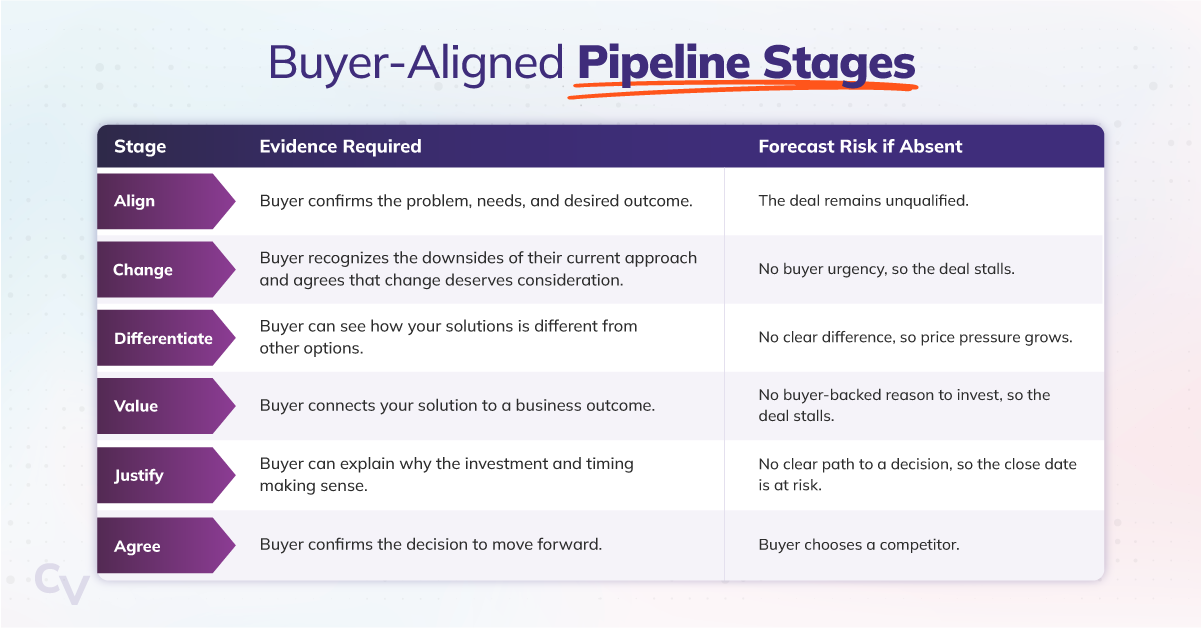
Most teams build their pipeline stages around internal milestones instead (e.g. a seller completing a meeting, sending a proposal, scheduling a demonstration, or updating a CRM field). Those milestones record seller effort. They say nothing about whether the buyer is any closer to a decision.
Sellers should move a deal to the next stage only when they have concrete evidence that the buyer is ready to advance.
What Breaks Here
- Stages reflect seller activity instead of buyer decisions
- Opportunities advance without clear exit criteria tied to evidence
- Pipeline coverage looks healthy until late-stage deals stall, slip, or disappear
- Managers use different definitions of progress when they review different activity, so pipeline quality is hard to assess consistently
What Sellers Need to Do Instead
Sellers should use pipeline stages that reflect a buyer’s decision-making process as they move through the deal. At each stage, sellers should have evidence that a buyer is ready to advance to the next stage or exit. Stages will be different depending on your company and product mix, but here’s an example:
What This Means for Your Forecast
Managers should raise forecast confidence only when the buyer has completed the actions required for the current stage and committed to a clear next step. A proposal, demo, or CRM update might show seller activity, but it doesn’t prove the buyer is closer to a decision.
Questions to Ask at This Stage
- Do your pipeline stages and exit criteria reflect the buyer’s decision process, rather than seller tasks?
- Can sellers point to specific buyer evidence that supports the current stage?
- Do managers apply the same buyer-based criteria when reviewing and advancing opportunities?
5. Coach and Inspect: Make Forecast Reviews Surface Risk
Even a well-designed process won’t change pipeline quality if managers use it only to inspect fields. Every forecast review should be a working session based on buyer evidence, decision risk, and the next interaction that might change the outcome.
What Breaks Here
- Managers spend too much time inspecting stage, amount, and close date
- Pipeline reviews become status updates instead of coaching conversations
- Managers intervene after risk is visible in the forecast rather than earlier, when they can still influence the next buyer interaction
- Training, process, and coaching operate in separate lanes
What Sellers Need to Do Instead
Sellers should enter 1:1s, pipeline reviews, and forecast calls ready to show the buyer evidence behind the current stage. For each opportunity, they should be able to explain what the buyer has confirmed, what decision risk remains, and what they need to happen next.
Managers should use that evidence to coach sellers on the next buyer interaction instead of requesting another close-date update. Managers can test:
- What buyer evidence supports the current stage?
- Which stakeholders have participated, and what have they confirmed?
- What decision risk remains unresolved?
- What does the buyer need to experience next?
- What will the seller do to create that experience?
- What will the buyer do if the opportunity is genuinely progressing?
This allows managers to focus their limited time on the accounts, opportunities, and behaviors where intervention can change the outcome.
What This Means for Your Forecast
A forecast review should end with a decision, like whether to keep the opportunity in its current category, downgrade it, move the close date, or remove it. Managers should base that decision on buyer evidence, not seller confidence.
Questions to Ask at This Stage
- Can sellers show the buyer evidence behind the current stage and forecast category?
- Do managers coach the next buyer interaction, or mainly inspect opportunity fields?
- Does your review cadence connect pipeline risk, seller behavior, buyer feedback, and coaching priorities?
Improve Your Forecast Accuracy
These steps give managers a consistent way to assess each opportunity’s progress and risk based on buyer evidence. At each stage, sellers must show what the buyer has confirmed, what remains unresolved, and what needs to happen next. Managers can then challenge unsupported stage changes, identify stalled deals earlier, and build a forecast that reflects buyer progress instead of seller activity.
To have confidence in your forecast, every review should examine:
- What has the buyer confirmed since the last review?
- Which stage-exit criterion is met, and what remains unresolved?
- Which stakeholders have participated, and who still needs to weigh in?
- Why is the amount and close date credible from the buyer’s perspective?
- What buyer action is scheduled next, and when will it happen?
- What evidence would cause you to downgrade, slip, or remove the opportunity?
This helps ensure every opportunity belongs in your pipeline and gives you a clearer view of what will actually close and when.
Make Buyer Evidence the Standard
Use the five steps in this guide to set a clear standard: target buyers with a relevant problem, earn meetings with a message that matters, qualify the problem before advancing, require buyer evidence at each stage, and use these inputs to coach the next interaction.
With this standard, sellers can follow a clearer path and managers can inspect opportunities against the same evidence. Your team can spend more time on opportunities buyers are advancing, remove deals that lack evidence, and enter forecast calls with fewer assumptions.
When your team can show what buyers have recognized, confirmed, and agreed to do next, you can test, calibrate, and improve your forecast accuracy with less guesswork.