Solutions and such do some things and some other things here Maecenas sed diam eget risus varius blandit sit amet non magna. Aenean lacinia bibendum nulla.
You’re measured on different outcomes—but your success depends on the same buyer decisions. This is where you find the programs and proof built for your goals.
Choose your role to see what that looks like in practice.
When teams rely on opinions, content gets noisy and inconsistent. Our resources are grounded in buyer evidence—so you can sharpen decisions, messaging, and execution.
Find insights, articles, webinars, and more evidence-backed resources to grow revenue.
Insight Selling: Everybody's Doing Insight Sales...Or Are They?
Tim Riesterer /
August 25, 2026 /
Sales Skills
Most sellers who claim to do insight selling are really just recycling the same analyst data their competitors use. In this article, you’ll see how to lead with a point of view that shifts how a buyer sees their situation, instead of just adding more facts to a pitch.
What Is Insight Selling?
Insight selling is a sales approach where you lead with a relevant, research-backed point of view that reframes how a buyer sees their situation. You surface a risk, gap, or missed opportunity they hadn’t considered, so they have a compelling reason to change rather than stay with the status quo.
This isn’t information about your product but should be something that will give buyers additional context as to why they need your product. Sellers can use compelling insights to position themselves as trusted advisors and demonstrate that they understand their buyer’s needs.
Insight sales examples include sharing things like data about your buyer’s business, trends you’ve noticed in their industry, or current economic or global forces impacting the market.
Are Sales Teams Actually Doing Insight Selling?
Insight sales is everywhere, at least that’s the impression in the market. According to a Corporate Visions survey, 81 percent of companies say they’re selling with insights.
Selling with insights has become so popular over the years that the industry has various standards, some rigorous and others lax, about what qualifies as insight selling today.
But, regardless of how companies internally define what insight sales is, and regardless of the quality of insights their sellers are delivering, you can bet on this:
An insight selling approach has been roundly embraced as a key element of provocative selling. In other words, insight sales, rigorously developed or not, has saturated the sales market.
Because insights are so pervasive in the sales industry, the bar for qualifying as a credible insights provider is rising.
Your competitors all have access to the same information as you. So the traditional “insights” selling model of recycling third-party analyst figures, re-packaging those findings, and laying claim to the concepts will only commoditize your sales message.
That approach doesn’t deliver insights. It delivers true but ultimately useless information to your buyers.
Well-thumbed analyst reports and established marketing information won’t have an impact on more discerning prospects and customers, who demand more than just regurgitated facts and figures to make purchasing decisions.
To sell effectively with insights, sellers need to break this cycle of “true but useless” information and take a more edgy, counterintuitive approach, supported by original, research-based rigor.
The Types of Insights You Can Share
You want to share relevant information with your buyers, but not all insights are created equal.
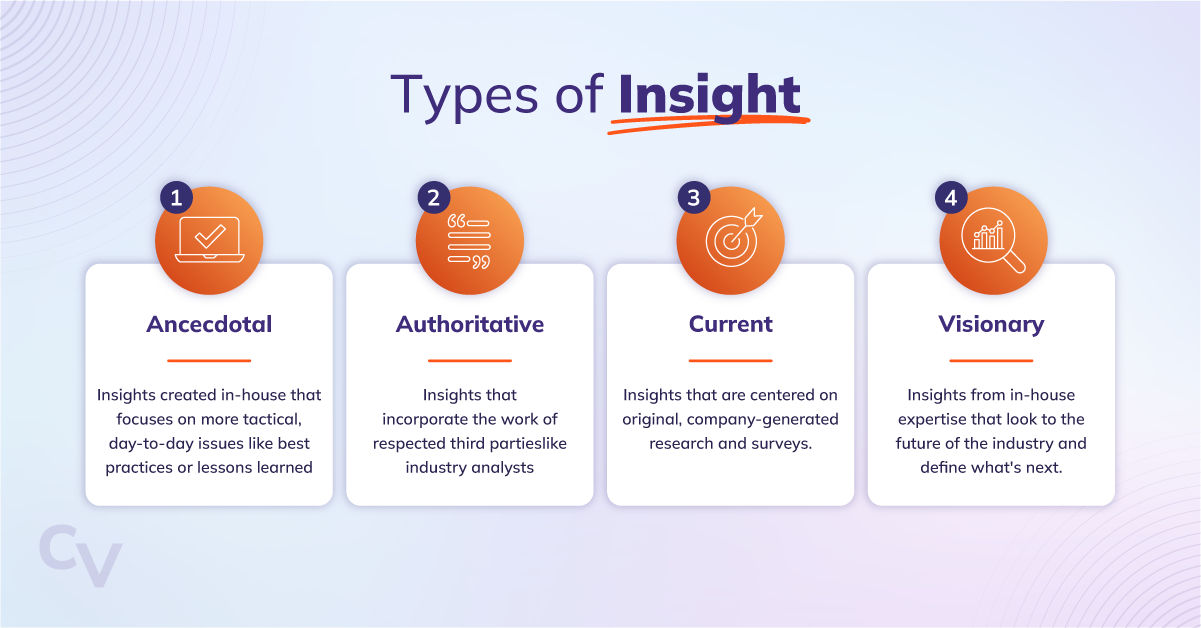
There are four main types of insights used by salespeople:
Anecdotal – Insights created in-house that focuses on more tactical, day-to-day issues like best practices or lessons learned
Authoritative – Insights that incorporate the work of respected third parties like industry analysts
Current – Insights that are centered on original, company-generated research and surveys.
Visionary – Insights from in-house expertise that look to the future of the industry and define what’s next.
There are four types of insights that sellers can use. Some are more effective than others.
Some of these insight types are simply better than others at revealing deficiencies or missed opportunities in your prospect’s current situation. And some are better than others at adding urgency and persuading buyers to take action.
In one survey of the four types of insights, respondents deemed anecdotal insights to be the least effective in terms of achieving positive selling outcomes with buyers. Ironically, respondents said this insight type appeared most often in their campaigns and sales content.
The survey also revealed that “visionary” insights, based on original, company-generated research and forward-looking market interpretations, were viewed as the most effective insight type, but were used the least in sales situations.
So, if you want to stand out from your competition, share visionary insights to make the biggest impact.
You might also encounter a broader industry framing that separates insight selling into two categories: opportunity insight (surfacing a problem or opportunity the buyer hadn’t recognized) and interaction insight (creating value through the conversation itself). These labels are useful shorthand, but they often conflate the what with the how. Our four-type model keeps the distinction cleaner, separating what you share (anecdotal, authoritative, current, visionary) from how you deliver it, so you can evaluate both dimensions separately.
How Insight Selling Differs from Solution and Consultative Selling
Sellers often hear “insight selling,” “solution selling,” and “consultative selling” used interchangeably, but the three approaches differ in where the conversation starts and who sets the agenda.
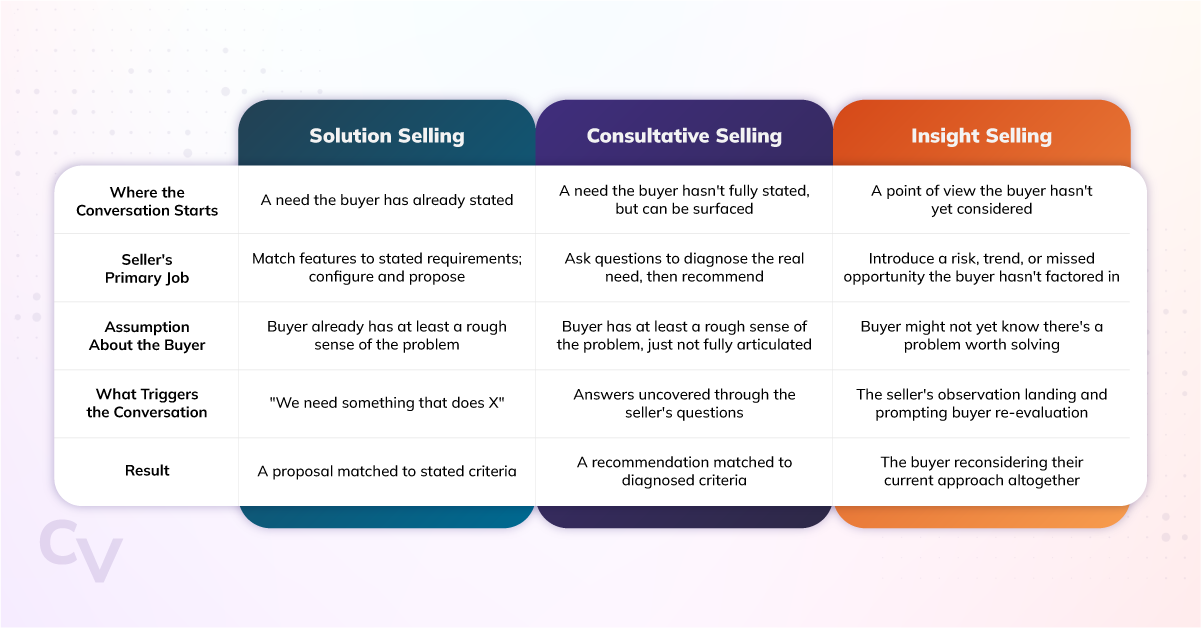
Solution selling is an approach where a seller responds to needs a buyer has already articulated. A prospect says, “We need software that does X,” and the seller matches features to requirements. The seller’s job is to configure and propose.
Consultative selling moves one step earlier. The seller asks diagnostic questions to surface needs the buyer hasn’t fully stated, then recommends a solution based on those findings.
Both approaches assume the buyer arrives with at least a rough sense of the problem.
How insight selling compares to solution selling and consultative selling.
Insight selling flips the sequence. Instead of waiting for buyers to describe their situation or answering questions designed to diagnose it, you lead with a sharp point of view about a risk, trend, or missed opportunity the buyer hasn’t yet considered. You introduce a problem before the buyer asks for a solution. When that observation lands, buyers re-evaluate their current approach and open space for a different kind of conversation.
This distinction matters most when your buyers believe their status quo is working. In those moments, responding to stated needs or diagnosing articulated pain doesn’t move the deal forward, because the buyer doesn’t perceive pain. Leading with an Unconsidered Need, something they hadn’t accounted for that threatens their goals, creates a reason to change. Sellers who master this insight selling approach move from order-taker to agenda-setter, shaping how buyers think about their situation before competitors even enter the room.
Deliver Visionary Insights When Selling
To be visionary, your insight selling messages and content must be:
Original – Carry out primary research or market surveys to uncover market-related data that will resonate with your buyers. Ensure that they’re statistically relevant and have sound conclusions to increase your effectiveness during a sales call.
Exclusive – Generate data points that are unique to you and that you can use as the foundation for developing counterintuitive insights about emerging trends in your market. You can then use these insights, which you own, to carve out distinct positioning for your products and business strategy that your buyers will gravitate to.
Forward-looking – Develop a insight-driven narrative on both sides of the lead handoff that asserts a distinct point of view to your buyer—a perspective that shapes the conversation and leverages your findings to deliver unique interpretations of emerging issues, challenges, and trends.
If you can develop a visionary insight thatreveals an inconsistency or uncertainty in the way a prospect’sdoing something today, the better you’ll set yourself apart from other insight sellers.
How Should You Deliver Your Insights?
When you create and deliver insights-based messages, you hope the story you tell will promote behavior change in your buyers. In other words, you want your insights to not only pique your buyer’s interest momentarily but motivate them to take action.
1. Use Risk + Resolution Framing
In one Corporate Visions study, we conducted an experiment to compare the impact of two types of insight-based messages on behaviors and emotions. One message presented only a risk, while the other presented both the risk and a potential resolution.
The results showed that the message with both risk and resolution was significantly more persuasive.
The study suggests that although presenting risks alone can grab a prospect’s interest, it’s not as effective as pairing those risks with specific ways to resolve the issue. By combining risk and resolution in an insights-based message, sellers can elicit the desired emotional response and incite behavior change.
You can apply these findings by offering an insight that highlights the risk associated with your buyer’s current business practices. Introducing a risk they can’t ignore builds urgency in their minds to take action. Then, you can present your product as the solution to resolve those risks.
2. Use Questions Wisely in Insight Selling
When most sellers think about insight selling, they lean on a popular sales technique known as “diagnose then prescribe.” This selling tactic involves asking prospects a series of questions to identify their problems, and then presenting your solution to address those identified needs.
However, our researchers wanted to determine if this discovery method was the best way to use questions and insights together in the sales process.
Working with Dr. Zakary Tormala, a Stanford Graduate School of Business social psychologist and persuasion expert, we ran an online experiment with more than 300 participants to investigate whether message effectiveness and persuasion differ based on whether diagnostic questions are asked before or after delivering an insight. Message effectiveness was measured by how influential, compelling, and shareable the message was and, most importantly, how likely the receiver was to buy a new product to solve their problem.
The study found that sharing an insight before asking diagnostic questions to a buyer can enhance the persuasive power of a message. By a statistically significant margin, participants admitted a greater degree of need and were more open to new solutions when the insight came first. Asking diagnostic questions before the insight produced no more persuasive power than sharing the insight and skipping those questions altogether.
Leading with an insight acts as an “anchoring effect” that gives the prospect permission to admit more pain. Questions remain critical in transferring ownership of the insight and initiating the process of self-persuasion, but they only have the desired impact when asked after delivering an insight to the buyer.
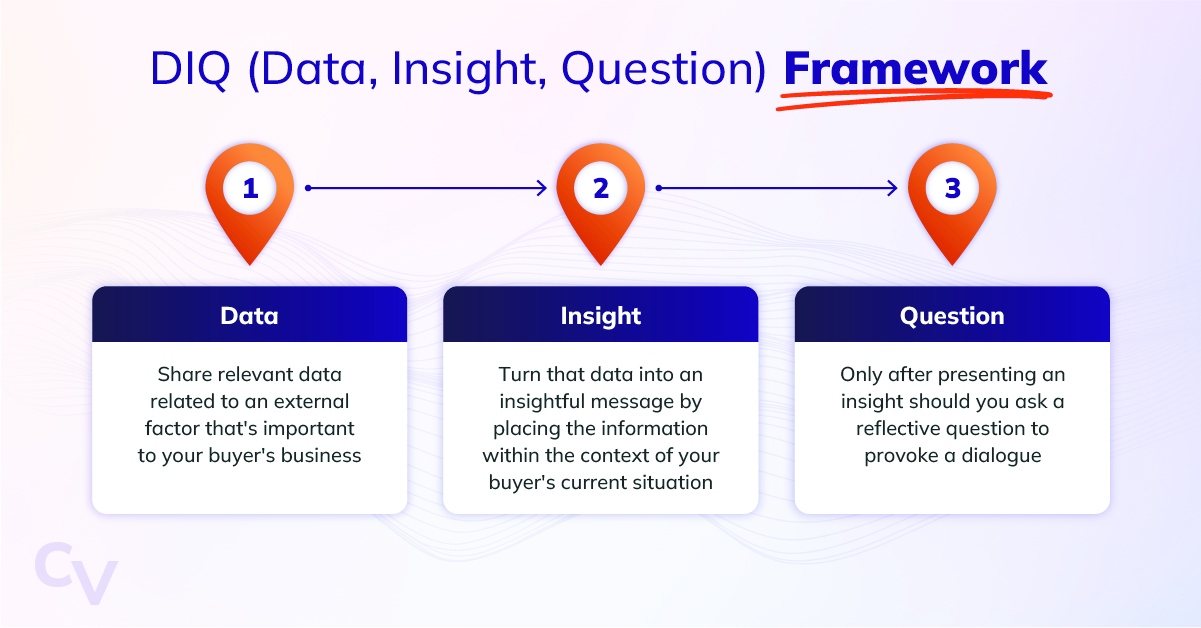
You can easily apply these findings by following the Data, Insight, Question (DIQ) framework:
Data – Begin by sharing relevant data related to an external factor that’s important to your buyer’s business.
Insight – Next, turn that data into an insightful message by placing the information within the context of your buyer’s current situation.
Question – Only after presenting an insight should you ask a reflective question to provoke a dialogue.
By using this approach, you give context to your insight, directly related to your buyer’s needs, and then engage them in thinking about what they need to do about the insight you shared.
Use the DIQ (Data, Insight, Question) framework to make your insights more impactful.
When Should You Share Your Insights in the Sales Process?
Depending on what type of sales conversation you’re having, it’s important to understand not only what kind of insights to share, but also when to deliver them to have the most impact during the sales process.
For example, there’s a 180 degree difference between what motivates prospects versus your existing customers to buy. And our research shows that timing your insights correctly can make a marked difference in your chances at winning those conversations.
In a customer acquisition conversation, the most influential insights tell your prospects something they don’t already know about an unrealized problem or missed opportunity that’s holding them back from their business goals. This technique is called messaging to a prospect’s “Unconsidered Needs.” Corporate Visions research found that introducing provocative Unconsidered Needs lifts a message’s persuasive impact by 10 percent compared with messages that only validate needs the buyer already recognizes.
In a customer expansion conversation, any insights you share should introduce “hard truths” about why they need to evolve their situation, but only after you reinforce your value as their established vendor.
By tuning your insights to the motivations of each audience, you maximize relevance and influence at different moments across the customer experience.
How Can You Tell If Your Insights Are Resonating with Your Buyers?
Our analysis of buyer feedback from more than 150,000 B2B deals revealed a set of predictive sales competencies that represent critical moments that can win or lose a sale in your buyer’s decision-making process.
Providing expert insights is one of those make-or-break skills. If your buyer doesn’t feel like you’re providing insights that create a compelling vision of the future and give them a convincing reason to change, chances are you aren’t going to win that sale.
The problem is buyers won’t always be able to articulate if inadequate insights caused a lost sale unless you ask them directly. Obtaining buyer feedback from all your sales calls is one of the easiest ways to see whether your insights are hitting the mark and driving decisions.
Make Insight Selling Work for Your Business
Insight selling, when done well, is a powerful sales technique that can build credibility and trust with buyers. While many sellers claim to be doing it, few are doing it well.
Develop insights that are considered visionary and deliver them in a way that compels your buyer to act. You’ll establish credibility and build trust with your buyers. Ultimately, doing this well will set you apart from your competition and persuade your buyers to choose you.
Learn how precise sales prospecting helps sellers build better pipeline by building a digital presence, earning qualified meetings, and winning back lost customers.
Prolonged discovery and scripted demos slow deals down. These 12 science-backed sales tips and tricks show you how to shorten your sales cycle, create urgency, and win more revenue.
A sales insight is a piece of information that changes how a buyer thinks about their situation. Unlike product facts or feature lists, an insight reframes a problem, reveals a risk, or introduces an opportunity the buyer hadn’t considered. When delivered well, it shifts the conversation from “tell me about your offering” to “I need to rethink what I’m doing.”
blog-faq-question
The four types of insights are anecdotal (in-house best practices), authoritative (third-party analyst content), current (original research and surveys), and visionary (forward-looking perspectives based on proprietary data). Survey data shows visionary insights drive the strongest buyer response, yet sellers use them the least. Anecdotal insights appear most often but rank lowest in effectiveness.
blog-faq-question
Solution selling responds to needs a buyer has already stated. A prospect says “we need X,” and the seller matches features to requirements. Insight selling leads with a unique point of view the buyer hadn’t considered, introducing a problem before the buyer asks for a solution. This distinction matters most when buyers believe their status quo is working and don’t perceive a need to change.
blog-faq-question
Industry frameworks often split insight selling into opportunity insight (surfacing problems or opportunities the buyer hasn’t recognized) and interaction insight (creating value through the sales conversation itself). These categories overlap with the how and what of insight delivery. A cleaner approach separates what you share from the delivery method, so you can evaluate each dimension on its own.
blog-faq-question
Timing depends on the conversation type. In acquisition conversations, lead with an insight about an unrealized problem or missed opportunity to disrupt the buyer’s status quo. In expansion conversations, first reinforce the value you’ve already delivered, then introduce “hard truths” about why the customer needs to evolve. Misjudging the message in the moment undermines even the strongest insight.
About the Author
Tim Riesterer
Tim Riesterer, Chief Strategy Officer at Corporate Visions, is the sought after expert on evidence-based revenue growth using counterintuitive approaches. Known for his candid thought leadership and engaging keynotes, he’s spent decades testing and refining go-to-market strategies that put buyers squarely at the center. Tim is the author of four insightful books, including Customer Message Management, Conversations that Win the Complex Sale, The Three Value Conversations, and The Expansion Sale.
Get More Selling Techniques Like This
Learn more science-backed sales techniques to win your most critical sales conversations.