Solutions and such do some things and some other things here Maecenas sed diam eget risus varius blandit sit amet non magna. Aenean lacinia bibendum nulla.
You’re measured on different outcomes—but your success depends on the same buyer decisions. This is where you find the programs and proof built for your goals.
Choose your role to see what that looks like in practice.
When teams rely on opinions, content gets noisy and inconsistent. Our resources are grounded in buyer evidence—so you can sharpen decisions, messaging, and execution.
Find insights, articles, webinars, and more evidence-backed resources to grow revenue.
Buyers act on what they remember, not on the clever line they forgot by the next meeting. Most marketing content never makes that cut. In a Corporate Visions industry survey, 87 percent of respondents said they were unsure or did not believe their audience acts on their content.
They’re right to feel unsure.
Our research methodology grounds how we study buyer decisions. Decision Science research with cognitive neuroscientist Dr. Carmen Simon shows that when people make a decision, the brain predicts the rewards of a choice from past memories, then uses that information to choose the most favorable path. People act on what they remember, not what they forget. If you want your assets to shape buying decisions, you need a clear answer for how to make marketing content memorable after the first open.
There’s just one big obstacle.
People Will Forget Most of Your Content
People remember, on average, only about 10 percent of the information they consume after 48 hours. That share might vary (sometimes three percent, sometimes 12 percent). On average, it’s a tiny portion.
To make matters worse, the small amount people remember is completely random. Your carefully crafted proof point might vanish while a throwaway aside hangs around for days.
With that in mind, how do you make sure the most important message is what sticks after someone interacts with your marketing content?
Control Your 10%
Think of the small amount of information people remember as your metaphorical “10%.” The single most important idea you want buyers to retain from your content is your 10% message—the same discipline we unpack in more depth in how to make your most important point stick.
Your 10% message should be actionable and repeatable. It should also connect to something your audience finds rewarding: progress on a commercial goal, relief from a known risk, or a clearer path through a stalled decision.
One practical move: replace a mundane table of contents or agenda slide with a concrete, action-oriented promise of what readers gain by staying with the piece. Then return to that promise throughout the content.
Present your 10% message with no more than 3-4 specific, actionable supporting points. Use those supports to organize the piece. When you win attention this way, you also win a place in memory.
What Belongs in Your 10% Message
Your 10% message is one decision-relevant idea a buyer can repeat later in a committee room without your deck open. It is not a slogan, a product laundry list, or a vague theme about “innovation.”
Use these criteria when you draft it:
Actionable: Someone can act on it or champion it in a buying conversation.
Repeatable: A non-expert stakeholder can restate it in plain language.
Rewarding: It ties to a commercial outcome the audience already cares about.
Focused: It names one primary idea, not five equal claims fighting for recall.
Differentiated: A competitor in your category can’t honestly claim the same statement.
If two smart colleagues would summarize your asset with different headlines, you still have a pile of points rather than a 10% message.
How to Anchor Content Around Three to Four Supporting Points
Treat your three to four supports as the outline, not as optional color. Each support should prove, illustrate, or apply one facet of the 10% message. Sequence them so each section earns the next return to the core claim.
A simple build:
State the 10% message early as a concrete promise.
Assign each major section to one support.
End sections by restating how that support advances the same core message.
Cut or demote any claim that doesn’t serve one of those supports.
You don’t need longer content to be memorable. You need an asset that refuses to let the reader’s random 10% pick the wrong takeaway.
[IMAGE- Simple diagram of one 10% message at the center with three to four supporting points as the outline spokes, labeled actionable, repeatable, and rewarding]
Repeat Responsibly
If your content is too abstract, generic, or unfocused, buyers might grasp the gist, but their memory won’t be precise enough to influence decisions later. One way to fight that kind of “random memory” is to repeat your 10% message throughout the piece.
People are more likely to remember a message you repeat often enough, but only when you repeat it responsibly. Responsible means useful returns to the same focused claim and its supports, without spamming every bullet on the slide.
What Happens When the Message Appears Once
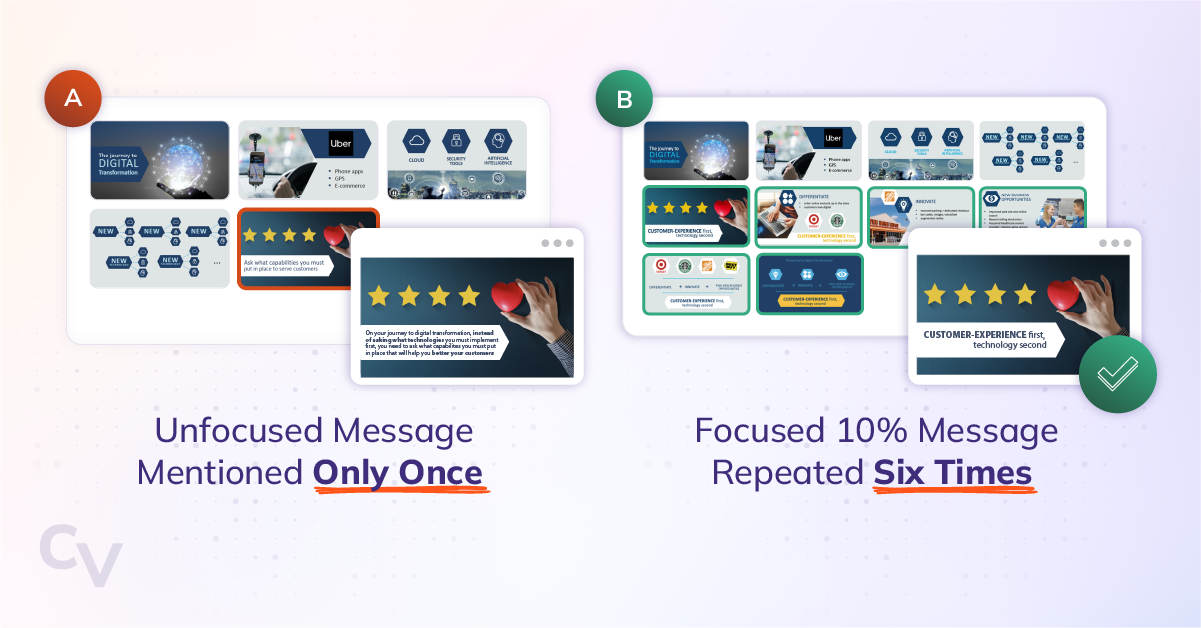
In a Corporate Visions study summarized in The Science of Unforgettable Marketing Content, we invited two groups of B2B participants to watch a five-minute business presentation. Participants imagined they were executives evaluating a digital transformation solution.
Each group watched one of two presentations:
Presentation A: A typical business message appeared only once.
When a message shows up once, people often leave with a fuzzy impression. They might recall that the topic mattered without retaining the precise claim they need in a later decision. Without that precision, “random memory” wins. The room debates something adjacent to your point instead of your point.
What Changes When You Repeat a Focused Message
Presentation B: A focused 10% message appeared six times.
The results:
89 percent of people who watched Presentation B remembered the 10% message, with precision, immediately after the presentation. The figure only dropped to 77 percent when we tested memory again 48 hours later (full study write-up).
Participants remembered the content more clearly when they heard a focused 10% message repeated with intent.
In one neuroscience research study, we compared two different presentations.
For longer assets, scale the pattern. In related Corporate Visions research on 20-minute presentations, teams that repeated a 10% message more often improved precision memory, and a practical rule of thumb is to return to that message about 8–12 times across a 20-minute presentation—not as filler, but as useful waypoints tied to the same claim.
Why does that work? When you repeat the message this way, buyers start recognizing a pattern. They treat patterned information as important and worth retaining for future decisions. You improve content recall with marketing message repetition that stays useful, not noisy.
Establish a Pattern
Marketing often has to explain highly complex concepts in manageable ways. You hear the advice constantly: “simplify complexity.”
People need some complexity to stay engaged and process information. Randomness is what breaks recall. Most business content is too random and too unfocused. Teams structure assets so complex ideas never become easy to consume, digest, and remember.
In Corporate Visions research on this topic (study write-up), participants remembered and enjoyed a presentation more when it included more slides and more complex visuals.
You don’t need to strip your content bare. Your audience needs a recognizable set of rules so they can process complexity without losing the thread.
Why Randomness Beats Complexity as the Real Problem
When you jump topics, mix competing claims, and introduce new frameworks midstream, readers work harder and retain less. When you pattern the piece, you can carry denser visuals and more detail because each new piece of information has a job relative to the core message.
If you’ve been cutting slides and still losing recall, the issue might not be length. Every section might be introducing a new organizing idea.
How to Use Your 10% Message as the Rule Set
As you structure marketing content, establish a pattern with your 10% message as the anchor. Resist the urge to stray; every digression adds randomness.
A practical rule set:
Open with the 10% message as the promise of the piece.
Map each major section to one of your three to four supports.
Introduce new detail only when it strengthens a support or the core claim.
Return to the 10% message at natural decision points (section opens, proof moments, close).
Keep visual motifs consistent so the eye learns the same structure the ear hears.
As the story unfolds, you can still introduce new information in manageable returns to the core 10% message you want people to remember. Buyers use that structure as the pattern for storing and later retrieving your commercial point of view.
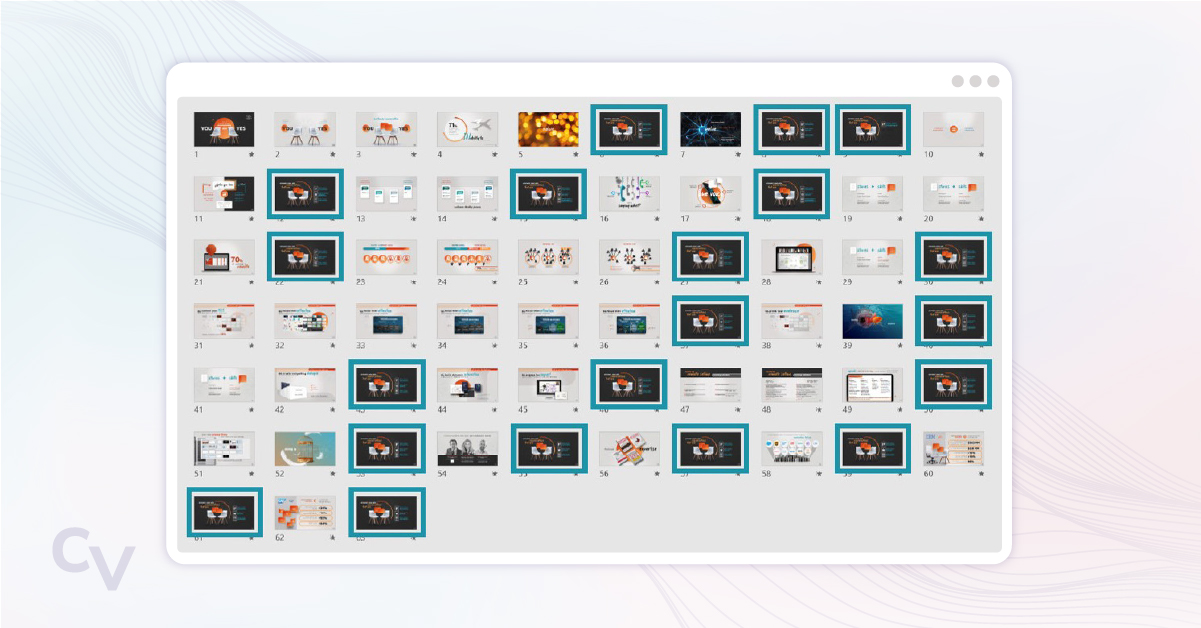
Repeat your 10% message throughout your content.
Make Marketing Content Stick When Buyers Decide
When a buying group reconvenes days after your webinar, deck, or campaign touch, they won’t reopen every slide. They’ll argue from whatever fragment still feels true. If you’ve controlled the 10% message, repeated it with discipline, and patterned the piece so complexity stays learnable, that fragment is more likely to be your commercial claim rather than a competitor’s slogan or a random anecdote from the Q&A.
When the decision is still open, science-backed marketing content earns its keep: fewer disposable assets in the feed, and one message durable enough to survive the gap between first exposure and final choice.
Watch the webinar replay How to Make Marketing Memorable with cognitive neuroscientist Dr. Carmen Simon for more science-backed techniques that make marketing content stick in buying decisions.
In well-defined categories, many companies can solve the same problems with similar capabilities and pricing. So what does it take to create a truly unique value proposition?
More than ever, your prospects and customers rely on digital content to learn, form opinions, and decide whether your solution will help them meet their business goals. But if the goal is to create content that persuades buyers to choose your solution, why doesn’t most content drive decisions the way it should?
Everyone recognizes the value of storytelling in business. But most marketing stories don’t move the audience to make buying decisions. Here are three science-backed ways to make your marketing stories more engaging, memorable, and persuasive.
A 10% message is the single most important idea you want buyers to remember from an asset after most of the detail fades. Name it for the roughly 10 percent of information people retain after 48 hours. It should be actionable, repeatable, tied to something rewarding, and supported by no more than three to four specific points.
blog-faq-question
Repeat the focused message enough times that it forms a pattern, without restating every line for filler. In Corporate Visions research, a five-minute presentation that mentioned a focused 10% message six times produced 89 percent precise immediate recall and 77 percent recall after 48 hours. For a 20-minute presentation, aim for about 8–12 useful returns to the same 10% message. Keep each return tied to the same claim and its supports.
blog-faq-question
Simplifying can help when you remove noise, but complexity itself isn’t what breaks memory. Random, unfocused structure is. Research participants remembered and enjoyed presentations with more slides and more complex visuals when those elements followed a clear pattern anchored to a core message.
blog-faq-question
Test whether people can restate your 10% message with precision, not whether they “liked” the piece. Immediate and delayed recall (for example, after 48 hours) are stronger signals than vanity engagement metrics alone. If stakeholders describe different takeaways, the content isn’t controlling the 10% that sticks.
blog-faq-question
In decision-making, people predict the rewards of a choice from past memories, then favor the path that looks best. If your message never enters memory, it can’t shape that prediction. When buyers retain a clear, rewarding message, they’re more likely to carry your point into committee discussions and later choices.
About the Author
Anton Rius
Anton Rius, Sr. Director of Content Marketing, leads all content marketing strategy and production at Corporate Visions. Anton's extensive experience supporting B2B revenue growth with insightful content has been featured in publications like SalesPOP! and Relevance. Anton writes regularly at Long Tail Thinking.