Solutions and such do some things and some other things here Maecenas sed diam eget risus varius blandit sit amet non magna. Aenean lacinia bibendum nulla.
You’re measured on different outcomes—but your success depends on the same buyer decisions. This is where you find the programs and proof built for your goals.
Choose your role to see what that looks like in practice.
When teams rely on opinions, content gets noisy and inconsistent. Our resources are grounded in buyer evidence—so you can sharpen decisions, messaging, and execution.
Find insights, articles, webinars, and more evidence-backed resources to grow revenue.
Confident Isn’t the Same as Correct: Why Your AI Tools Need Predictive, Methodology-Governed Coaching
Tim Riesterer /
September 15, 2026 /
Thought Leadership
In August, 2026, Seismic finished absorbing Highspot, closing the largest consolidation the revenue enablement market has seen, backed by more than $100 million a year in combined R&D.
Forrester covered the story and landed on the only question that matters for the leaders who now own that platform decision: Will the new Seismic-Highspot close the gap between what these platforms can do and what most organizations can operationalize?
Product differentiation has narrowed to the point that nearly every serious platform now bundles AI content creation, coaching and role-play, buyer engagement, and analytics. In Forrester’s words, “the challenge is no longer assembling capabilities but orchestrating them.”
Buried in Forrester’s list of what will define revenue enablement’s “next era” is a line worth sitting with: “AI amplifies maturity; it doesn’t replace it.” Organizations with strong governance, coaching, and enablement discipline get a disproportionate return on the same AI spend as everyone else.
Put another way: Tech’s job is handling data and context—nothing more.
Neither the signal-gathering platform nor the AI using the data decides what good looks like. A bigger, better-orchestrated “context library” still can’t discern whether what your sellers say and do is really the best approach.
Sales tech stack without methodology-governance creates more noise.
The Copilot That Knew Everything and Judged Nothing
I watched this play out with a client earlier this year.
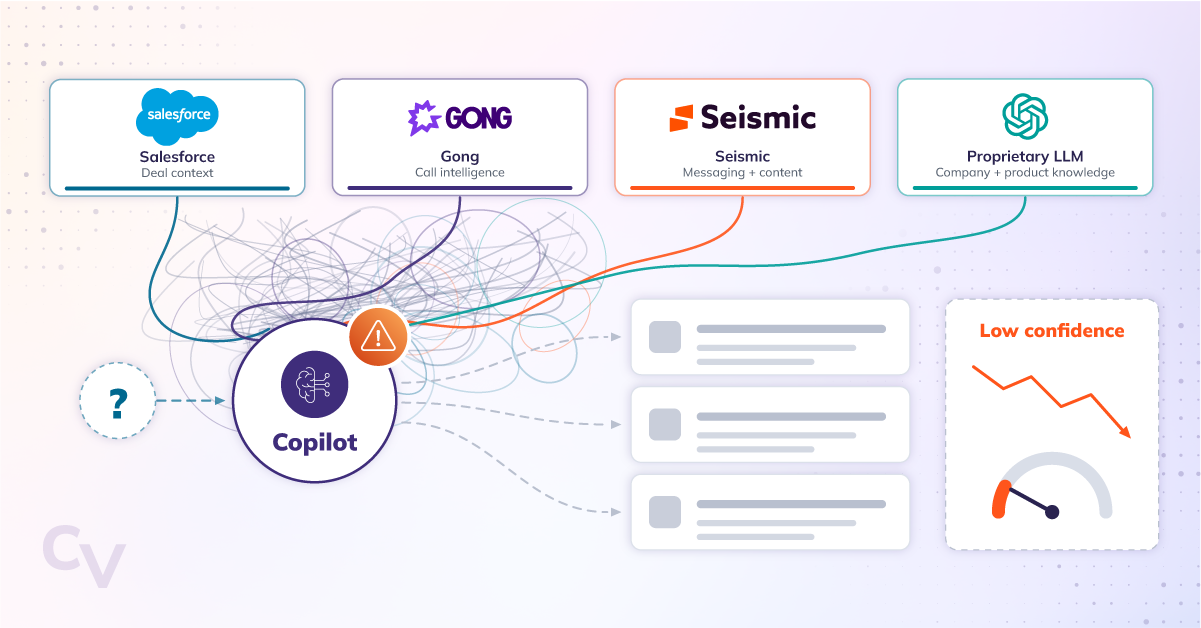
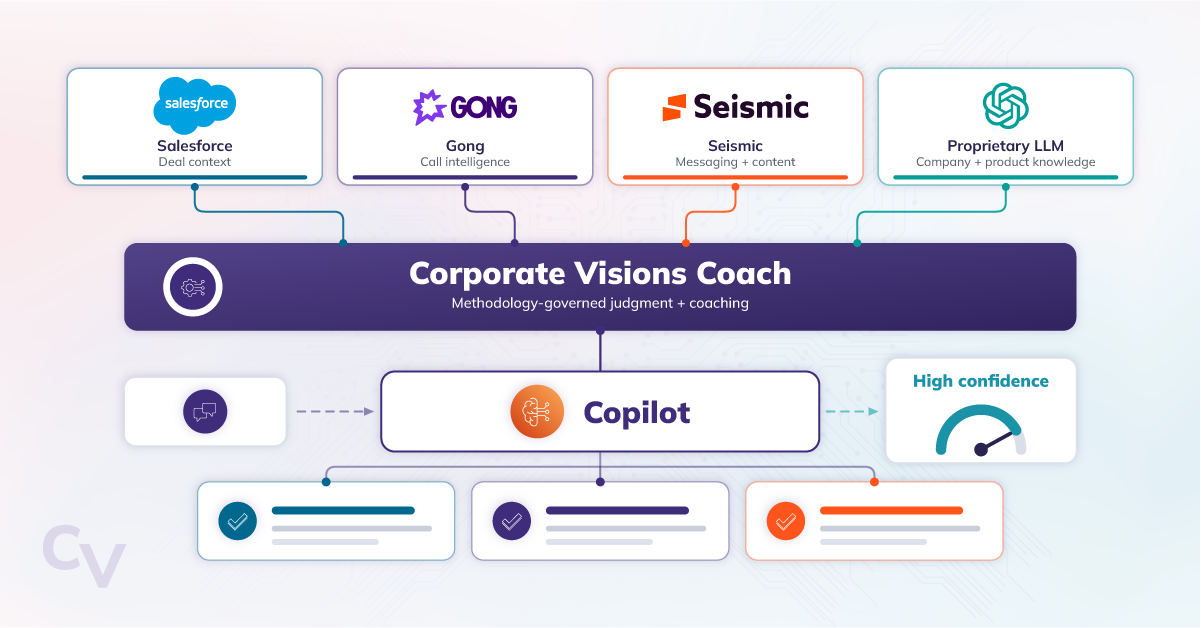
They’d given their sellers an AI assistant (Copilot) to ask questions and provide deal guidance.
They started with a proprietary model loaded with product information, pricing, and configuration content. Then they went further and wired in Seismic for their messaging and positioning, Gong call transcripts, and their Salesforce deal history.
Every answer that came back from the AI looked solid at first blush: full sentences, specific numbers, and a clear next step. But that artificial confidence didn’t last long.
Some of the AI answers were plausible hallucinations. Sometimes it pulled the wrong context for the deal stage. And over time, reps stopped trusting the tool and started double-checking everything themselves, which defeated the purpose of using it at all.
None of the vendors did anything wrong. The AI did what AI does. Salesforce, Gong, and Seismic each delivered the signal they’re built to deliver.
The problem was in the space between all that signal and the seller’s next move—nothing in the stack was capable of predictively discerning what good looks like, so the system defaulted to plausible-sounding, generic advice instead of defensible, evidence-based judgement.
This is the crossroads revenue leaders are standing at right now.
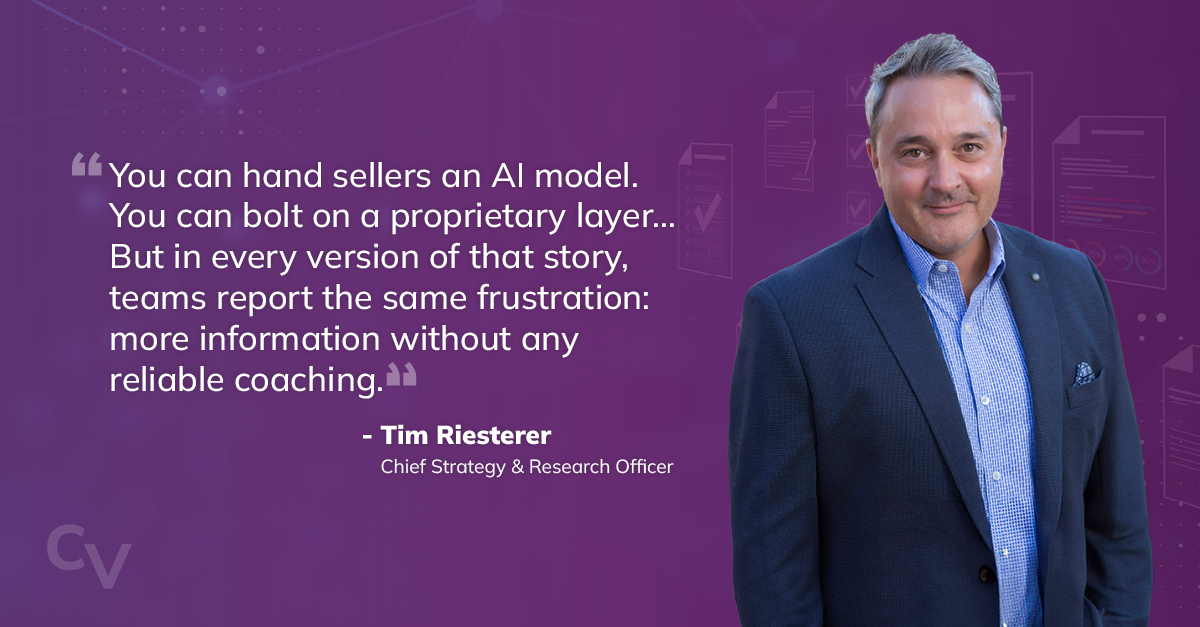
You can hand sellers an AI model. You can bolt on a proprietary layer. You can integrate every signal source you own. But in every version of that story, teams report the same frustration: more information without any reliable coaching.
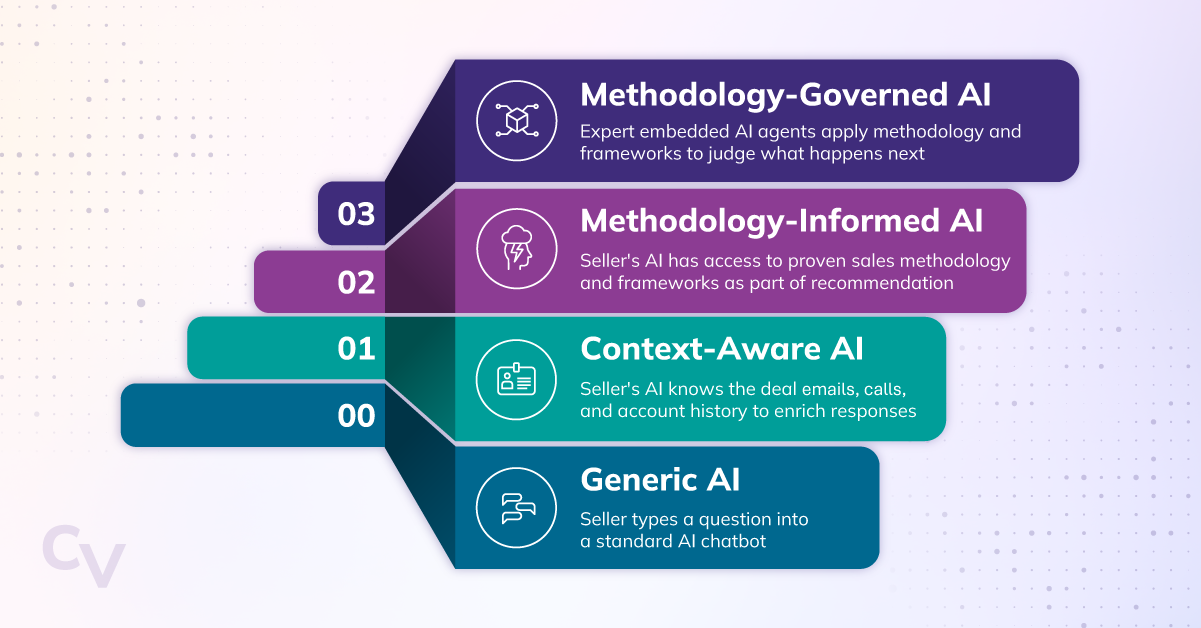
The four tiers of agentic sales coaching.
What Most Metrics Don’t Tell You
Adoption numbers, prompt volume, and practice completion rates are useful operating metrics. But none of them tell you whether a seller made a better decision when talking to their buyer.
Watch the AI’s recommendation, and you’ve only confirmed the system produced an answer.
Watch what the seller does with it next, and you’ll see whether performance moved at all. That’s the moment you need to measure.
So, when you’re trying to measure return on any AI investment, ask: Can the system diagnose the situation, apply the right framework, evaluate the recommendation against a validated standard, and hand the seller one specific next action?
This is what I call the decision-transfer test.
The Decision-Transfer Test
Decision transfer means that a validated commercial standard survives the trip from raw context to a recommendation your sellers can trust. It isn’t a claim of perfect causality, but an evidence chain that leaders can inspect and improve, one link at a time.
To test whether it’s working, ask six questions:
Did the system diagnose the actual situation, not just a generic topic?
Did it apply the proven framework for that specific stage and deal?
Did it evaluate the recommendation against a standard built on real buyer behavior?
Did the recommendation stay inside guardrails a manager would set?
Did the seller walk away with one specific next move, not general advice?
Did the buyer’s next response actually change because of it?
By asking those first five questions, you can tell whether to trust the system’s recommendation. Picture them as a discernment layer: Diagnose → Apply → Evaluate → Constrain → Recommend.
A Practical Scorecard for Revenue Leaders
Weak implementation
Governed implementation
Diagnose
Generic topic or keyword matching
The situation read against what good looks like for that stage and deal
The same proven framework applied for every rep, every deal, every stage
Evaluate
No check against a standard, or an unvalidated one
Scored against a standard built on real, validated buyer behavior
Constrain
Unbounded recommendations with no escalation path
Guidance that stays inside proven boundaries and flags a manager when it should
Recommend
Generic advice disconnected from the moment
One specific next action for call prep, execution, or follow-up
1. Diagnose: Read the Situation Before You Answer It
Before you trust any recommendation, the system needs to read the deal, the stage, and performance signals attached to the rep.
Go back to that Copilot example. Salesforce, Gong, and Seismic each handed over a signal to AI. None of them were built to know what good looks like, and the AI wasn’t either. That judgment has to come from somewhere else.
This is the piece the Seismic-Highspot merger doesn’t touch, and Forrester said as much without naming it directly: capabilities have converged, so the differentiator moves from what a platform can do to how an organization orchestrates it.
The new Seismic will run a bigger, better-integrated content operation, but the tech still won’t diagnose which behaviors win the deal.
2. Apply: Run the Same Methodology Every Time
A diagnosis only matters if the system applies the right methodology consistently—for every rep, every stage, and every deal. That consistency is the entire point of putting a methodology in the loop instead of leaving judgment to whoever happens to be on the call.
Most sales organizations already own a version of this methodology. It sits in a playbook, a deck, or a certification course, and reps use it when they remember to and skip it when a deal gets hard.
A methodology-governed AI applies it every time, the same way, at a scale you simply can’t staff for.
3. Evaluate: Score It Against What Good Looks Like
Before you apply any methodology, make sure it’s an evidence-based standard. This is where a lot of AI coaching turns into guesswork dressed up as advice: it sounds plausible, but it may or may not be what evidence shows that “good” is supposed to look like in that moment.
A methodology-governed system evaluates its own recommendation against a standard built on validated buyer behavior—not a best guess about what usually works, and not one seller’s personal playbook.
That standard has to earn its authority the same way any research does: tested and proven to work in B2B sales situations, not generic best practices or someone else’s opinion.
4. Constrain: Keep Guidance Inside Guardrails
Your best manager can’t sit in on every call, for every rep, at every stage of every deal. A methodology-governed system carries the guardrails for them.
It “knows” what it’s allowed to recommend on its own, what needs a manager’s eyes first, and when the evidence underneath a recommendation is too thin to act on.
5. Recommend: Give the Seller One Specific Move
All of these steps converge on one output: a recommended next action—backed by evidence and deal data—and specific enough for a seller to act on immediately.
When you think about it, this is what a lot of AI-powered tech tries to do right now. It will confidently make recommendations, but without that evidence-backed discernment layer as a filter between input and output, you can’t trust what it recommends. In fact, it could be leading you astray.
Sales tech stack with methodology-governed AI creates cohesion.
AI Becomes a Learning System
You don’t create a governing layer by consolidating tech. That only gets you a larger, better-organized pile of the same signal that overwhelms AI in the first place.
Forrester’s own conclusion was that the market’s central challenge has never been technology alone. It’s the ability to operationalize that technology through governance, integration, behavior change, and organizational discipline. You still have to build the discernment layer that diagnoses, applies, evaluates, constrains, and recommends before a seller ever sees an answer.
And the standard shouldn’t stay fixed. The feedback you get from every deal, whether won, lost, or no-decision, should feed back into the system and continue to sharpen what “good” means for the next diagnosis.
Buyers want seller guidance in complex deals, just not at every touchpoint. Here's what 150,000 win-loss decisions reveal about those moments and what it takes for sellers to deliver in them.
Your sellers are already using AI, but plausible-sounding advice isn't the same as sound sales judgment. Find out why methodology-governed AI is the competitive foundation for future growth.
Tim Riesterer, Chief Strategy Officer at Corporate Visions, is the sought after expert on evidence-based revenue growth using counterintuitive approaches. Known for his candid thought leadership and engaging keynotes, he’s spent decades testing and refining go-to-market strategies that put buyers squarely at the center. Tim is the author of four insightful books, including Customer Message Management, Conversations that Win the Complex Sale, The Three Value Conversations, and The Expansion Sale.